
Parts and contaminants · 4 min read · Updated 2026-09-26
Ultrasonic cleaning of CNC machined parts before assembly
A machined part that goes into an assembly carries its coolant, chips and burr flakes into the product unless they come off first. What assembly asks of the cleaning step, how to lay out wash, rinse and dry around the machining cell, and how to keep the part clean between the tank and the fitter's bench.
Technical guide. Figures are taken from our own spec tables; for your process we confirm the settings with a cleaning trial.
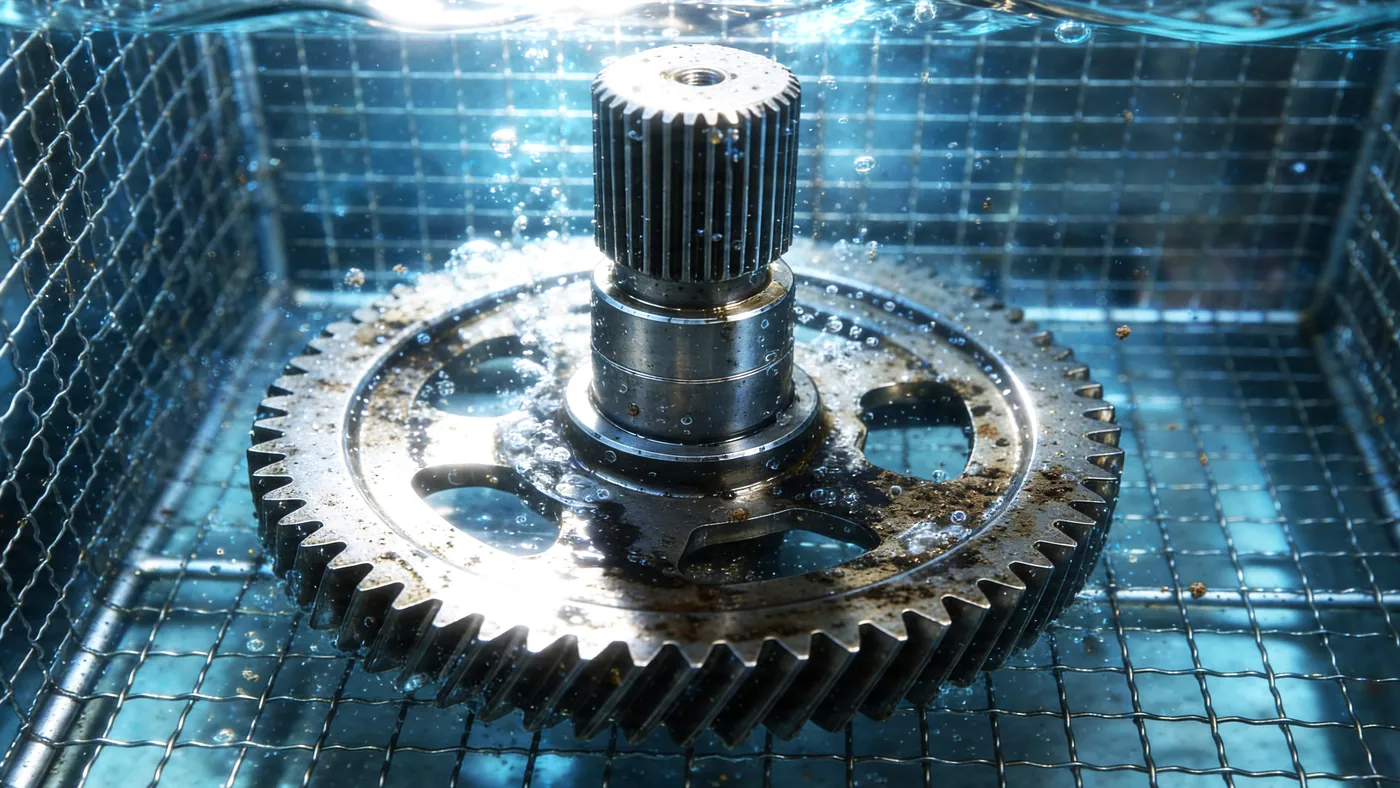
A part off a machining centre looks clean. It is not. Every bore, thread and cross-drilling holds coolant, and in that coolant sit chips, grinding fines and loose burr flakes. In an assembly they become the particle that scores a seal, jams a valve spool or wears a bearing in its first hundred hours. Cleaning before assembly is therefore not about appearance; it is about what is left in the places nobody can see. Ultrasonic cleaning is the standard method because cavitation works inside those places, where a spray or a brush does not reach.
What assembly asks of the cleaning step
The fitter or the assembly line needs four things from a cleaned part:
- No loose particles in bores, threads and pockets. The drawing or the customer's cleanliness specification says how many and how large; see precision parts before inspection for how that is measured.
- No coolant film. Residual emulsion or neat oil affects press fits, thread-locking compounds, adhesives and seals, and it collects dust on the shelf.
- No corrosion between cleaning and assembly. Bare steel flash-rusts within hours after a water-based wash if it is left wet or unprotected.
- No damage. Precision faces must not knock against each other in the basket.
The machining residue itself is covered in removing swarf, chips and coolant. This article is about building the cleaning step around assembly.
The cleaning sequence
| Step | Purpose | Typical setting |
|---|---|---|
| Ultrasonic wash | Coolant, chips and fines out of every cavity | Steel: alkaline cleaner 3 to 5 %, 55 to 65 °C, 28 kHz, 5 to 10 min. Aluminium: inhibited light-alloy cleaner, 50 to 60 °C, 40 kHz, 3 to 8 min |
| Rinse | Cleaner and loosened particles off the part | Clean water at 40 to 50 °C, ultrasonic on for parts with blind holes |
| Final rinse | Spot-free, with inhibitor for steel | Demineralised water, corrosion inhibitor as the supplier specifies |
| Dry | Nothing wet goes to storage | Hot-air dryer at 70 to 90 °C, blow-off of blind holes first |
Two tanks, wash and rinse, are the minimum for parts that go into an assembly. With only one tank, the cleaner and whatever it holds stay on the part as it dries. See multi-tank lines and rinsing and drying.
Aluminium housings and light alloys
Most machined housings, manifolds and brackets are aluminium, and aluminium is the easiest part to spoil. A strong alkaline cleaner etches machined faces grey in minutes, especially when hot. Use a cleaner rated for light alloys, usually pH 9 to 11 with inhibitors, keep the temperature at or below 60 °C and the time short, and prefer 40 kHz on thin walls and fine threads. Rinse immediately; aluminium stains when the cleaner dries on it.
Loading the parts
Precision parts should not touch each other in the bath. Ultrasound makes loose parts vibrate, and two ground faces rubbing for ten minutes leave marks.
- Part carriers with pins or slots, one part per position, are standard for housings and shafts. They also keep the orientation fixed, so blind holes drain and drying is repeatable.
- Blind holes face down or sideways so air escapes and liquid drains; see threaded parts and blind holes.
- Small turned parts go in a fine-mesh basket in a single layer, not a heap. See loading the basket.
Where the cleaning station goes
The station sits between the machining cell and assembly, and its size follows the takt of the cell, not the size of the part alone.
| Output | Set-up |
|---|---|
| A few carriers a day | UMX Pro 62L or 88L with a rinse tank and a hot-air dryer, filled by hand |
| One carrier every 10 to 15 minutes | ST-96 or ST-117 wash, ST rinse, DT-96 dryer, carriers moved by hoist |
| Continuous flow from several machining centres | AL-150 or AL-300 with lift and filtration, rinse and dryer stations alongside, or an MT multi-tank line with a carriage |
Filtration matters more than tank size. Machining coolant and fines load the wash tank every cycle; a filter loop and a skimmer keep the last carrier of the week as clean as the first. See ST or SF and filtration and bath life.
From tank to assembly
A clean part can be recontaminated in minutes.
- Handle with clean gloves. Fingerprints are salt and fat; on steel they rust, on bonding faces they cause adhesion failure.
- Cover or bag the parts if they wait more than a shift. Keep them away from grinding and machining dust.
- Keep the time short. Steel that must wait days gets an inhibitor in the final rinse or a light preservative, which the assembly procedure must accept.
- Check the cleaning, not just the parts. A weekly foil test, the cleaner concentration and a filter change on schedule keep the result from drifting.
What cleaning does not do
Ultrasonic cleaning removes loose and loosely bonded particles. It does not remove a burr that is still attached; a burr that breaks off in the field was never a cleaning problem. Deburring comes before the wash, and the wash then removes what deburring left behind.
To lay out a cleaning station for a specific part and output, the quote checklist lists what we need.