
Operation and maintenance · 3 min read · Updated 2026-09-25
The foil test: a one-minute check of cavitation
A sheet of household aluminium foil in the bath for sixty seconds shows where the tank cleans and where it does not. How to run it, what the hole pattern means, and how to use it as the acceptance test for a new machine and the monthly check for an old one.
Technical guide. Figures are taken from our own spec tables; for your process we confirm the settings with a cleaning trial.
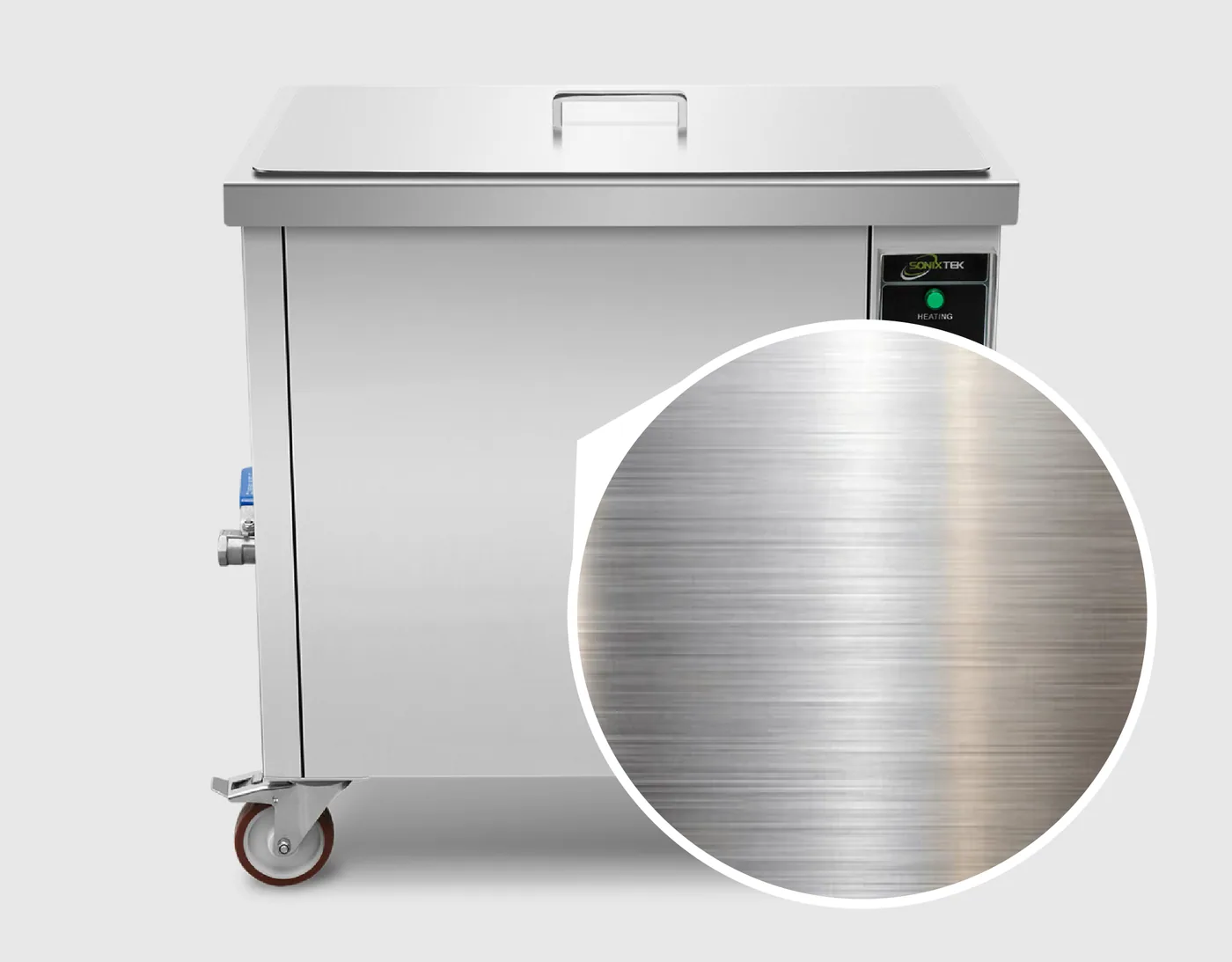
There is no gauge on an ultrasonic cleaner that reads "cavitation". The foil test is the nearest thing, it costs nothing, and it is the test we run on every tank before it leaves and the one we ask customers to run when they report weak cleaning.
How to run it
- Fill the tank to the working level with the normal cleaning solution, bring it to working temperature and degas it, five to ten minutes of ultrasound or the degas programme. A cold, gassy bath fails the test regardless of the machine.
- Cut a sheet of ordinary household aluminium foil, about 15 to 20 µm thick, to the inside width of the tank and to a height that reaches from 20 mm above the floor to just below the surface.
- Hold it vertically in the bath, across the long axis of the tank, with the basket removed. A wire frame or two clothes pegs on a rod keep it flat; do not let it touch the floor or walls.
- Run the ultrasound for 60 seconds with sweep on.
- Lift it out, rinse, and hold it up to the light.
On a large tank, repeat at three positions along the length and, if the tank is deep, with the foil horizontal at two depths.
Reading the foil
- Even perforation across the sheet, a fine pepper of holes with dimpled edges, within 60 seconds: the tank is working as designed. This is what a new ST-96 or UMX Pro produces.
- Perforation only in patches above some transducers, blank areas above others: transducers or a generator channel are down. On a multi-generator tank, one blank third means one generator. Time for service.
- Perforation in horizontal bands with clean strips between them, roughly 18 to 26 mm apart: standing waves. Sweep is off or the generator has no sweep. Standing-wave bands lie half a wavelength apart: in water about 26 mm at 28 kHz and about 18 to 19 mm at 40 kHz.
- Perforation strong at the bottom, fading towards the surface: normal in a deep tank with floor transducers only, more pronounced when the bath is under-filled or the load is heavy. Side-wall transducers on the larger AL and AU tanks are there to flatten this.
- Dimples but no holes after 60 seconds: weak cavitation. Gassy bath, cold bath, foil too thick, or the transducer bond is ageing. Degas and repeat before calling anyone.
- Holes but with torn, ragged edges: the foil was too thin or the test ran too long, not a machine fault.
Keep the foils, dated, in a folder. A tank's foil at delivery is its fingerprint; the same test a year later shows drift long before the parts do.
As an acceptance test
For a new machine, run the test on delivery at three positions and file the foils with the delivery note. For a specification with a cleanliness requirement, the foil is not the acceptance test of the process, the part is, but it proves the machine's contribution.
As a maintenance check
Monthly on a production tank, weekly on a tank running three shifts. Fifteen minutes including degassing, and it catches a failing generator before the shift discovers that nothing came out clean. The troubleshooting article starts from the foil result.
What the foil cannot tell you
Foil measures the energy arriving at a surface in the free field. It says nothing about whether a specific part in a specific basket is cleaned, which depends on loading, chemistry, temperature and time. A tank that passes the foil test and still leaves parts dirty has a process problem, not a machine problem.