
Multi-tank lines

Multi-tank cleaning lines

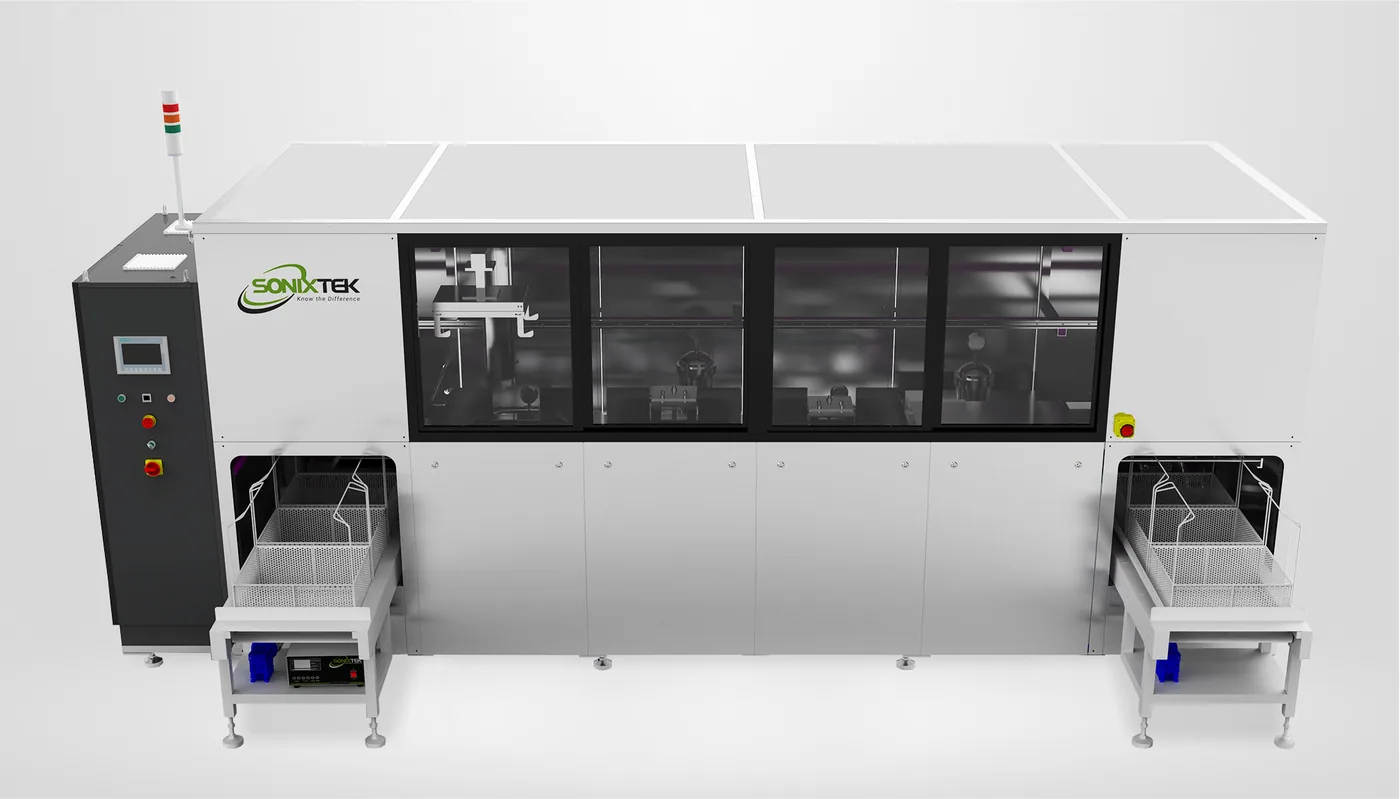
Multi-tank ultrasonic cleaning lines built to order: wash, rinse, passivate and dry with automatic basket handling; MT-75 is a reference configuration.
Discuss your processSpecifications

Multi-tank cleaning lines
MT-75 — Multi-tank cleaning lines

About this series

A multi-tank line is built around your process rather than chosen from a table: several tanks in sequence — wash, rinse, passivate, dry — with the baskets moved between them by a servo-controlled handling system, each tank independently set for cycle time and temperature, and the whole line run from a 7- to 19-inch touchscreen, sized to the line, on a multi-IO Siemens PLC.

The options are what make it a line rather than a set of tanks: barcode selection of the cleaning programme, automatic detergent dosing, multistage filtration with distillation and reverse osmosis for water recycling, heating and chilling, oil skimmers and separators, a swing-and-roll drying station, and remote monitoring over your network. Tanks in AISI304, AISI316 or duplex, depending on the chemistry.

Discuss your process

Multi-tank cleaning lines

Built around your process

Every multi-tank line is designed for the parts, the soil and the cleanliness you need. Three ways to build it, from operator-handled tanks to a fully automatic line, and the stations and options that go into it. The MT-75 below is one reference configuration, not a fixed size.

Select a function for the details.

Multi-tank cleaning lines

Manual line

Wash, rinse and dry tanks side by side on one frame; the operator moves the basket from station to station.

Each station has its own timer, temperature and ultrasonic controls. The operator lowers the basket, starts the station, and carries it on when the cycle ends.

The most economical way to a clean and dry part: suited to small batches, frequent changes of part family and workshops where an operator is at the line anyway. Tank sizes, frequencies and the number of stations are chosen per project.

Read more in the knowledge base

Multi-tank cleaning lines

Semi-automatic line

Each station gets its own lift: it lowers the basket, moves it up and down during cleaning and lifts it to drain. The operator only moves the basket on.

The lift makes every cycle the same: immersion, oscillation during the ultrasonic stage and the drain time are programmed per station, so the result no longer depends on the operator.

A good fit for heavy baskets and repeated batches that do not justify a transport robot. Stations can later be linked into a fully automatic line.

Read more in the knowledge base

Multi-tank cleaning lines

Automatic line

A servo-controlled transport carriage takes the basket from loading to unloading through every station under a PLC programme.

The carriage picks the basket at the loading position, lowers it into each tank in turn, oscillates it during the ultrasonic stages, lets it drain and sets it down on the unloading side. Soft start and stop protect sensitive parts.

A Siemens PLC with a 7- to 19-inch touchscreen, sized to the line, holds a programme per part family: times, temperatures and agitation per station, with real-time monitoring. Built for continuous production with minimal operator intervention.

Read more in the knowledge base

Multi-tank cleaning lines

Stations: from 2 to 7

Typical sequence: pre-wash, ultrasonic wash, one or two rinses, drying; optional passivation or rust protection.

Pre-wash or degreasing takes the gross soil off first, so the ultrasonic tank stays clean longer. The ultrasonic wash removes the fine soil. Rinses take the detergent film off; a final rinse in demineralised or RO water prevents water spots. Drying ends the line.

Optional stations add passivation, rust protection after the rinse, or a second drying stage for parts with deep bores.

Multi-tank cleaning lines

Tanks, frequencies and power

Tank size, ultrasonic frequency and power are set per station: 28 kHz for heavy soil, 40 kHz for fine cleaning, 80 kHz for delicate parts.

Each tank is sized from the largest part and the basket, not from a catalogue. Strong 28 kHz cavitation suits a pre-wash with oil, polishing paste and chips; 40 kHz cleans small, fine detail; higher frequencies are gentle enough for polished and delicate parts.

The MT-75 reference line uses tanks of about 75 litres with 40/80 kHz; larger and smaller tanks are built to order.

Read more in the knowledge base

Multi-tank cleaning lines

Filtration and water

Recirculating filtration per tank, oil skimmers, and rinse water from RO or deionised supply keep the baths clean and the rinse spot-free.

Each ultrasonic and rinse tank can have its own multi-stage filtration, down to fine cartridges for the final rinse, with overflow edges that carry floating soil away.

For water-intensive lines: reverse osmosis, deionisation or distillation recover and reuse rinse water; heating and chilling hold each bath at its set temperature.

Read more in the knowledge base

Multi-tank cleaning lines

Drying

Hot-air drying with forced circulation, optionally filtered air or a swinging basket for parts with blind holes.

Drying runs with hot air at 60 to 100 °C with forced circulation and an insulated chamber. Filtered air keeps particles off cleaned parts.

A swinging or tilting basket in the dryer turns blind holes and cavities so the water runs out instead of standing in them.

Read more in the knowledge base

Multi-tank cleaning lines

Programmes and traceability

Programme selection by barcode, automatic detergent dosing, cycle logs and remote monitoring over your network.

Scanning a batch or part code selects the right cleaning programme. Dosing tops up the detergent by time or conductivity, with low-level alarms.

Cycle logs with time stamps, filter changes and alarms can be exported or read remotely over the network.

Multi-tank cleaning lines

Materials and build

Stainless steel throughout: AISI 304 as standard, AISI 316L or duplex where the chemistry needs it.

Tanks, frame and covers are stainless steel with smooth welds. AISI 316L or duplex steel is used for acidic or chloride-containing chemistry, for example in passivation.

Lids, exhaust connections, insulation and safety guarding are part of the design, and the line is laid out to fit your floor and loading direction.

Read more in the knowledge base

Models

Every size in this series.

Multi-tank cleaning lines

Specifications

Custom machines

Not in the standard range? We build it.

Every industrial machine is made to order, so the tank size, material, heating, filtration, lid, lift and controls follow your parts and your process. If the machine you need is not on this page, describe the parts and the soil and we design it around them.

Let's find the right fit

Not sure which size you need?

Send us the part, the quantity per hour and the soil you are removing. We will size the tank and the frequency with you.
Discuss your process

Region

Choose your country or region

Sonixtek machines are supplied by a regional company or partner. Your choice sets the contact details shown on the site and where your enquiry is handled.