
Choosing a machine · 4 min read · Updated 2026-09-25
ST or SF: when the bath needs its own filtration
The ST series is a heated ultrasonic tank; the SF series is the same tank built around a circulation loop with a buffer tank, oil skimmer and laminar flow. The second costs more and stands longer between bath changes. Where the line between them runs, with the overlapping models compared.
Technical guide. Figures are taken from our own spec tables; for your process we confirm the settings with a cleaning trial.
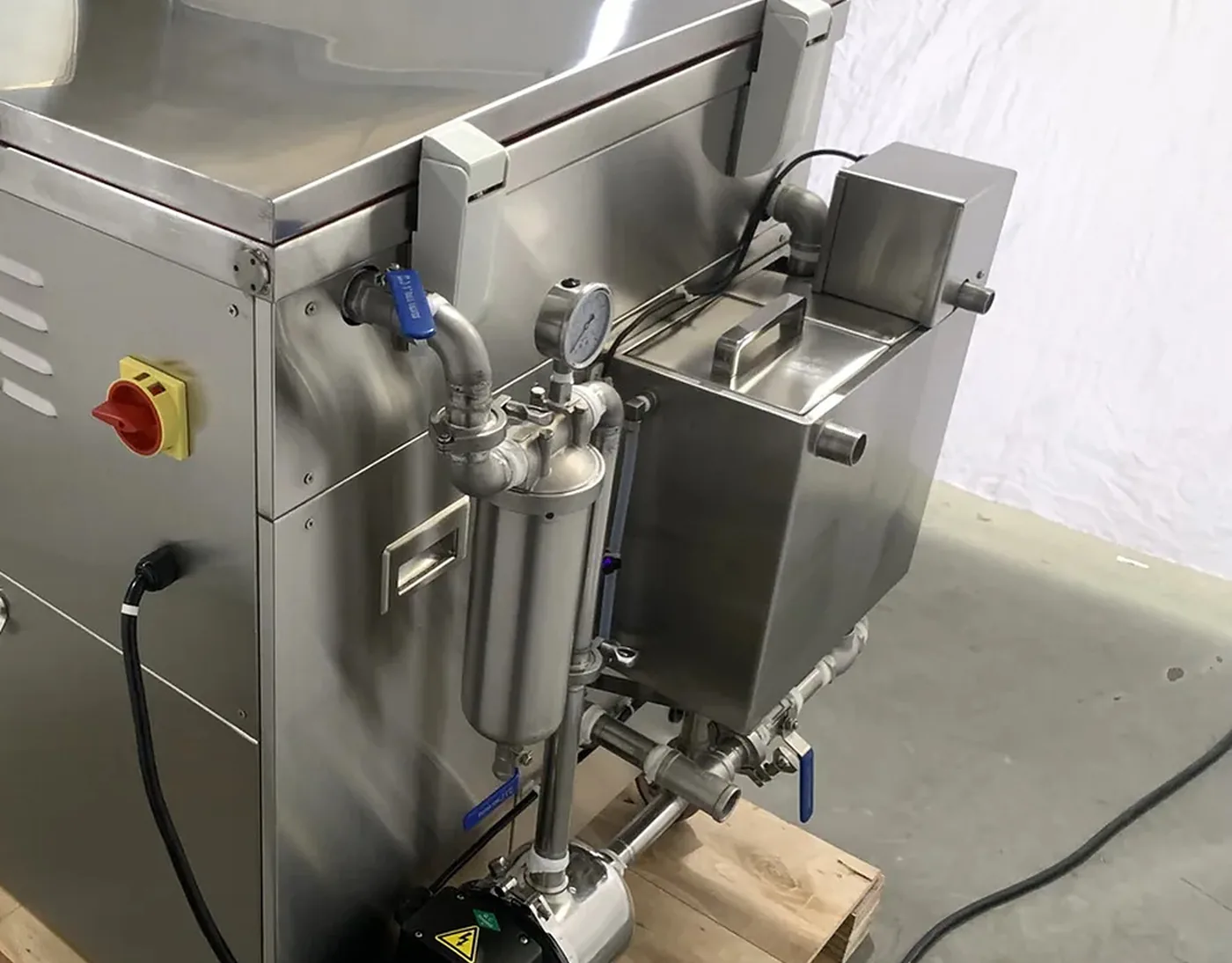
Two of our series overlap between 200 and 400 litres
Side by side
| ST-206 | SF-225 | ST-300 | SF-310 | ST-400 | SF-360 | |
|---|---|---|---|---|---|---|
| Tank volume | 206 L |
225 L |
300 L |
310 L |
400 L |
360 L |
| Tank inside (L × W × D) | 750 × |
900 × |
900 × |
750 × |
1100 × |
1000 × |
| Useful depth | 260 mm |
560 mm |
260 mm |
730 mm |
260 mm |
660 mm |
| Ultrasonic | 2520 W, 42 transducers | 2880 W, 48 | 3720 W, 62 | 3600 W, 60 | 5760 W, 96 | 4320 W, 72 |
| Heating | 6 kW, to 100 °C |
6 kW, to 100 °C |
8 kW | 9 kW | 10 kW | 9 kW |
| Transducers | bonded to the tank | in a stainless box | bonded | box | bonded | box |
| Filtration | add-on loop | built in: pump, filter, buffer tank, skimmer, laminar flow | add-on | built in | add-on | built in |
| Basket load | 100 kg |
200 kg |
125 kg |
200 kg |
150 kg |
200 kg |
| Outside (L × W × H) | 945 × |
1535 × |
1210 × |
1385 × |
1410 × |
1635 × |
On the ST the useful depth is that of the standard basket, 260 mm
What the SF loop does
- Liquid is drawn from the surface overflow and from the floor.
- It passes a bag or cartridge filter that takes out chips, grit and carbon flakes.
- It rests in the buffer tank, where free oil separates and a skimmer takes it off.
- It returns to the cleaning tank as a laminar sheet across the surface, pushing floating oil and foam to the overflow, so the part leaves the bath through clean liquid.
The loop runs between cycles and during them. The result is a bath that stays at working strength for weeks on oily, chip-laden work instead of days, and parts that do not pick up a film on the way out. The filtration article covers why that matters.
Choose the ST when
- The parts are lightly soiled or the soil is dry: dust, polishing compound, light oil.
- The tank runs a few batches a day, and a weekly bath change is acceptable.
- The floor space is tight: the ST-206 takes about a third of the floor area of the SF-225.
- The process is hot soaking and carbon, where the chemistry, not the particle load, ends the bath.
- A loop might be wanted later. A stand-alone filtration unit can be added to any ST tank.
Choose the SF when
- Machining swarf, coolant or grinding fines come in every batch.
- Oily parts go through all day and the bath must not lay a film back on them.
- The bath change is a cost: 300 litres
(79.3 US gal) of heated solution and its disposal, every week, is what the SF saves. - The parts must leave through a clean surface: before coating, before assembly, before inspection.
- The transducers must be serviceable without draining, or side-mounted for a deep load.
In numbers
An unfiltered 300-litre bath on oily machined parts lasts three to five working days; the same bath in an SF-310 with the skimmer running lasts three to five weeks. At one change a week versus one a month, the SF saves around forty bath changes a year, each one 300 litres
And above that
Beyond 400 litres