
Parts and contaminants · 4 min read · Updated 2026-09-30
Cleaning medical device components before assembly
Machined, moulded and stamped parts bring oil, mould release and particles into a device. How to set up the cleaning step and validate it under ISO 13485.
Technical guide. Figures are taken from our own spec tables; for your process we confirm the settings with a cleaning trial.
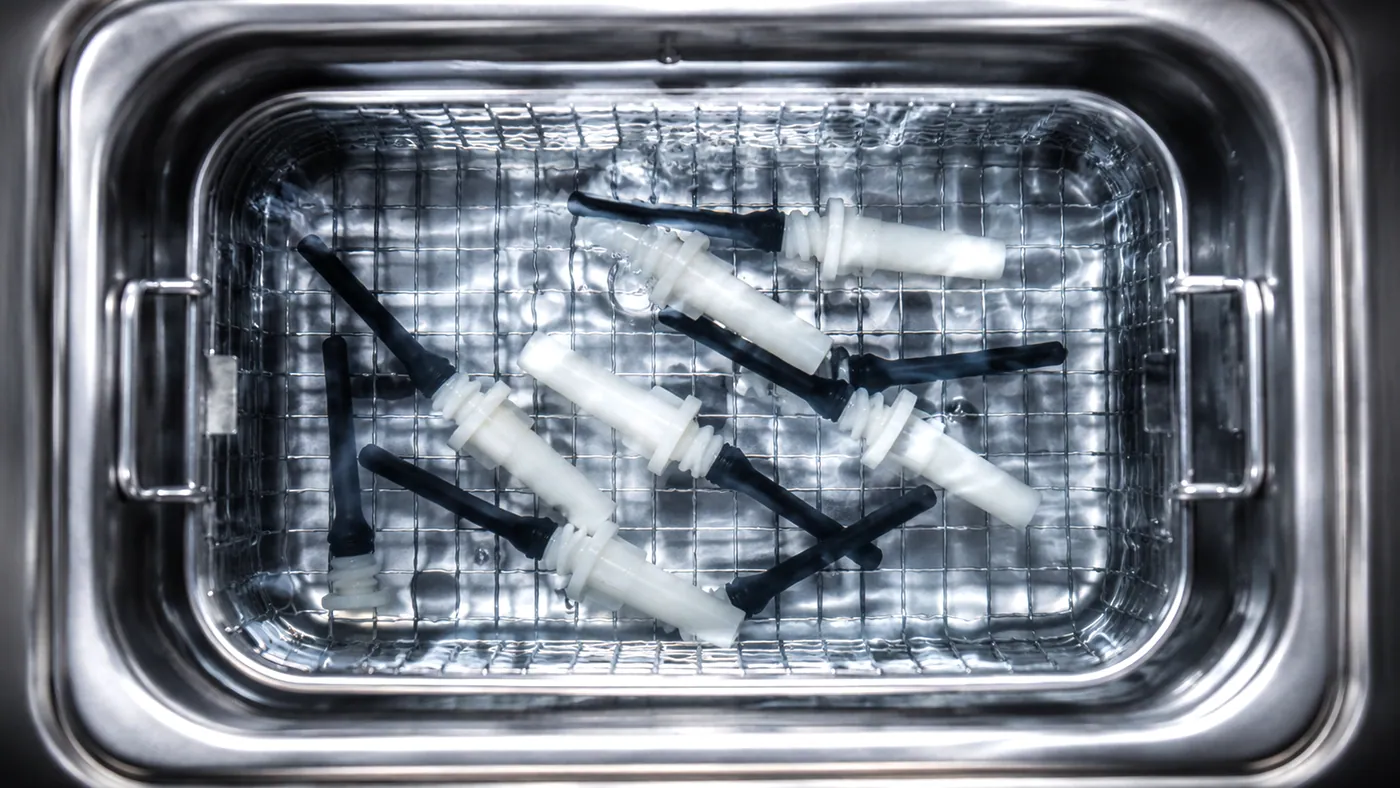
A medical device is assembled from parts that have been machined, moulded, stamped, laser-cut, welded or bought in. Each of them arrives at the assembly bench with something on it: coolant, stamping oil, mould release, preservation oil, particles, fingerprints. Whatever is still there at assembly ends up inside the device. Sterilisation after packaging kills microorganisms, but it does not remove a single particle or a milligram of oil. The cleaning step before assembly is where those residues have to go.
This is manufacturing. The device maker cleans under its own quality system, and industrial ultrasonic equipment is used for it.
What the parts carry
| Part type | Typical residues |
|---|---|
| Machined metal parts: stainless, titanium, aluminium | Coolant, cutting oil, chips, burr flakes in threads and cross-drillings |
| Stamped and formed parts: springs, clips, contacts | Stamping and drawing oils |
| Injection-moulded plastics: PC, PP, PEEK and others | Mould release, flash particles, dust held by static charge |
| Laser-cut and welded tubes | Oxide, spatter, recast particles, especially inside |
| Glass and ceramic parts | Polishing and lapping residues |
| Purchased parts | The supplier's preservation oil and packaging dust |
For metal parts from the machine shop, the settings in machining swarf and coolant apply. Tubes and parts with channels have their own article: medical tubing and channels.
Why the residues matter
- Biocompatibility. The biological evaluation of a device under ISO 10993 covers what is on it as supplied, which includes manufacturing residues and the cleaning agent itself.
- Particles. A loose particle in a fluid path, an implant or a drug delivery device is a hazard in its own right.
- Joining and coating. Adhesives, laser welds, ultrasonic welds and coatings fail on oily or release-coated surfaces.
- Function. Valves, pistons and fine mechanisms jam or leak on chips and fibres.
- Bioburden. Soil carries microorganisms and protects them, and the sterilisation validation relies on a low, stable bioburden.
The cleaning set-up
| Station | Metal parts | Plastic parts |
|---|---|---|
| Ultrasonic wash | Alkaline cleaner with inhibitor, 50 to 60 °C, 40 kHz, 5 to 10 min | Neutral or mild alkaline cleaner, 40 to 50 °C, 40 kHz, 3 to 5 min |
| Rinse | Clean water, ultrasound on | Clean water |
| Final rinse | Purified water, conductivity monitored | Purified water, conductivity monitored |
| Dry | Hot air, 70 to 90 °C | Hot air below the plastic's limit, often 50 to 60 °C |
40 kHz is the default for small components. 80 kHz suits fine particles on polished parts and delicate plastic parts, 28 kHz heavy metal parts with coarse chips; see 28 kHz or 40 kHz. Aluminium needs an inhibited cleaner. Soft plastics can be marked by cavitation where they rest against the basket, so they sit in fixtures or on plastic-coated supports rather than loose on wire mesh. After the dryer, parts go straight to a clean assembly area in covered trays; see CNC machined parts before assembly for the handling after cleaning.
Validating the step under ISO 13485
ISO 13485 asks the manufacturer to document cleanliness requirements for its product (clause 7.5.2) and to validate any process whose result is not fully verified afterwards (clause 7.5.6). A cleaning step usually falls under both: nobody tests every part for residue. The usual structure:
- Installation qualification (IQ). The machine is installed as specified; utilities, temperature sensors and timers are checked and calibrated.
- Operational qualification (OQ). The process is run at the limits of its settings, lowest temperature, shortest time, weakest concentration, fullest load, and still meets the cleanliness criteria. The cavitation pattern is mapped, for example with the foil test.
- Performance qualification (PQ). Repeated production runs with worst-case parts, the ones with the deepest blind holes and the most residue, show that the result is consistent.
After validation, the parameters are fixed in stored programmes, and routine monitoring keeps them there: concentration checks, rinse conductivity, cavitation checks at a set interval, and the bath change interval established in the validation. A new cleaner, a new fixture or a new machine is a change to a validated process. See filtration and bath life for what shortens a bath's life.
Measuring the result
The acceptance criteria come from the device's risk management and biological evaluation, not from the cleaning machine. Common methods on sample parts:
- Particles: extraction, filtration through a membrane, counting and sizing under a microscope, as in technical cleanliness testing.
- Organic residue: total organic carbon on an extraction liquid, or gravimetric non-volatile residue.
- Identification: infrared spectroscopy when a residue has to be named.
- Surface energy: contact angle or test inks on surfaces that are bonded, welded or coated.
- Visual: inspection under magnification, the fast daily check.
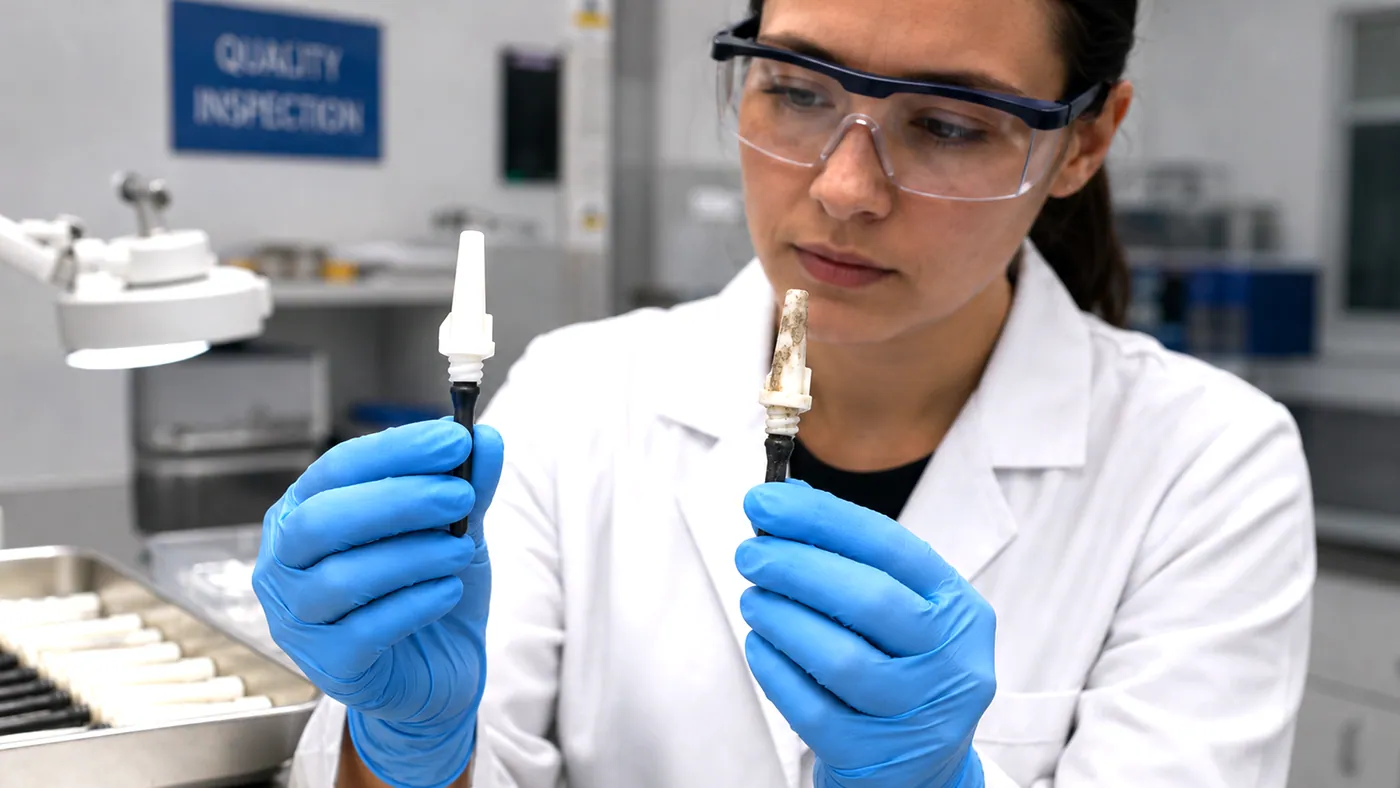
Which machine
| Work | Set-up |
|---|---|
| Development, pilot lots, small batches | UMX Pro 50L at 40 kHz with programmes, rinse tank, DT dryer |
| Series of machined parts | AL-75 or AL-150 with lift and filtration, rinse stations, DT dryer |
| Small precision and plastic parts | MT-75: 75 L wash at 40 or 80 kHz, with rinse and dry in one frame |
| High volume to a cleanliness specification | MT multi-tank line with wash, rinses, purified-water final rinse and dryer under one carriage |
The precision parts article covers cleaning for inspection, and the medical industry overview the rest of the sector.