Choosing a machine · 3 min read · Updated 2026-09-25
Multi-tank lines: wash, rinse, dry
When a clean part has to come out dry and residue-free, one tank is not enough. How a wash, rinse and dry line is laid out, how a transport carriage moves the basket through it, and how to decide the number of stations from the cleanliness you need.
Technical guide. Figures are taken from our own spec tables; for your process we confirm the settings with a cleaning trial.
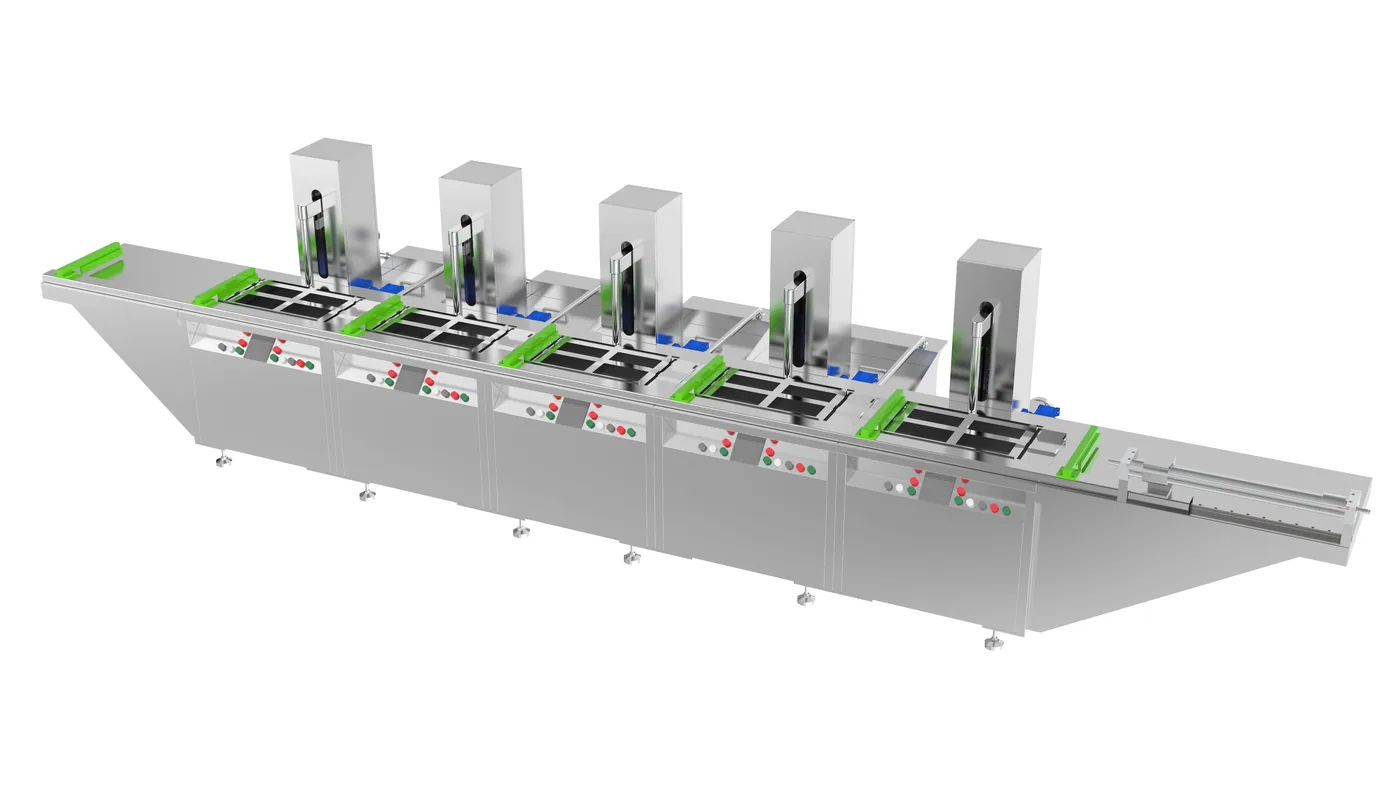
An ultrasonic wash tank removes the soil. What it leaves on the part is a film of the cleaning solution with the soil dissolved and suspended in it. For many jobs that is fine; the part is wiped, or goes to a process that does not care. For parts that are painted, coated, welded, assembled with seals or measured to microns, the film has to come off and the part has to be dry. That is a line.
The standard sequence
- Ultrasonic wash in heated detergent solution, 28/40 kHz. Removes oil, grease, chips and carbon.
- Rinse in clean water, often heated, sometimes with ultrasound to flush out blind holes and crevices. Removes the detergent film and the soil it carries. A second rinse in demineralised water follows for parts that must not show water spots.
- Dry in hot air at 60 to 100 °C with forced circulation. Removes the rinse water from surfaces, blind holes and threads.
Optional stations: a pre-wash spray for gross soil, a rust-inhibitor dip after the rinse for bare steel, a vacuum dryer for parts with deep bores.
How a line moves the basket
On an automatic line the stations stand in a row under a transport carriage. The carriage picks the basket from the loading position, lowers it into each tank in turn, oscillates it during the ultrasonic stages, lifts and dwells to drain, and sets it down on the unloading side. A Siemens touchscreen holds the programme per part family: times per station, temperatures, agitation on or off. Stack lights show the state from across the shop. On a manual line the operator moves the basket from station to station; on a semi-automatic line each station has its own lift and the operator only moves the basket on. These are the MT multi-tank lines. The AL and AU series are single tanks with a lift platform: they wash, and do not move the basket between tanks.
Tank sizes, frequencies and the number of stations are chosen per project. The MT-75 is one reference configuration: a 75-litre wash tank with 40/80 kHz for small precision parts, with rinse and dry stations in one frame. Where the wash itself needs a large single tank with a lift, an AL or AU machine can stand at the start, with the basket moved to the rinse and dry stations by hoist.
How many stations
The cleanliness you need decides it.
- Visually clean, will be handled or machined again: wash only. An ST or AL tank.
- Clean and dry, no spots acceptable: wash, rinse, dry. Three stations.
- Clean before coating, painting or bonding: wash, rinse, demineralised rinse, dry. Four stations; the second rinse keeps detergent residues below what a coating notices.
- Particle cleanliness to a specification (gravimetric or particle count): wash, rinse, rinse, dry, with filtration on every liquid station and a bath-change schedule tied to the measured result.
- Bare steel stored after cleaning: add an inhibitor dip before drying.
Throughput
The cycle time of the line is the longest station, usually the wash at 5 to 15 minutes, because the carriage can only carry one basket while the others wait in their tanks. A line with one wash tank delivers one basket per wash cycle. Two wash tanks side by side double it. Ask for the parts per hour you need and the basket load, and the number of tanks follows; the sizing guide gives the basket, this gives the count.
Custom lines
Most lines are built to the customer's sequence: tank count, tank sizes, which stations have ultrasound, which have filtration, carriage speed, a conveyor in and out. The custom units article shows the kind of lines that come out of that, and the enquiry form asks for the information we need to lay one out.