
Process and parameters · 4 min read · Updated 2026-09-25
Loading the basket: shadowing, orientation and how much is too much
Half of all "the machine does not clean" complaints are loading problems. How parts shadow each other, why blind holes go in tilted with the opening upward, what a basket load of 75 or 100 kg really means, and how to lay out a batch so the last part is as clean as the first.
Technical guide. Figures are taken from our own spec tables; for your process we confirm the settings with a cleaning trial.
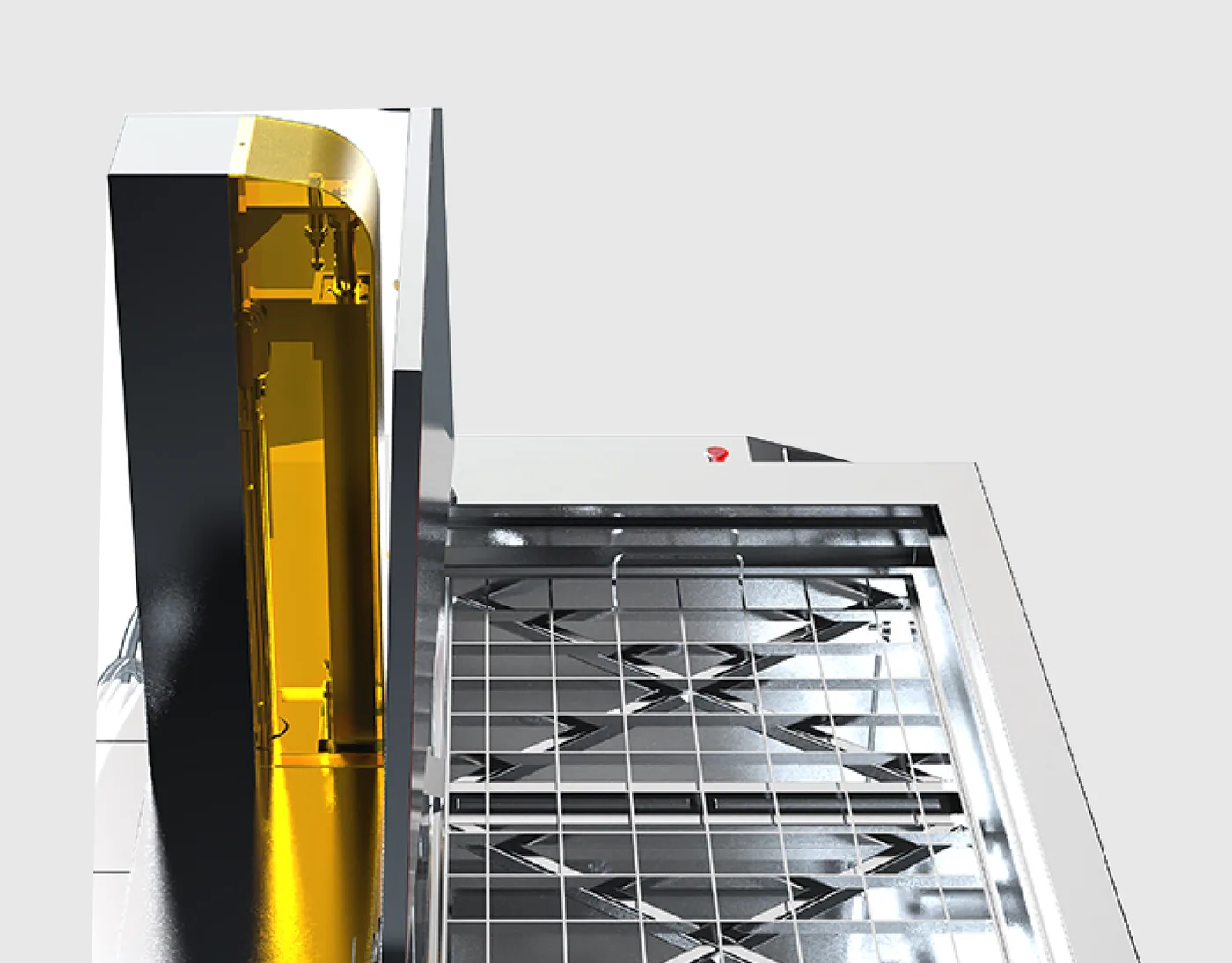
Sound in water behaves like light in a room with one lamp: it travels in straight lines from the transducer floor, bounces off walls and the surface, and casts shadows. A part in the shadow of another part is not cleaned. Everything about loading follows from that.
One layer, with gaps
Parts lie in a single layer with 10 to 20 mm between them. Stacked parts clean on their outer faces only; parts touching each other leave an unwashed line along the contact. For flat parts, stand them on edge in a rack so both faces see the field; for round parts, a mesh insert that keeps them apart.
The basket itself matters. A fine mesh scatters more sound than a coarse one; our baskets use 5 to 10 mm mesh or bar grids for that reason, with finer inserts only where small parts would fall through. A solid tray is not a basket: it shields everything above it.
Orientation
- Blind holes go in tilted, the opening angled upward about 30 to 45° or sideways, so the air in them rises out and the liquid reaches the bottom of the hole. A blind hole facing straight down holds an air pocket: a hole that is never cleaned, and the pressure inside it also keeps liquid out. After lifting the basket, tip the parts so liquid and loosened chips drain from the holes.
- Threads and fine detail face up or sideways, towards the free field, not down towards the floor where the basket grid casts its shadow.
- Cupped parts (pistons, cups, housings) follow the same rule: tilted or on their side so they fill without an air pocket and drain when lifted; a cup straight open side down traps air, and one straight open side up holds a pool of dirty liquid and comes out with a tide mark.
- Long parts lie along the long axis of the tank; across it they bridge the field and shadow the whole width.
- Heavy parts sit on the basket floor, light parts on top of a rack above them, never the other way round.
Lowering the basket slowly, or lowering it and lifting it once before the cycle, lets trapped air escape. The agitation on the AL and AU series does this continuously, which is why dense loads clean better on a lift; see the agitation article.
How much
Two limits apply.
Weight. Basket load ratings are 30 to 50 kg on the STS-150 to STS-300, 75 kg on the ST-40 and ST-65, 100 kg on the ST-96 to ST-206, 125 kg on the ST-300, 150 kg on the ST-400, and 75 to 1000 kg on the AL and AU series. They are set by the basket, the rails and the lift, not by the cleaning.
Sound. A load absorbs energy. As a rule of thumb, the parts should fill no more than about a third of the tank's working volume and cover no more than about two thirds of the floor area in plan view. Beyond that the field collapses in the middle of the load and cycles stretch without the result improving. On a 96-litre ST-96 with a 600 × 400 mm floor, two thirds is about 490 × 330 mm. A layer of parts on roughly 400 × 260 mm with gaps covers about 43 % of the floor and stays well inside that limit; it holds a lot of injectors and a modest number of cylinder heads.
Depth
Parts need 30 to 50 mm of liquid above them; the surface layer is turbulent and full of foam and does not clean. They also need to sit 10 to 30 mm above the floor, which the basket feet provide. So the useful height of a tank is the depth minus about 40 to 80 mm. That is why our specification sheets list "useful" dimensions next to the tank dimensions, and why the sizing guide starts from the part, not the litres.
Small parts
Fasteners, needles, inserts and jets go in a fine-mesh insert or a perforated beaker, never loose in the main basket, and in a shallow layer. Small parts pile on each other and the pile stays dirty inside. For the smallest parts the indirect method in a beaker is usually better than the main bath.
A quick check
If the parts at the centre of the basket come out less clean than those at the edge, the load is too dense. If the tops are clean and the undersides are not, add agitation or turn the parts once mid-cycle. If everything comes out with a line at one height, the part sat across a standing-wave node: switch sweep on, or lower the basket 10 mm.