
Parts and contaminants · 4 min read · Updated 2026-09-26
Cleaning threaded parts and blind holes with ultrasound
Tapped holes, blind bores and internal threads trap chips, coolant and air. Why the trapped air is the real enemy, how part orientation, degassing and movement get the liquid in, which frequency suits fine threads, and how to get the liquid out again.
Technical guide. Figures are taken from our own spec tables; for your process we confirm the settings with a cleaning trial.
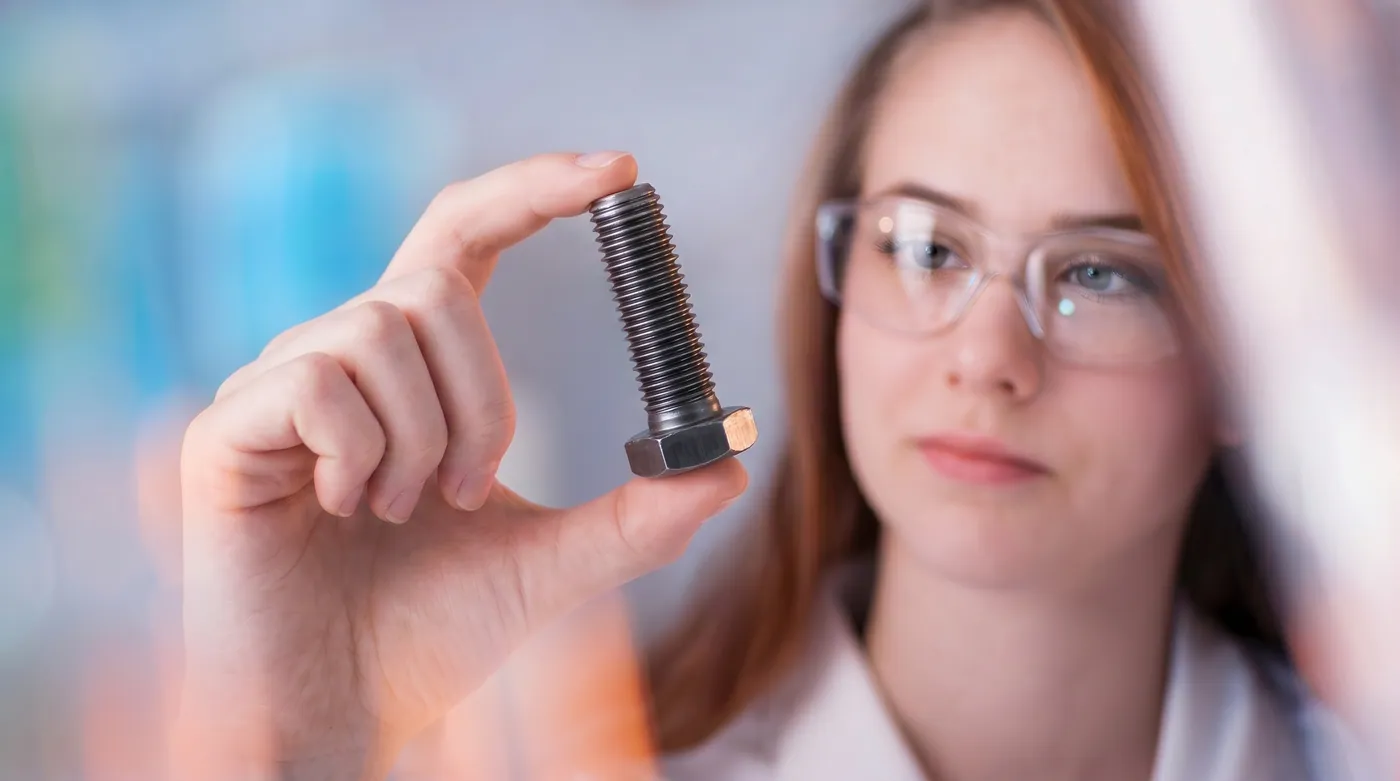
A tapped blind hole is the hardest place on a machined part to clean. The tap packs chips into the bottom, coolant fills the rest, and the thread flanks hold both. A spray does not reach the bottom, a brush does not fit, and compressed air blows the top chips out and packs the rest in harder. Ultrasonic cleaning is the method that works, because cavitation happens wherever the liquid is, however narrow the space. The condition is that the liquid actually gets there.
Air is the problem, not the dirt
A blind hole that goes into the bath opening-down stays full of air. A hole that goes in opening-up often still traps a bubble at the bottom, held there by surface tension. Where there is air, there is no liquid, and where there is no liquid, there is no cavitation. Most complaints about uncleaned blind holes are air pockets.
Four things get the liquid in:
- Orientation. Tilt the part so every blind hole has its opening angled upward, about 30 to 45°, or sideways; the air then rises out and the liquid reaches the bottom. Never load a blind hole facing straight down. A fixture or carrier that holds the part at 30 to 45° often cleans better than any change of chemistry.
- Degassing. Fresh water holds dissolved air that forms bubbles in the holes. Degas a new bath before the first load, and use the degas function if the generator has one; see sweep and degas.
- Wetting. A cleaner with low surface tension enters narrow gaps that plain water bridges over. This is one reason not to clean in water alone; see cleaning liquids.
- Movement. Lifting and lowering the basket a few times during the cycle pumps liquid in and out of the holes and carries loosened chips away. On AL systems the lift does this automatically; see agitation.
Frequency and power
| Geometry | Frequency | Why |
|---|---|---|
| Fine threads (M2 to M6), small bores under 3 mm | 40 kHz | Smaller bubbles fit the thread root and small bores, gentle on thread flanks |
| Medium and coarse threads, bores over 6 mm, heavy chips | 28 kHz | Stronger implosions move compacted chips and heavy coolant residue |
| Parts with both | 28 kHz wash, then an ultrasonic rinse at 40 kHz | Heavy soil out first, fine particles second |
See 28 kHz or 40 kHz. Power density matters less than orientation here; a strong bath does not clean a hole that is full of air.
The cycle
| Step | Setting |
|---|---|
| Wash | Alkaline cleaner 3 to 5 %, 55 to 65 °C (aluminium: light-alloy cleaner, 50 to 60 °C), 8 to 15 min, basket moved or lift agitation on |
| Blow-out | Short blast of air into each blind hole over the tank, to drain the loosened chips and liquid |
| Rinse | Ultrasonic rinse in clean water, 2 to 5 min, parts again tilted |
| Blow-out and dry | Air nozzle into the holes, then hot-air dryer or vacuum dryer |
Deep holes, with depth more than five to eight times the diameter, often need two wash cycles with a blow-out between them. Chips that are wedged into the thread, rather than loose in it, are a machining problem: a worn tap or wrong chip evacuation. Cleaning loosens loose chips; it does not cut free a chip that is jammed in the flank.
Getting the liquid out
A blind hole that holds cleaner or rinse water after the dryer is a corrosion point on steel and a stain on aluminium, and in an assembly it is a drop of water in the product. The tilt that let the air out holds liquid in the hole when the basket comes up, so first tip each part to drain the holes and the loosened chips. After that:
- Blow out each hole with a nozzle, not a general blast over the part.
- Dry hot and long enough for the part mass to reach temperature; a heavy block with deep holes needs more time than its surface suggests.
- Vacuum drying reliably empties holes where hot air cannot, and is worth considering for hydraulic and fuel-system parts.
See rinsing and drying and dryer tanks.
Checking the result
Cut a scrap part through the hole and look. It is the fastest way to prove a new process. In production, a borescope or an extraction test on a sample part checks that the holes stay clean. The foil test checks the bath, not the holes.
Which machine
| Work | Set-up |
|---|---|
| Small parts, occasional | UMX Pro 50L or 62L at 40 kHz with a tilted fixture, rinse tank |
| Machined parts daily, chips and coolant | SF-225 or SF-310 with filtration, so loosened chips leave the bath instead of settling back into the holes |
| Blocks and housings in volume | AL-150 or AL-300: the lift moves the load up and down during the cycle, which pumps the holes |
Related: removing swarf, chips and coolant, hydraulic valves and blocks and why ultrasound reaches where brushes cannot.