
Parts and contaminants · 4 min read · Updated 2026-09-30
Cleaning electronic parts before assembly with ultrasound
Housings, heat sinks, shields and frames carry oil, chips and fingerprints into the device. How to clean them first, and why conductive particles matter.
Technical guide. Figures are taken from our own spec tables; for your process we confirm the settings with a cleaning trial.
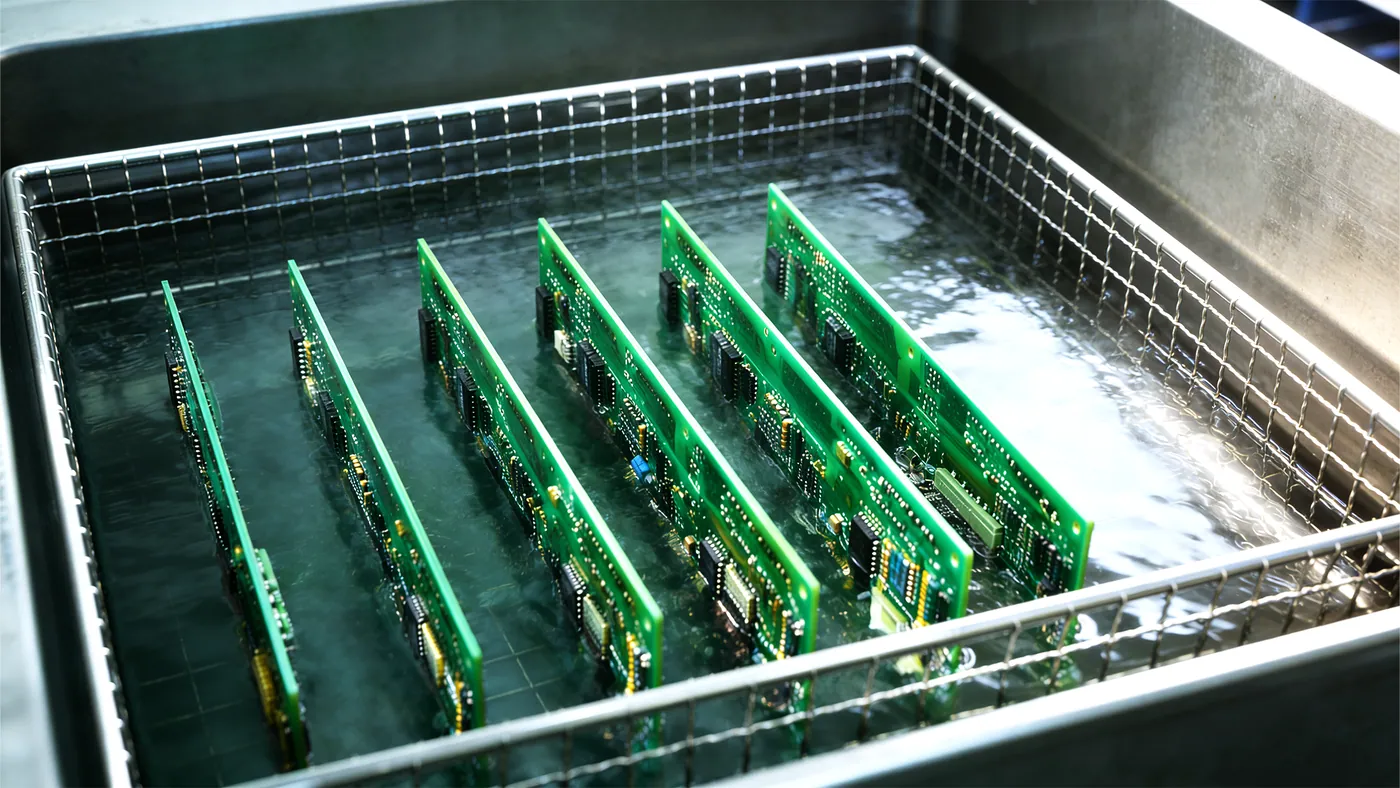
The circuit board gets most of the attention in electronics cleaning, but much of the dirt in a finished device arrives on the mechanical parts: the machined housing, the extruded heat sink, the stamped shield, the frame and the brackets. Whatever they carry into the assembly stays there, next to the board, for the life of the product. A metal chip that falls out of a housing thread onto a board is a short circuit waiting for the right moment.
The parts and what they bring
| Part | Made by | Typical soil |
|---|---|---|
| Housings and covers | Die-casting, CNC machining | Coolant, chips in threads and pockets, release agent, burr flakes |
| Heat sinks | Extrusion and machining, skiving | Coolant, chips between fins, extrusion lubricant |
| Shields and cans | Stamping, forming | Stamping oil, fine burrs |
| Frames, brackets, chassis parts | Stamping, bending, machining | Oil, particles, fingerprints |
| Screws, spacers, inserts | Turning, cold heading | Oil, fines |
| Plastic housing parts | Injection moulding | Release agent, dust from deflashing |
Why particles matter more in electronics
In a hydraulic valve a particle blocks a spool. In electronics a conductive particle can bridge two conductors at different potential, or come loose later and move with vibration until it finds a place where it does damage. Non-conductive particles and fibres cause trouble too, in connectors, on optical paths and under thermal interface material.
The ZVEI guide to technical cleanliness in electrical engineering applies the test approach of VDA 19.1 to electronic parts: particles are extracted from the part, collected on a membrane, counted and sized, with metallic and non-metallic particles counted separately. The limits are set by the product maker, often by comparing the largest particle allowed with the smallest gap between conductors on the board. The cleaning station's job is to meet that limit batch after batch.
Oil and fingerprints
Oil films do their own damage. On a heat sink, a film under the thermal interface material affects how well it wets the surface. On a housing that is bonded, sealed or painted, oil costs adhesion; see cleaning parts before coating. Fingerprints leave salt and skin oil, which corrode aluminium and copper under a seal or a coating and are ionic contamination next to the electronics. Clean parts are handled with gloves from the dryer onward.
The cleaning sequence
| Station | Purpose | Typical setting |
|---|---|---|
| Ultrasonic wash | Coolant, oil, chips, fines | Light-alloy cleaner for aluminium and zinc, mild alkaline for steel, 50 to 60 °C, 28 or 40 kHz, 5 to 10 min, filtration on |
| Ultrasonic rinse | Cleaner and loosened particles | Clean water, 40 kHz, 2 to 3 min |
| Final rinse | Salts; no spots on visible surfaces | Demineralised water |
| Dry | No water in threads, pockets and between fins | Hot air, 60 to 80 °C |
28 kHz suits heavy machining residue in cast housings; 40 kHz suits thin stampings, plated and anodised parts and fine particles. Anodised, chromate-converted and plated parts get the mild chemistry and short times from the cleaning liquids article. Parts with deep threads and blind holes are covered in threaded parts and blind holes.
Heat sinks
Fins shield each other. A heat sink lying flat in the basket has its fins pointing up, full of liquid that barely moves, with chips still sitting at the fin roots. Stand it on its end with the fins vertical and the channels open to the sides, so the field reaches between the fins and the chips can fall out. Narrow fin gaps benefit from 40 kHz and from a lift or manual up-and-down movement. Drying follows the same logic: fins vertical, channels draining.
Machining residue first, not later
For machined housings the cleaning belongs at the machining cell, not at the electronics line. Chips, coolant and burr flakes are much easier to remove while the coolant is fresh, and a housing that arrives at assembly already clean does not bring its dirt into the clean area. The layout of wash, rinse and dry next to the machining cell is covered in cleaning CNC machined parts before assembly. Deburring comes before cleaning: ultrasound removes loose particles, not burrs that are still attached.
Storage and handling
- Pack clean parts in closed, clean containers or bags, not open boxes.
- Keep the cleaned-parts store away from machining, grinding and packaging material that sheds fibres.
- Unpack at the assembly station, with gloves.
- Keep the packaging for clean parts separate from the packaging the raw parts arrived in.
Which machine
| Work | Set-up |
|---|---|
| Small batches, prototypes | ST-40 or ST-65, rinse tank, drying cabinet |
| Housings and heat sinks in batches | UMX Pro 88L to 162L or ST-96 with filtration, demineralised rinse, DT-96 dryer |
| Larger volumes, parts with cavities and fins | AL-150 to AL-400 with lift and filtration, rinse and demineralised rinse stations, dryer |
Battery housings, busbars and cooling plates follow the same logic with tighter particle limits; see battery components. The electronics industry page collects the related articles.