
Process and parameters · 4 min read · Updated 2026-09-25
Filtration and bath life
A cleaning bath fails in three ways: it fills with particles, it saturates with oil, or its chemistry is used up. Filtration handles the first two and stretches the third. What a filtration loop and an oil skimmer do, when a bath needs them, and how to tell when a bath is finished.
Technical guide. Figures are taken from our own spec tables; for your process we confirm the settings with a cleaning trial.
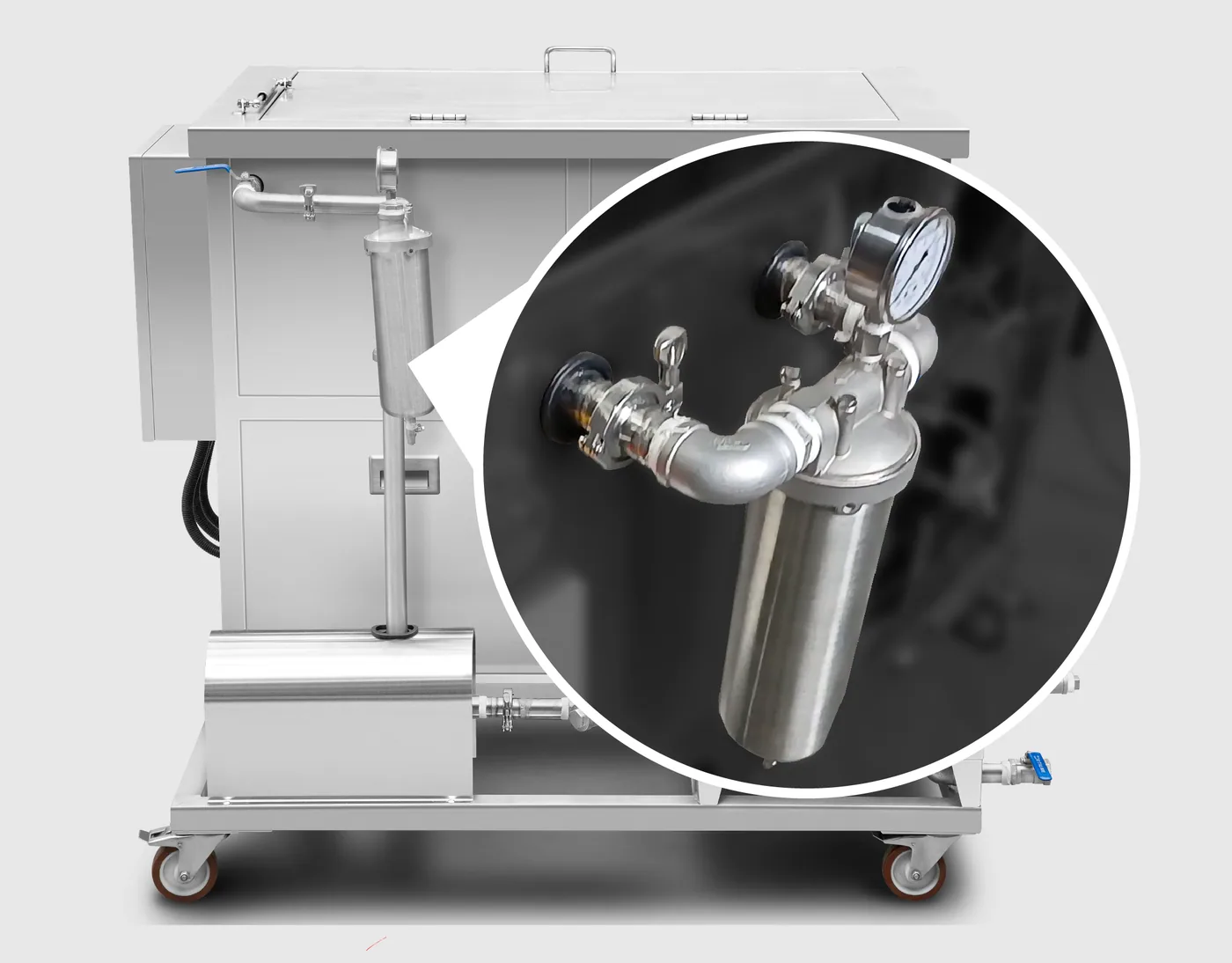
Every part that goes into the bath leaves something behind. The bath cleans well on day one, adequately on day three, and at some point it starts putting soil back onto the parts. Filtration moves that point from days to weeks; knowing what loads your bath decides whether you need it.
How a bath dies
Particles. Swarf, grit, carbon flakes and dust sink to the floor, where the cavitation stirs the fine fraction back up. Fine particles in suspension scatter the sound, so cleaning power drops, and they redeposit on the parts as they are lifted out through the surface layer.
Oil. Alkaline cleaners emulsify oil, holding it as droplets in the liquid. An emulsion can carry a few grams of oil per litre before it is saturated; a 100-litre bath is full after roughly 200 to 500 g of oil, which is a couple of days of oily gearbox parts. A saturated bath re-deposits a thin film of oil on every part on the way out.
Chemistry. The active components of the cleaner are consumed by the soil and by carry-over. A bath at half concentration cleans slowly and leaves residues; topping up the water without topping up the cleaner is the commonest cause.
What filtration does
A filtration loop draws liquid from the tank, usually from the surface and floor together, pumps it through a filter and returns it. Three components cover the three failure modes:
- Particle filter. A bag or cartridge filter of 5 to 50 µm removes the particles. Coarse filters for swarf, finer for particles that must not redeposit on precision parts. Bags are cheap and changed weekly; cartridges last longer and give a defined cut-off.
- Oil skimmer. A belt, disc or weir at the surface takes off oil that has separated from the emulsion, which happens when the bath is still and warm. Skimmed oil goes to a separate container; the bath keeps its capacity to emulsify. The buffer tank on the SF series and the skimmers on the AU and SPR series are this component.
- Laminar flow. The return flow enters the tank as a sheet across the surface, pushing floating oil and foam to the overflow and the skimmer, so the part leaves through clean liquid. The SF and AL series have it as an option or standard.
The loop runs continuously between cycles and, on the SF series, during cleaning as well. Turnover of the tank volume three to five times an hour is a working figure.
When you need it
| Situation | Filtration |
|---|---|
| Occasional cleaning, light soil, benchtop or small ST | none; change the bath |
| Daily cleaning, machining swarf, coolant | particle filter |
| Daily degreasing of oily parts | particle filter and oil skimmer |
| Continuous production, several baskets an hour | full loop with laminar flow, plus a rinse |
| Cleanliness specification on the part | full loop, finer filter, bath analysis |
The SF series (225 to 360 litres) is built around the loop: transducer boxes rather than bonded transducers so the flow reaches the whole floor, a buffer tank with a skimmer, and a control cabinet that runs the pump on a schedule. On the AL and AU series filtration is a module; on the UMX Pro it is an option. On an ST tank a stand-alone loop can be added later.
Bath life in practice
A filtered degreasing bath at 60 °C on a mixed load runs two to four weeks between changes; unfiltered, three to five days. What ends it is the chemistry, and there are two ways to know: a titration kit from the cleaner supplier, five minutes once a week, or the parts, which is the expensive way.
Rules that help:
- Top up evaporation with water, but top up carry-over with solution at working concentration.
- Skim or let the bath settle overnight; oil that has separated comes off cleanly in the morning.
- Drain from the floor valve monthly to remove the sludge that no filter reaches.
- Log the change date and the batches between changes. The number stabilises after a few cycles and becomes the maintenance interval.
Disposal
A spent bath is water with detergent, oil and metal fines. Where it goes depends on local rules; in most of the EU an emulsified oily bath is a hazardous waste stream and cannot go to the drain. Skimming and filtering reduce the volume; an oil-water separator reduces it further. The maintenance article has the routine.