
Parts and contaminants · 4 min read · Updated 2026-09-30
Ultrasonic cleaning of communication equipment components
RF housings, cavity filters, waveguides and antenna parts, often plated aluminium: gentle chemistry, no etching, no loose particles, and dry cavities.
Technical guide. Figures are taken from our own spec tables; for your process we confirm the settings with a cleaning trial.
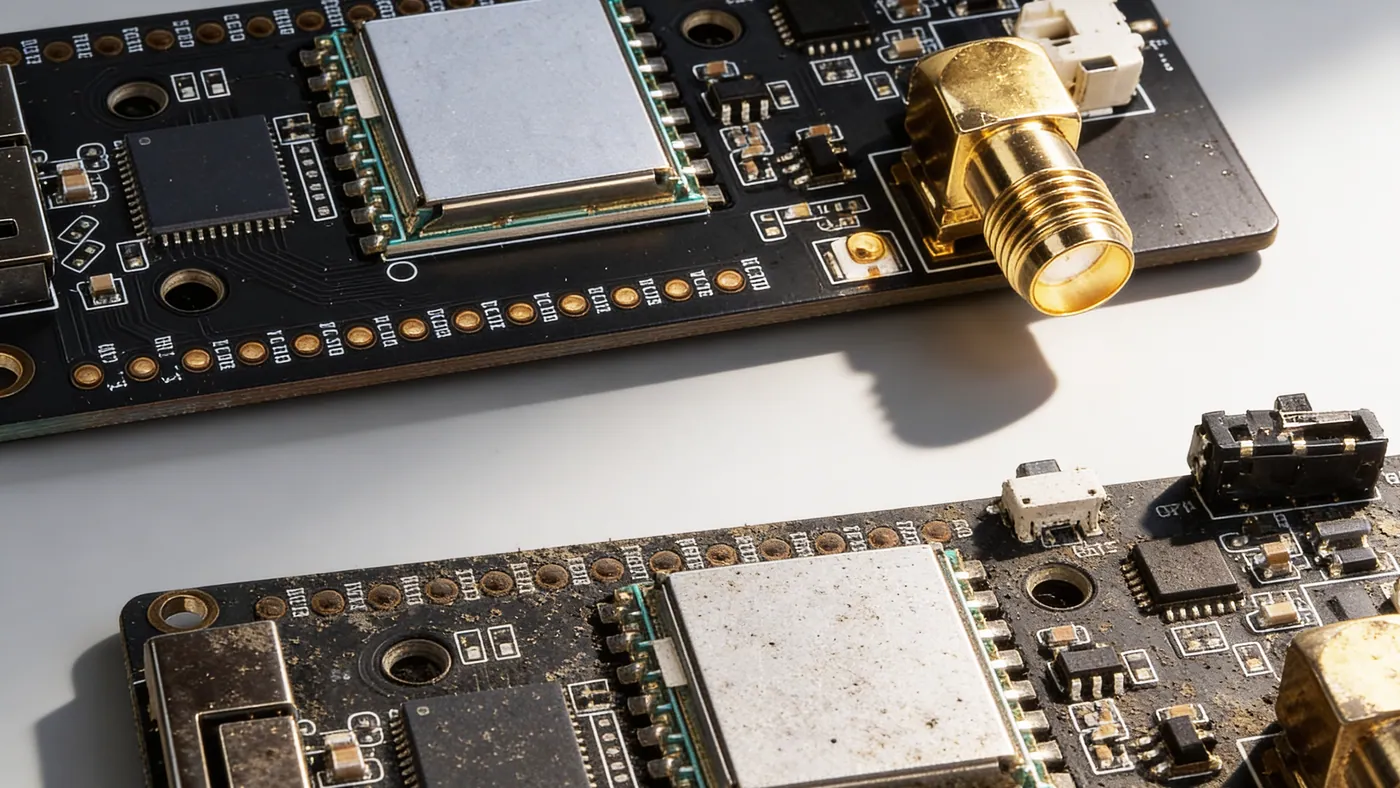
Radio-frequency hardware is mostly machined metal. Cavity filters, duplexers, combiners, waveguide sections, RF housings and antenna parts are milled from aluminium or brass, often plated with silver or gold, and assembled with tuning screws, resonators and covers. The current at these frequencies flows in a thin layer at the surface, so the surface is the component. A chip left in a cavity, a stain on the plating or a residue in a joint shows up as insertion loss, detuning, arcing at high power or passive intermodulation (PIM).
What must come off
| Soil | Source | RF effect |
|---|---|---|
| Chips and burr flakes | Milling of cavities, drilling of tuning-screw holes | Detuning, arcing, PIM when a loose particle touches a surface |
| Machining coolant | Milling | Film that stains plating and traps particles |
| Plating residue | Incomplete rinsing after plating | Stains, corrosion, poor contact at joints |
| Flux | Soldered connectors and resonators | Corrosive residue near joints |
| Fingerprints | Handling | Salts and oil that tarnish silver and corrode aluminium |
| Dust and fibres | Storage, assembly | Particles in cavities and waveguides |
Loose metal particles are the most serious. A particle that moves inside a filter cavity or waveguide can create an intermittent contact, which is a classic source of PIM, and it may not show up until the part is under vibration or temperature change in the field.
Gentle chemistry, no etching
The base material and the plating set the chemistry.
- Bare or chromate-converted aluminium: a light-alloy cleaner, usually mildly alkaline with inhibitors. Strong alkali etches aluminium grey within minutes, changes the surface and removes conversion coatings.
- Silver plating: a neutral cleaner rated for silver. Silver tarnishes in sulphur compounds and some cleaners attack it; test first.
- Gold plating: chemically stable, but often thin. Keep power and time moderate.
- Brass and copper parts: neutral or mildly alkaline; they tarnish in strong alkali and ammonia.
The cleaning liquids article has the full material list. Acidic products do not belong in an AISI 304 tank and are the wrong choice for plated RF parts anyway.
Settings
| Parameter | Setting |
|---|---|
| Frequency | 40 kHz; 80 kHz on the MT-75 for finely plated, small parts |
| Temperature | 45 to 55 °C for aluminium and plated parts |
| Time | 3 to 5 minutes; check, then extend only if needed |
| Rinse | Deionised water, twice, the first with ultrasound |
| Dry | Warm filtered air, 50 to 70 °C, until every cavity and hole is dry |
Loading matters because cavity parts trap air. A filter body lying cavities-up holds a pocket of air in each cavity at the start and a pool of liquid at the end. Put cavity parts on their side or at an angle so air can leave and liquid can drain, and rotate them half way through if the geometry demands it. See loading the basket and blind holes.
Where cleaning sits in the process
- After machining, before plating. Coolant and chips come off; plating on a clean surface adheres and is uniform. This is a machined-parts job with a light-alloy cleaner; see cleaning parts before coating.
- After plating, before assembly. A short, mild cycle to remove handling residue and any particles, followed by a deionised rinse and a thorough dry.
- After soldering of connectors or resonators. Flux comes off, with the settings in removing flux residues.
- Repair and refurbishment. Parts returning from the field carry dust, corrosion products and sometimes moisture. Strip them down first: gaskets and absorbers are replaced, not cleaned.
Drying waveguides and cavities
Water in a waveguide or a filter cavity changes the RF performance and leaves spots on the plating. Drain with the openings down, blow out with clean, dry, oil-free compressed air, then dry in warm air until the part is dry inside. Long waveguide sections dry from the inside out slowly; stand them vertically and give them time. A part that is cool to the touch after the dryer usually still has water somewhere, because evaporation takes heat out of it. The rinsing and drying article covers the methods.
What to leave out
Ferrites and absorber materials that are glued in, parts with paper labels, and populated modules with components that do not tolerate ultrasound. The precision electronics risk guide lists them. Connectors on RF parts follow the connector article.
Which machine
| Work | Set-up |
|---|---|
| Laboratory, repair, single filters and small housings | STS-150 (15 L, 330 × 300 mm) to STS-300 (30 L, 500 × 300 mm), 40 kHz |
| Machined RF housings in batches, before plating | UMX Pro 62L to 162L or ST-96 at 40 kHz with filtration, demineralised rinse, DT-96 dryer |
| Plated small parts, wash-rinse-dry in one frame | MT-75, 75 L, 40/80 kHz |
The electronics industry page collects the related articles.