Parts and contaminants · 4 min read · Updated 2026-09-30
Cleaning precision electronics without damage
Which electronic components tolerate ultrasound and which do not, and how frequency, power, time, support and a sample test keep a cleaning process safe.
Technical guide. Figures are taken from our own spec tables; for your process we confirm the settings with a cleaning trial.
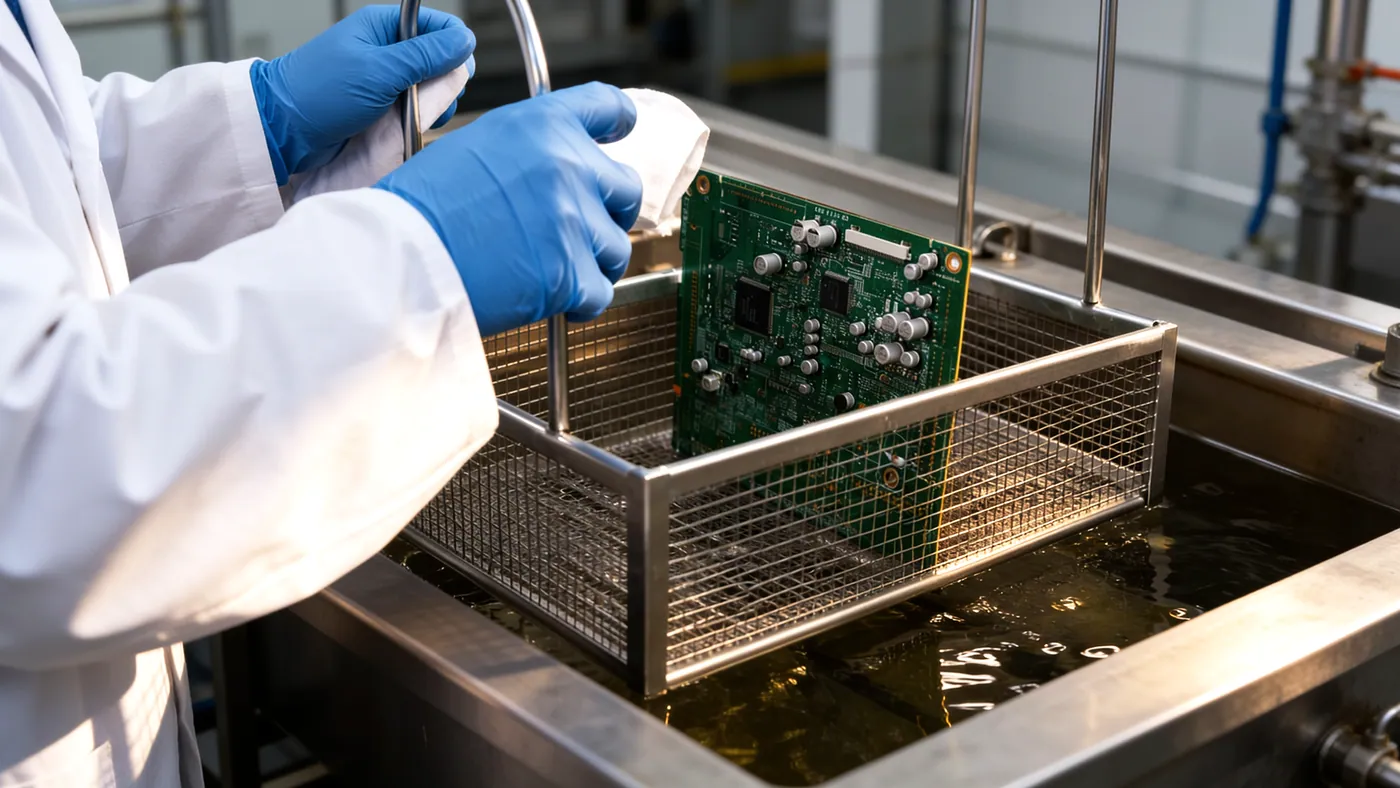
Cavitation is a mechanical process. Millions of bubbles collapse against every surface in the bath, which is why it cleans under a component that no brush can reach. The same energy reaches everything else on the part: a crystal, a suspended silicon beam, a relay contact, a bond wire. Most electronic components shrug it off. Some do not, and a few fail in ways that pass an electrical test on the day and fail in the field later. This guide sorts the components into groups and sets out the process controls that keep the risk low.
Components by risk
| Risk | Components | What happens |
|---|---|---|
| Usually tolerant | Resistors, ceramic capacitors, sealed ICs in moulded packages, diodes, transistors, fully sealed connectors, most solder joints | Nothing, with sensible settings |
| Check the data sheet | Electrolytic capacitors, inductors with ferrite cores, sealed crystals and oscillators, optocouplers, potentiometers with sealed housings, LEDs with soft lenses | Some makers allow ultrasonic cleaning with limits; some forbid it |
| Keep out of the bath | Tuning-fork crystals, MEMS accelerometers, gyroscopes and microphones, unsealed relays and switches, open trimmers, displays, buzzers and speakers, humidity and gas sensors, chip-on-board with exposed bond wires, anything marked "no ultrasonic" | Fracture, stiction, liquid ingress, broken bonds, damaged displays |
| Never | Batteries and cells, including coin cells | Short circuit, corrosion, fire risk |
Crystals and oscillators. A quartz crystal is a resonator. The tuning-fork crystals used for real-time clocks resonate at 32.768 kHz, close to the working frequencies of ultrasonic cleaners, and many data sheets forbid ultrasonic cleaning. Higher-frequency crystals are less exposed but not immune; follow the data sheet.
MEMS devices. Accelerometers, gyroscopes and microphones contain structures a few micrometres thick, suspended over the substrate. Ultrasound can drive them to resonance, crack them, or push them into contact with the substrate where they stick. Microphones and pressure sensors also have an open port that lets liquid in.
Relays and switches. An unsealed relay or switch fills with liquid and does not dry. Relays sold as wash-tight or sealed are designed for board washing; check the data sheet, and remove any vent tab only after cleaning, as the maker instructs.
Displays and labels. Liquid gets between the layers of a display. Paper labels come off, and some printed markings fade in alkaline cleaners.
The sensors article goes deeper into sensor types.
The process controls
Frequency. 40 kHz is the standard for electronics: the bubbles are smaller and each collapse carries less energy than at 28 kHz, which is kept for castings and heavy soil. The MT-75 runs at 40 and 80 kHz; the higher frequency is gentler still and reaches finer particles. See 28 or 40 kHz and particle size and frequency.
Sweep. A fixed frequency sets up standing waves with spots of high and low intensity. Sweep moves those spots continuously, so no component sits at a peak for the whole cycle. Use it wherever the generator offers it; see sweep and degas.
Power. Power density differs a lot between machines:
| Machine | Ultrasonic power | Volume | Power density |
|---|---|---|---|
| STS-030 | 120 W | 3 L | 40 W/L |
| STS-150 | 360 W | 15 L | 24 W/L |
| STS-300 | 600 W | 30 L | 20 W/L |
| UMX Pro 50L | 840 W | 50 L | about 17 W/L |
| MT-75 | 1200 W | 75 L | 16 W/L |
A small benchtop tank is intense by design. For delicate assemblies, use a machine with adjustable power, such as the UMX Pro, and run it reduced, or keep the cycle short in a benchtop unit. See power density.
Time. Damage from cavitation accumulates with time. Most electronics cleaning is done in 3 to 6 minutes; a process that needs 20 minutes has a chemistry or temperature problem, not a time problem. See how long to clean.
Temperature. 45 to 55 °C for boards, within the lowest limit on the bill of materials. Some component data sheets state a maximum temperature for cleaning; that figure, not the cleaner's, sets the bath temperature. See choosing the cleaning temperature.
Part support. Parts never lie on the tank floor: the floor is the radiating surface, and direct contact transmits vibration straight into the part. Use a basket, a rack or a beaker, with the parts not touching each other or the basket walls more than needed.
Qualify with a sample
For any new assembly, test before running a batch:
- Go through the bill of materials and mark every component in the "check" and "keep out" rows.
- Clean one sample assembly at the planned settings.
- Clean a second sample for three times the planned time. If it survives, the process has margin.
- Test both electrically and functionally; measure crystal frequency and sensor outputs where fitted.
- Inspect under a microscope for lifted labels, markings, cracked parts and residue.
- Store the settings as a programme so the qualified process is what runs every time.
Which machine
| Work | Set-up |
|---|---|
| Rework bench, small assemblies | STS-060 to STS-150, 40 kHz, short cycles, boards on a rack |
| Production, qualified programmes per assembly | UMX Pro 50L to 88L, 40 kHz, adjustable power, sweep and degas standard |
| Most delicate parts, finest particles | MT-75, 40/80 kHz, wash, rinse and dry in one frame |
The process for whole boards is in cleaning circuit boards after soldering. The electronics industry page collects the related articles.