
Parts and contaminants · 4 min read · Updated 2026-09-30
Cleaning sensors and microelectronic parts with ultrasound
Sensor housings, probes, optical windows and sensor elements before assembly: what ultrasound cleans well, and which sensor types must never go into the bath.
Technical guide. Figures are taken from our own spec tables; for your process we confirm the settings with a cleaning trial.
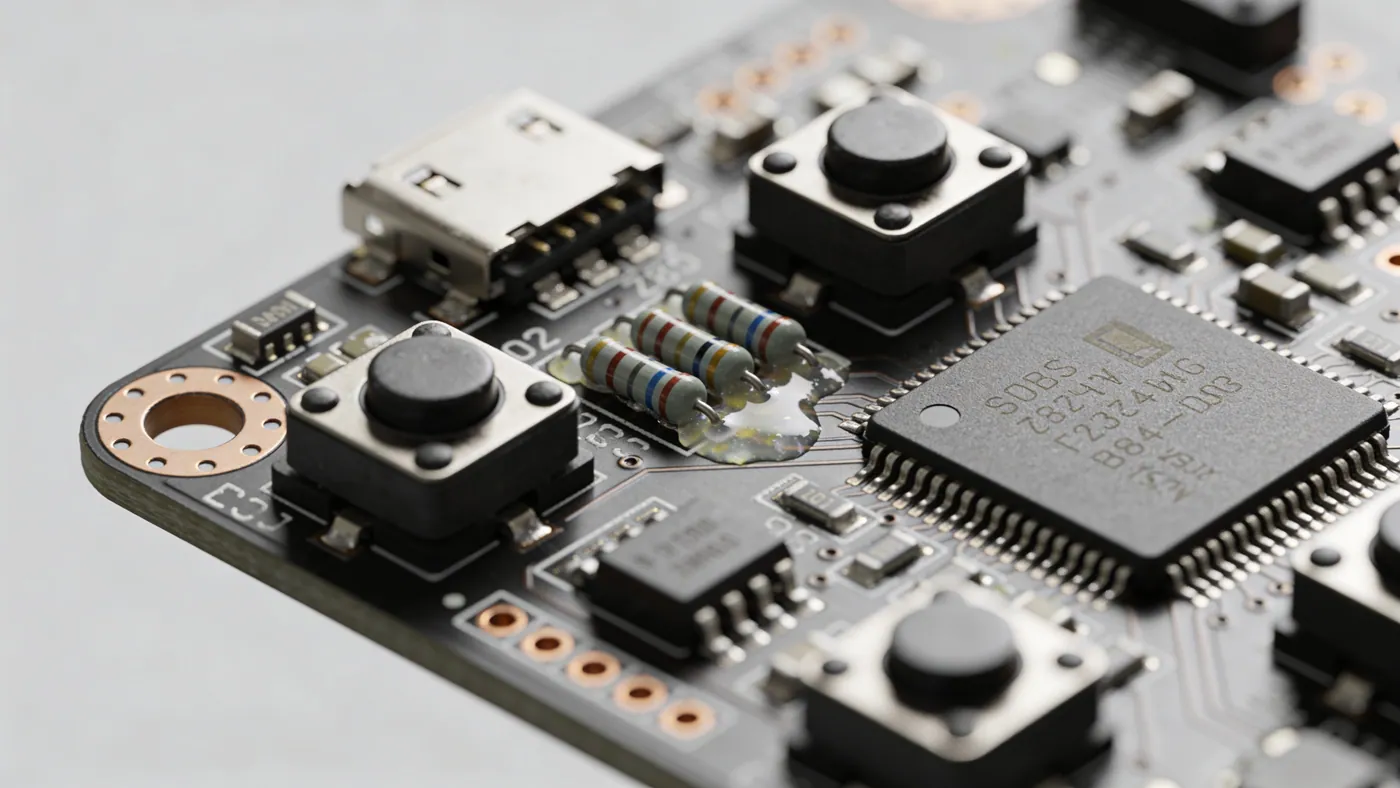
A sensor measures through a surface: a membrane, a window, a sheath or an electrode. Anything on that surface is part of the measurement. A film of oil on a pressure diaphragm shifts its response, a fingerprint on an optical window scatters light, a particle in a gap between electrodes changes a capacitance. Ultrasonic cleaning is a good way to get those surfaces clean before assembly. It is also a good way to destroy some sensors, so the first question is always which part it is.
Two groups: parts and working sensors
Sensor cleaning splits into two groups that need different answers.
Parts before the sensor exists: housings, sheaths, probe bodies, fittings, optical windows, lenses before mounting, electrode blanks, ceramic substrates, lead frames. These are metal, glass, ceramic or plastic parts, and they clean like other precision parts, with gentle settings.
Working sensors and populated sensor modules: these carry the sensing element, and whether they tolerate a bath depends on how that element is built. Many do not.
What can go in
| Part | Typical soil | Setting |
|---|---|---|
| Stainless steel probe sheaths and thermowells | Machining oil, particles, fingerprints | Mild alkaline cleaner, 50 to 60 °C, 40 kHz, 3 to 5 min |
| Machined aluminium or stainless sensor housings | Coolant, chips, burr flakes | As for CNC parts before assembly, then deionised rinse |
| Glass or sapphire windows, uncoated | Fingerprints, polishing residue, dust | Neutral cleaner or the maker's solvent in a beaker, room temperature to 40 °C, 1 to 3 min |
| Ceramic substrates before assembly | Particles, handling residue | Neutral cleaner, 40 kHz, short cycle, deionised rinse |
| Sealed, potted sensors (for example sheathed thermocouples and resistance thermometers) | Process residue after use | Chemistry compatible with the sheath and seal, short cycle; check the maker's instructions |
Optical parts with coatings (anti-reflection, filters, mirrors) are cleaned only with the method and chemistry that the coating maker approves. Some coatings are soft and lift under cavitation. Lenses that are cemented or glued into a mount are cleaned only if the adhesive is rated for the liquid and temperature.
For small parts and optics the indirect method is usually right: the parts sit in a beaker with their own liquid, the beaker stands in the water-filled tank. The main bath stays clean, a small volume of expensive liquid does the work, and a solvent never touches the heated tank.
What must never go in
These sensor types have open, moving or resonant structures, or openings that let the liquid into the element. Keep them out of the bath entirely.
| Sensor type | Why |
|---|---|
| MEMS accelerometers and gyroscopes | Suspended silicon structures can be excited to resonance, fracture or stick to the substrate |
| MEMS microphones | Open sound port; the membrane is micrometres thick |
| Pressure sensors with an open port or gel-filled cavity | Liquid in the cavity, damage to the diaphragm or gel |
| Humidity and gas sensors | Open sensing layers and membranes; the liquid poisons or shifts the element |
| Sensors with a vent membrane | The membrane leaks when wetted under cavitation |
| Quartz resonators and tuning-fork crystals | The resonant structure can be excited and break; many data sheets forbid ultrasonic cleaning |
| Unencapsulated chips with bond wires | Cavitation can fatigue fine bond wires |
| Any part the maker marks "no ultrasonic cleaning" | The marking is the answer |
The precision electronics risk guide covers these limits in more detail, including how to qualify a part that is not listed. If such a sensor sits on a board that needs cleaning, it is fitted after cleaning, masked, or the board is cleaned by hand.
Settings for sensor parts
- Frequency: 40 kHz, or 80 kHz on the MT-75 for the most delicate parts and the finest particles; see particle size and frequency.
- Power: reduced where the machine allows it. A small benchtop tank has a high power density by design; keep cycles short.
- Temperature: room temperature to 55 °C, below the limit of any plastic or adhesive in the part.
- Time: 1 to 5 minutes. Check the result, then extend if needed.
- Support: parts held in a basket, beaker or fixture, never lying on the tank floor, not touching each other.
- Rinse: deionised water. Ionic residue on a sensor element can shift readings and corrode electrodes.
- Dry: warm filtered air, parts oriented so every cavity drains; see rinsing and drying.
Cleanliness that matters for sensors
For optical parts, the check is visual: a dark-field lamp or a microscope shows films and particles. For sensor housings and probe parts that go into an assembly, the particle limits come from the product specification and are tested as for other components; see cleaning electronic parts before assembly. Clean parts go straight into covered trays and are handled with gloves.
Which machine
| Work | Set-up |
|---|---|
| Optics, windows and small sensor parts | STS-030 (3 L) to STS-090 (9 L), 40 kHz, beakers in the indirect method |
| Probe sheaths, housings, batch work | STS-150 to STS-300 or UMX Pro 50L at 40 kHz, deionised rinse, warm-air drying |
| Precision parts, wash-rinse-dry in one frame | MT-75, 75 L, 40/80 kHz |
The electronics industry page collects the related articles.