
Parts and contaminants · 3 min read · Updated 2026-09-25
Removing flux residues from circuit boards and assemblies
Flux left after soldering attracts moisture, corrodes joints and leaks current between tracks. Which flux types need cleaning, the 40 kHz bath that removes them without harming components, what to keep out of the tank, and how to prove the board is clean.
Technical guide. Figures are taken from our own spec tables; for your process we confirm the settings with a cleaning trial.
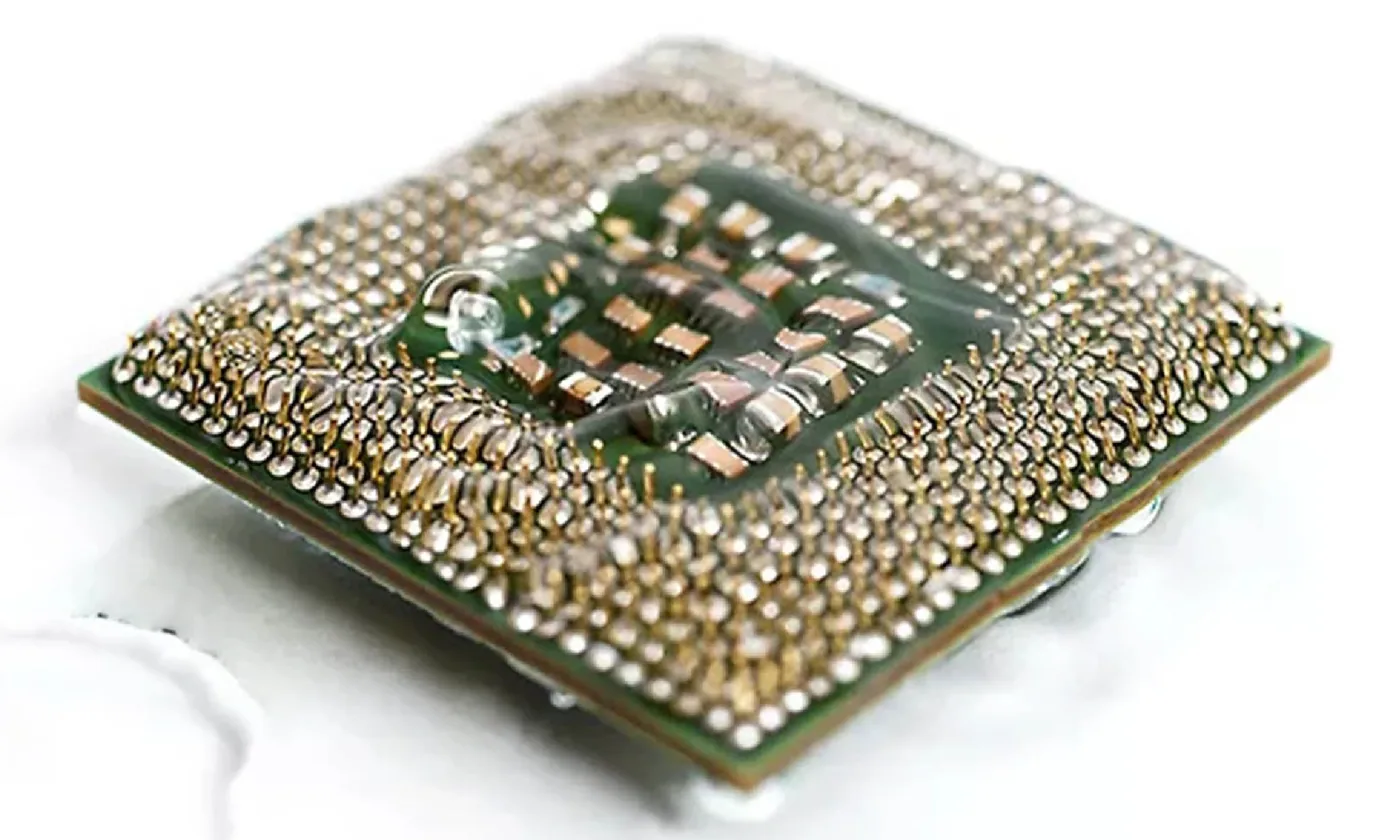
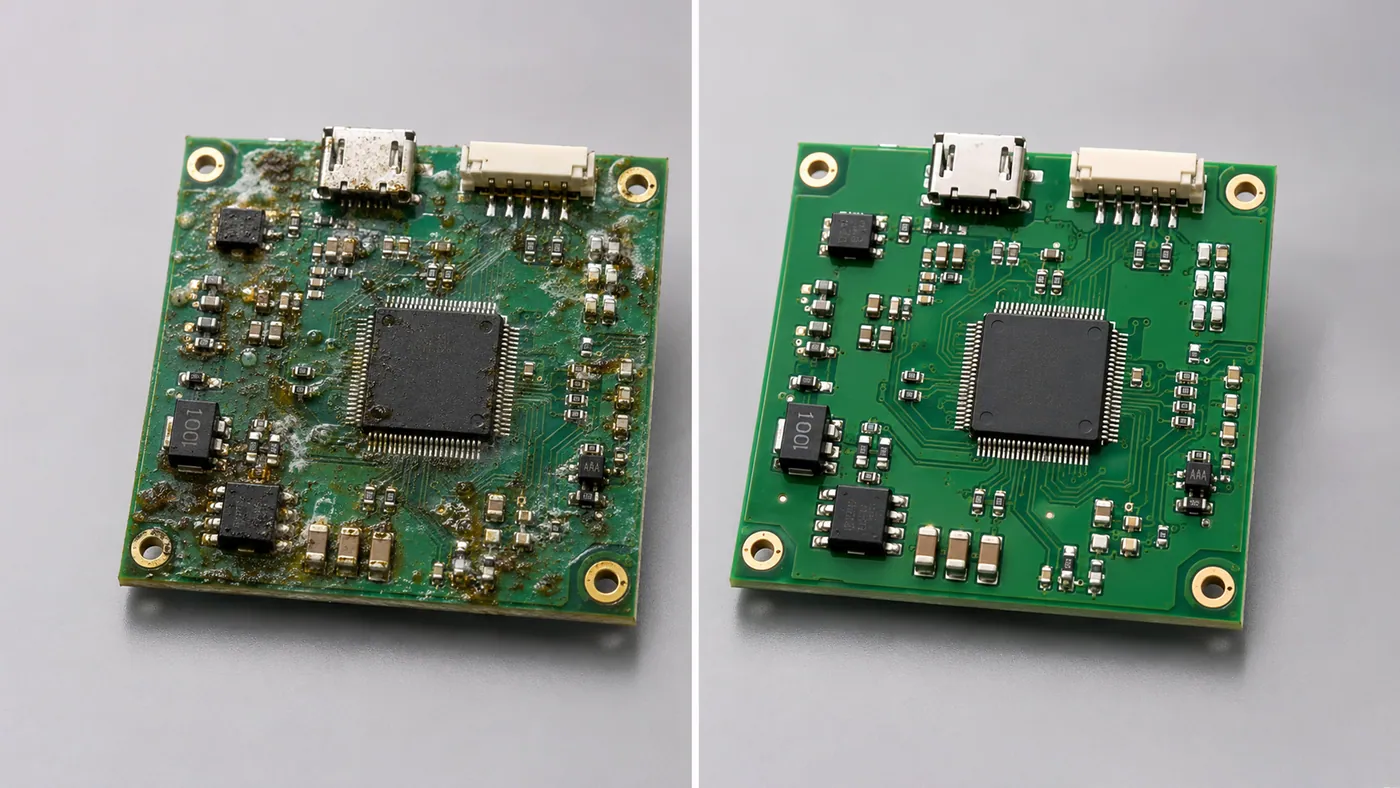
Flux does its work during soldering and is a liability afterwards. Rosin residues are sticky and trap dust; water-soluble fluxes are hygroscopic and, if left on, conduct between tracks once the air is humid; the activators in both are mildly corrosive over months. For consumer electronics "no-clean" flux is often left on. For automotive, aerospace, medical and industrial controls, and before conformal coating, it comes off.
Which fluxes, which cleaner
| Flux | Residue | Cleaner | Notes |
|---|---|---|---|
| Rosin (RA, RMA) | hard, amber, sticky | alkaline saponifier at 3 to 10 %, or an engineered aqueous flux remover | saponifier turns rosin into a water-soluble soap |
| Water-soluble (OA) | white, hygroscopic, ionic | hot deionised water, sometimes with a mild surfactant | the easiest to clean and the most important to clean |
| No-clean | thin, glassy, low-solids | engineered flux remover for no-clean | harder to dissolve than rosin; plain water does little |
| Lead-free process residues | as above, more tenacious | as above, hotter and longer | higher soldering temperatures polymerise the residue |
Solvents (IPA, modified alcohols) also dissolve flux, but they are not used in an open heated ultrasonic tank; see safety. A cold beaker of IPA in the indirect method is the workshop compromise for single boards.
The bath
Frequency. 40 kHz. The smaller bubbles reach under components with 0.1 mm stand-off and do not shake solder joints. 28 kHz is not used on populated boards.
Temperature. 45 to 55 °C. Warm enough for the saponifier, cool enough for electrolytic capacitors, crystals and LCDs. Check component data sheets; some quote an ultrasonic cleaning limit.
Time. 3 to 6 minutes. Longer cycles do not clean better and risk the components.
Power density. Moderate. The UMX Pro series at 12 to 16 W per litre with adjustable power and sweep suits boards; the high densities of a small benchtop unit are acceptable for short cycles.
Sweep on. Without it, a standing wave can hold a crystal or a fine wire at an antinode for the whole cycle.
Rinse. Two stages: warm deionised water with ultrasound to flush the saponified residue from under components, then a clean deionised rinse. Tap water is not used at any stage; its ions are the contamination you are removing.
Dry. Warm air at 50 to 60 °C in a DT dryer or a drying cabinet until the board is dry under the components, 15 to 30 minutes. Compressed air alone leaves water under large parts.
What can go wrong
- Components with cavities: relays, some crystals, unsealed switches, trimmers. Water gets in and stays. Mask, clean before fitting, or clean by hand.
- Ultrasonic-sensitive parts: some quartz crystals and MEMS devices carry a "no ultrasonic" marking. Respect it; the resonant structure can fracture.
- Labels and markings: rosin saponifiers lift some inks and paper labels. Test one board.
- White residue after drying: saponified rosin not rinsed, or hard water. Better rinse, deionised water.
- Bath saturated: a saponifier bath is spent after a few dozen boards per litre; a cloudy bath redeposits. Titrate and change.
Proving it is clean
For regulated work, the standard measures are resistivity of solvent extract (ROSE testing) for a quick overall figure and ion chromatography for a per-ion result. For everyone else, a board under a UV lamp shows rosin as a fluorescent haze, and a 10× loupe under the components shows what the rinse missed. Repeatable cleanliness comes from a written programme on the machine: the UMX Pro stores time, temperature and power per board family so the second shift runs what the first shift qualified.
Which machine
Repair benches and prototype shops: an STS-060 to STS-150 at 40 kHz, with a board rack that stands the boards on edge. Production and coating lines: a UMX Pro 50L to 88L with programmes and the filtration module, a deionised rinse tank and a DT dryer. The electronics industry page collects the related articles.