
Parts and contaminants · 9 min read · Updated 2026-11-16
Removing drawing and stamping oils from stamped parts
Degreasing stamped parts in bulk: why flat parts nest and overload the bath, how to work out the oil load, and the loading, filtration, rinse and drying.
Technical guide. Figures are taken from our own spec tables; for your process we confirm the settings with a cleaning trial.
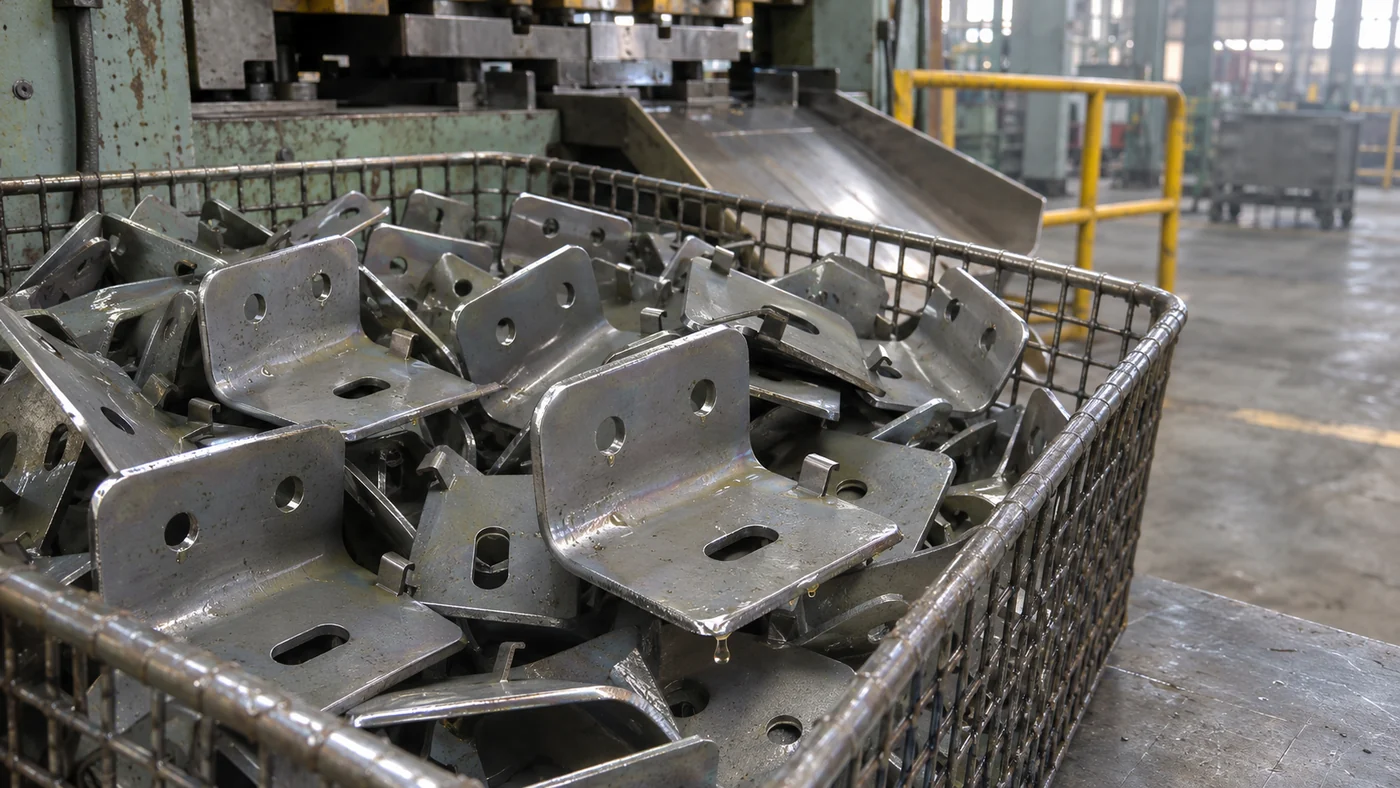
A press line delivers parts that are not dirty but wet. Stamping and drawing oil sits on both faces, in every bend and in the burr zone, and the parts arrive in a bin by the thousand. Before welding, painting, plating or assembly that film must go, from thousands of parts a day, without the bath turning into an oil emulsion by Wednesday. The general chemistry is in removing oil and grease; this article deals with what is special about stamped parts: high oil carry-in, flat parts that nest, and bulk loading.
How do you degrease stamped parts in bulk? Drain them at the press, work out the daily oil load, and take that oil out continuously with an oil skimmer and a demulsifying alkaline cleaner at 55 to 65 °C
Which forming lubricants are on stamped parts?
Stamped parts carry one of four groups of forming lubricant: vanishing oils, neat stamping and drawing oils, water-miscible lubricants, and drawing compounds. The group sets the bath. A light vanishing-oil film starts at 3 to 5 minutes, while a drawing compound starts at 60 to 70 °C
- Vanishing oils. Thin oils for light-gauge blanking. Much of the carrier evaporates and leaves a light film. The easiest case.
- Neat stamping and drawing oils. Mineral or synthetic oils, often with extreme-pressure (EP) additives for heavy forming. A full, sticky film that does not evaporate.
- Water-miscible lubricants. Emulsions and synthetics. A thinner oil film, often with residue from the additive package.
- Drawing compounds and pastes. High viscosity, sometimes with solid fillers, for deep drawing.
The group matters more than the brand. Ask your lubricant supplier for the safety data sheet and check whether the oil contains chlorinated EP additives. Chloride attacks an AISI 304 tank, so we need to know before we propose the tank material; for chloride-bearing chemistry we quote a 316L tank (see tank material and wall thickness).
Why do stamped parts use up a degreasing bath so fast?
Stamped parts use up a degreasing bath fast because each part carries its whole forming film. An alkaline bath holds only a few grams of oil per litre: a 225-litre bath at 3 g
Above that limit the bath lays oil back on the parts, as the filtration and bath life article explains. So the first number to work out is the oil you bring in each day (how to weigh it: see the questions below). An example to replace with your own figures:
| Oil balance | Example |
|---|---|
| Parts per day | 3,000 |
| Oil carried in per part | 0.2 g |
| Oil into the bath per day | 600 g |
| Oil a 225 L |
about 700 g |
Source: Sonixtek guide "Removing oil and grease", example re-based to 3,000 parts.
With an oil skimmer and a cleaner that lets oil separate, the same bath lasts weeks. Laminar flow on the SF series and the AL series helps further: the return flow sweeps floating oil across the surface to the overflow and the skimmer, so parts come out through clean liquid (see laminar flow in an ultrasonic tank).
Two more things make stamped parts hard. Flat parts nest: two oily blanks face to face stick together by the oil film between them, and come out with an oily patch where they touched. Bulk loading shadows: in a heap, the outside comes out clean while the centre still carries oil.
Before the tank
- Let the parts drain. A drip tray or a draining rack at the press takes off the free oil, and every gram that drips there stays out of the bath.
- Do not feed dripping parts straight into the ultrasonic tank. If the parts arrive wet with neat oil, a pre-wash tank takes the bulk off first.
- Keep lubricant groups apart if you can. Vanishing oil and a filled drawing compound do not need the same bath.
Which cleaner, temperature and time remove stamping oil?
Neat stamping and drawing oil comes off steel stampings in an alkaline degreaser at 3 to 5 %, 55 to 65 °C
| Lubricant | Cleaner | Temperature | Frequency | Starting time |
|---|---|---|---|---|
| Vanishing oil, light film | alkaline degreaser, 2 to 3 % | 55 to 65 °C |
28 or 40 kHz | 3 to 5 min |
| Neat stamping or drawing oil | alkaline degreaser, 3 to 5 % | 55 to 65 °C |
28 kHz | 8 to 15 min |
| Drawing compound, paste | alkaline degreaser, 3 to 5 % | 60 to 70 °C |
28 kHz | 10 to 20 min, pre-soak first |
| Aluminium, brass, thin or decorative parts | cleaner rated for the metal, inhibited | lower, per the cleaner's data sheet | 40 kHz | as short as the result allows |
Source: Sonixtek guides "Removing oil and grease" and "Cleaning liquids".
These are starting values; the cleaner's data sheet decides. Check the first baskets and adjust. A demulsifying cleaner works with the skimmer and keeps the bath's capacity free. Degas for five to ten minutes after every fresh fill.
How do you load flat stamped parts so they do not stick together?
Flat stamped parts stand on edge in a rack, with gaps, so no oil film holds two blanks together. Small stampings go in a fine-mesh insert in a shallow layer, filling at most about a third of the working volume. Steel stampings often reach the weight limit first, such as 125 kg
- On edge, with gaps, both faces of a blank see the sound field.
- Deep-drawn cups go in tilted or on their side. A cup with its open side down traps air; a cup with its open side up holds a pool of dirty liquid.
- Floor area: the parts cover no more than about two thirds of the basket floor.
More on racks and inserts is in loading the basket.
The lift on the AL series moves the basket up and down during the cycle. That shifts parts against each other, opens contact points and flushes loosened oil away, so dense loads clean better on a lift than in a static basket. Basket loads run from 75 kg
How are stamped parts rinsed and dried before painting or plating?
Stamped parts for painting or plating are rinsed in warm water at 40 to 60 °C
The rinse matters more on stamped parts than on most others, because flat faces and folds carry cleaning solution out of the bath.
- Add an inhibitor to the last rinse if steel parts will wait before the next step.
- Dry at once with hot air, for example in a hot-air drying tank from the DT series, which dries at 30 to 100 °C
(86 to 212 °F) . Parts on edge in a rack dry faster than parts lying flat. - Check with a water-break test (see the questions below).
The rinsing and drying guide covers rinse water quality in more detail. Why parts must not wait wet is explained in preventing water spots and flash rust after washing.
Which machine suits bulk degreasing of stamped parts?
For daily bulk degreasing, an SF-225 or SF-360 from the SF series takes oil out continuously with its pump, oil skimmer and laminar flow. For many heavy baskets per shift, the AL-150 or AL-300 adds lift agitation and oil separation. The line then runs clean, rinse, dry: a rinse tank and a hot-air dryer from the DT series follow the cleaner.
| Work | Machine | Bath | Basket load |
|---|---|---|---|
| Few baskets a day | ST series | 40 to 400 L |
75 to 150 kg |
| Daily bulk | SF-225 | 225 L |
200 kg |
| Daily bulk | SF-360 | 360 L |
200 kg |
| Heavy, every shift | AL-150 | 150 L |
125 kg |
| Heavy, every shift | AL-300 | 300 L |
200 kg |
Source: Sonixtek product data, Nov 2026.
The SF series has its buffer tank, filtration pump, oil skimmer and laminar flow built in; the AL series has lift, agitation, filtration and oil separation as standard. An ST series tank has no filtration loop, so its bath is changed more often.
More forming and production topics are on the manufacturing page.
Frequently asked questions
How do I measure the oil load of my stamped parts?
Weigh ten parts as they leave the press, clean them, and weigh them again. The difference divided by ten is the oil per part. Multiply it by the parts per day to get the oil that goes into the bath each day.
Do chlorinated EP additives matter for the tank?
They can. Chloride attacks an AISI 304 tank. Check the lubricant's safety data sheet for chlorinated EP additives and send the data sheet with your enquiry. For chloride-bearing chemistry we quote a 316L tank instead of the standard AISI 304.
What does a demulsifying cleaner do?
A demulsifying cleaner lets the oil separate from the bath instead of holding it in an emulsion. The oil floats up, the skimmer takes it off, and the bath keeps its capacity of a few grams of oil per litre for the next parts.
How do I check that a stamped part is free of oil?
Use a water-break test. Rinse the part in clean water and watch it drain. Water forms an even sheet on a degreased surface and breaks into droplets on an oily one. Paint and plating lines use the same test.
What to send us for a quote
- The lubricant: product name or type, and the safety data sheet.
- Oil per part, from the weighing above, and parts per day.
- Material, thickness and size of the largest and smallest part, and how they are delivered (bin, layer, rack).
- What comes next: welding, painting, plating, assembly or storage.
- The mains supply and the space at the planned spot.
Send this through the quote form. Our technical team works out the oil balance with you and proposes tank, filtration, rinse and dryer.