
Choosing a machine · 3 min read · Updated 2026-09-25
Tank material and wall thickness
Our tanks are AISI 304 stainless steel, 2 mm on the ST and SF series and 2.5 mm from the AL-600 upwards. Why that grade, why those thicknesses, what cavitation does to a tank floor over the years, and when AISI 316 is worth specifying.
Technical guide. Figures are taken from our own spec tables; for your process we confirm the settings with a cleaning trial.
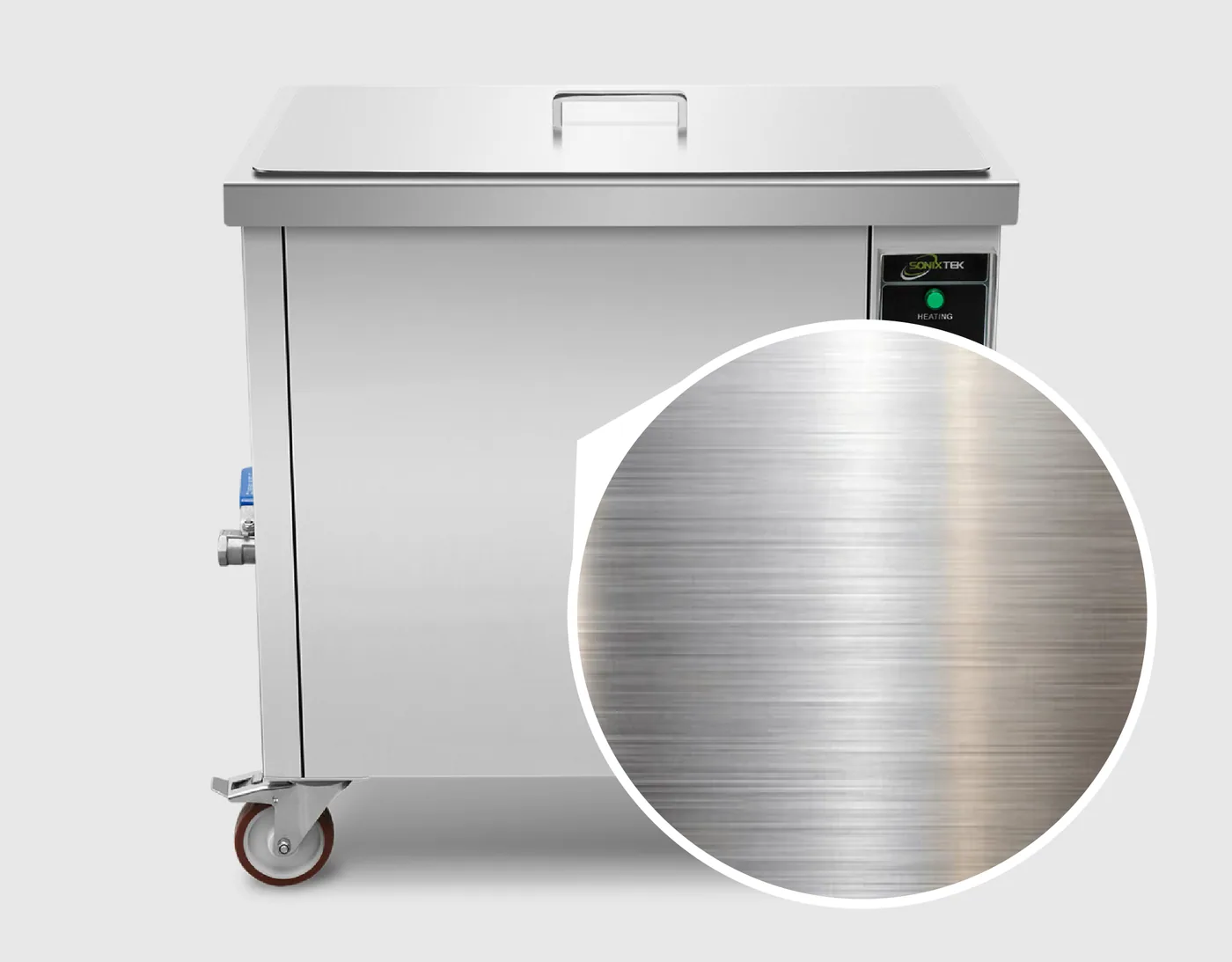
The tank is the part of an ultrasonic cleaner that works hardest and gets the least attention in a specification. It carries the liquid, it is the radiating surface for the transducers bonded beneath it, and it is attacked from inside by the very cavitation it produces.
AISI 304 as standard
All our tanks are welded from AISI 304 (1.4301) austenitic stainless steel. The grade is chosen because it:
- resists the neutral and alkaline aqueous cleaners that do most industrial cleaning, at the 40 to 80 °C those baths run at;
- welds cleanly, so seams can be ground flush and the inside of the tank has no crevices where soil and chloride can collect;
- transmits ultrasound well: its acoustic impedance is close enough to that of the transducer horn that most of the energy goes into the liquid rather than being reflected at the joint;
- is non-magnetic, so it does not hold swarf against the walls.
Its limit is chloride. Cleaners containing chlorides, tap water with high chloride at high temperature, and above all acidic descaling or de-rusting baths cause pitting in 304 that starts under deposits on the floor and grows through the wall. For those chemistries we build the tank in AISI 316 (1.4401), whose molybdenum content raises the pitting resistance markedly, or the chemistry is kept in an insert tank, as described in the direct and indirect cleaning article.
Wall thickness
| Series | Wall | Reason |
|---|---|---|
| ST, SF, UMX Pro, AL-75 to AL-400, DT, SPR | 2 mm | stiff enough across a 600 mm floor, thin enough to radiate |
| AL-600 and larger, AU-400 and larger | 2.5 mm | floor spans over a metre and basket loads to 2000 kg |
The thickness is a compromise. A thinner floor radiates the transducers' motion into the liquid more efficiently; a thicker floor spans a larger area without flexing under the load and the head of liquid, and it has more material to lose to erosion before it leaks. The step to 2.5 mm at 600 litres follows the span and the load, not the volume as such.
Cavitation erosion
The same collapsing bubbles that clean the part strike the tank floor. Over thousands of hours they roughen the floor above each transducer into a matt grey patch, then a shallow dish, and eventually a pinhole. How fast depends on power density, on how often the tank runs empty of parts (an empty tank puts all the energy into its own walls), on the liquid (plain water erodes faster than water with a surfactant) and on temperature.
Three habits extend the life of a floor by years:
- Never run the ultrasound with the tank empty or the liquid below the minimum mark.
- Keep a basket in the tank; the load absorbs energy that would otherwise hit the floor.
- Do not let hard parts rest on the floor. A part rattling on a bare floor scars it far faster than cavitation does; our baskets stand on rails or feet for that reason.
A floor that has worn through can be re-plated or replaced with the transducers re-bonded; it is a workshop job, not a reason to scrap the machine.
The tank lid
The diamond-shaped lid on the AL, AU and DT series is more than a cover: its ridge drains condensate back into the tank instead of onto the floor, and it cuts evaporation, which is the main heat loss from a hot bath and the main source of the smell in the room.
Specifying
State the cleaning chemistry in the enquiry. Alkaline, neutral or enzymatic aqueous cleaners at up to 80 °C: 304 as standard. Acidic, chloride-bearing, or unknown: say so, and we quote 316 or an insert tank. The what we need for a quote article lists the rest.