
Parts and contaminants · 8 min read · Updated 2026-11-16
Cleaning small turned parts in bulk
Turned parts in bulk: mesh and layer depth, blind holes, agitation without contact marks, rinsing the batch centre and hot-air drying the load.
Technical guide. Figures are taken from our own spec tables; for your process we confirm the settings with a cleaning trial.
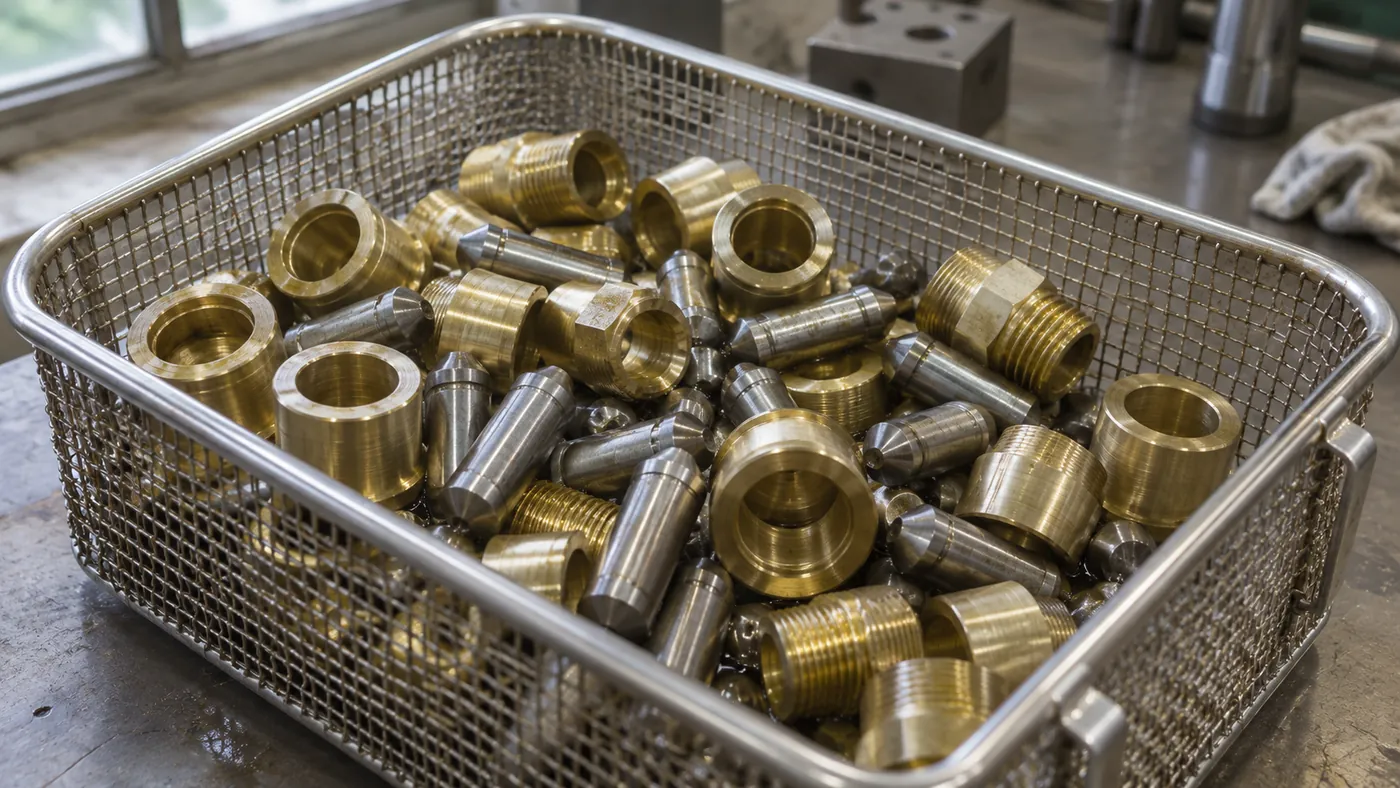
Small turned parts come off the lathe by the thousand, so they go into the basket as a heap. The top of the heap comes out clean. The centre comes out with coolant in the bores and an oily ring where two sleeves sat inside each other. A lathe leaves a film on the round faces and chips in the bore, and both need sound and fresh liquid to reach them.
How do you clean small turned parts in bulk? Spread them in a shallow layer in a fine-mesh insert, blind holes tilted 30 to 45° upward. Move the basket, rinse through the layer and dry with hot air. On the AL-75 ultrasonic cleaner with lift (75 L
How many turned parts go into one load?
The sound field sets the number of turned parts per load, not the 75 kg
Two limits apply, and the lower one wins. The weight rating covers the basket, the rails and the lift. With small parts the sound limit comes much earlier: a heap absorbs the energy in its outer layer, the centre stays dirty and a longer cycle does not help. If one cycle must hold more parts, add a second layer on a spacer or a second insert, not a deeper heap.
| Loading rule | Figure |
|---|---|
| Standard basket mesh or bar grid | 5 to 10 mm |
| Load per batch | ≤ about 1/3 of the working volume, ≤ about 2/3 of the floor area |
| Liquid above the parts | 30 to 50 mm |
| Clearance above the tank floor | 10 to 30 mm |
| Blind holes | tilted 30 to 45°, opening upward or sideways |
| Particle filter on the circulation loop | 10 to 25 µm |
Source: Sonixtek guides "Loading the basket" and "Removing machining swarf and coolant", read 16 Nov 2026.
Separate parts by material and geometry. Brass and steel may need different cleaners or inhibitors; take both from the cleaner's data sheet. Thin-walled sleeves that slide into each other need a different trial from solid pins. Record the accepted batch with a photo, the layer depth and the batch mass, so the next shift repeats it. The loading guide covers shadowing and layout.
Which mesh suits small turned parts?
Our standard baskets use 5 to 10 mm
Check the smallest diameter, the shortest length and any feature that can catch: a pin standing on end in a mesh opening, a thread crest hooked on the wire, a sleeve that clips over it. A caught part does not move, and its trapped side is not exposed. Remove loose swarf before washing. A fine insert also holds chips, which return on the next batch. Rinse and inspect the empty insert after every unload.
For the smallest parts, the indirect method often works better. The parts sit in a beaker with their own liquid, and the beaker hangs in the water-filled tank. Cavitation inside the beaker is somewhat weaker, but a small batch stays together and the main bath stays clean. See direct and indirect cleaning.
Does basket agitation help a dense load of small parts?
Basket agitation helps a correct load but does not rescue an overfilled one. The lift on the AL-75 moves the basket up and down, carries loosened soil away and lets fresh liquid and trapped air pass through the layer. Parts lying on or inside each other stay shielded. For finished surfaces and fine threads, run at 40 kHz.
Ultrasound makes loose parts vibrate. Two ground diameters rubbing for a whole cycle leave marks, and a polished shoulder that knocks against its neighbour is a rejected part even when it is clean. Trial the movement with the real insert and parts, then inspect shoulders, sealing diameters and thread crests under good light. If marks appear, reduce the layer, add dividers or move to a carrier with one part per position.
Without a lift, lower the basket slowly, or lower and lift it once before the cycle, so trapped air escapes. If the tops are clean and the undersides are not, turn the parts once mid-cycle. For heavy chips on steel, 28 kHz is the usual choice; the AL-75 is listed with either.
How should turned parts with bores and blind holes be loaded?
Load turned parts with blind holes tilted, openings about 30 to 45° upward or sideways, so air rises out and liquid under 30 to 50 mm
After lifting, tip the insert so liquid and loosened chips drain from the bores. Cross-drillings and internal threads hold coolant longest. A part with a deep blind hole may need a tilted insert or a fixture instead of a loose layer; see threaded parts and blind holes.
Fine chips stay in suspension and land back on the next batch. A particle filter of 10 to 25 µm on a circulation loop, with a magnetic separator for ferrous fines, keeps them out of the bath; on ST and AL tanks it is an add-on. Machining residue is covered in removing swarf and coolant.
How do you rinse and dry a bulk batch of small parts?
Rinse a bulk batch of small parts in warm, clean water and let the insert drain over each tank. Then dry with hot air. The DT-96 hot-air dryer (96 L
A packed centre keeps cleaner even when the outside rinses clear. An ultrasonic rinse flushes the film out of blind holes and threads, which a still dip does not. Rinse water at 40 to 60 °C
Sleeves and cups landing open side up carry water into the dryer. Spread the layer, and turn parts with pockets at half time. Bare steel left wet in warm air can flash-rust within an hour, so the dryer stands next to the rinse.
| Model | Volume (L) | Basket L × W × H (mm) | Max. load (kg) | Freq. / temp. |
|---|---|---|---|---|
| AL-75 | 75 |
– | 75 |
28 or 40 kHz |
| ST-96 | 96 |
580 × |
100 |
– |
| DT-96 | 96 |
580 × |
– | 30 to 100 °C |
Source: Sonixtek products.json and live product pages, read 16 Nov 2026; only figures on which both agree.
The DT-96 is built to match the ST-96, so an insert in that basket goes from wash to dryer without repacking. The AL-75 platform has a different format; check the transfer to the dryer before ordering. Compare the AL lift range, the DT drying tanks and, for small occasional batches, the UMX Pro compact cleaners. The CNC parts guide and the manufacturing page cover the step before assembly.
Frequently asked questions
Can small parts lie loose in the main basket?
No. Pins, fasteners and small sleeves go in a fine-mesh insert or a perforated beaker, in a shallow layer. Loose in a 5 to 10 mm
Can brass and steel parts be washed together?
Only if the cleaner suits both. Take the chemistry and any inhibitor for each material from the cleaner's data sheet. Keep separate batches when finishes or corrosion protection differ; a mixed batch also has to be sorted afterwards.
Should I use the finest mesh available?
No. A fine mesh scatters more sound than a coarse one and holds chips and water. Use the coarsest insert that still retains the smallest part, inside a standard 5 to 10 mm
Where should the inspection sample come from?
From the centre of the layer and from parts with blind holes, not from the top. If centre parts come out less clean than edge parts, the load is too dense. Check cleanliness, contact marks and dryness separately, after the parts have cooled.
What to send us for a quote
- Drawings or photos of the smallest and largest part: diameter, length, bores, blind holes and threads.
- Material and finish, and which surfaces must not show contact marks.
- The coolant or oil, with its data sheet, and how much swarf comes with the parts.
- Parts per day and per batch, and how they arrive (bin, tray, bag).
- What comes next: assembly, coating, plating or storage, and how cleanliness and dryness are checked.
Send this through the quote form. Our technical team proposes the insert, the layer and the wash, rinse and dry stations, and checks the transfer between them.