
Process and parameters · 8 min read · Updated 2026-11-16
Prevent water spots and flash rust after washing
Water spots and flash rust have different causes. Control rinse minerals, wet waiting time and humidity, then check drying and storage together.
Technical guide. Figures are taken from our own spec tables; for your process we confirm the settings with a cleaning trial.
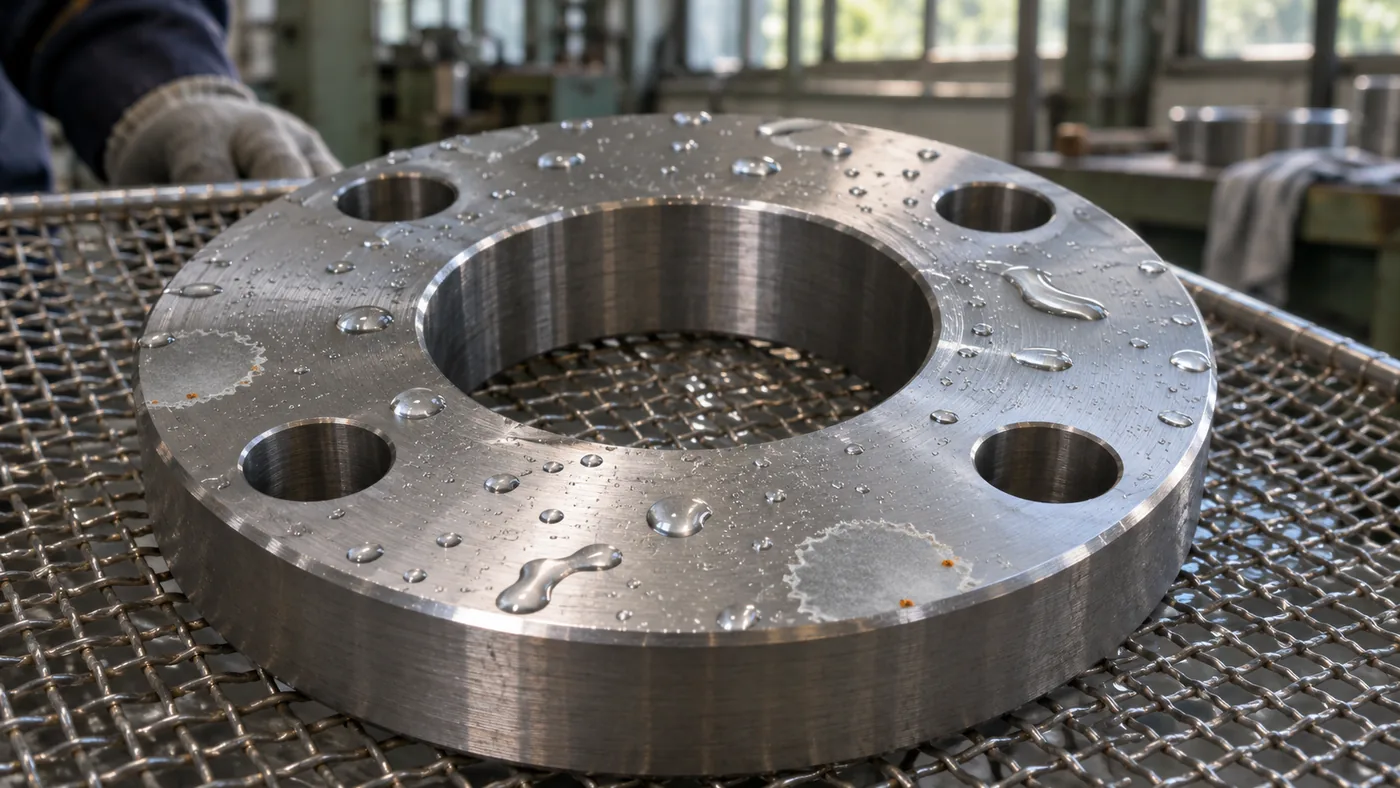
A white ring on aluminium and an orange bloom on steel may appear at the same place in the process, but they ask for different corrections. The ring can be material left behind as water evaporates. The orange bloom is corrosion while the surface remains wet. A hotter or longer drying cycle does not automatically solve either problem.
The rinse and drying guide explains the basic sequence. Here we connect water quality, transfer time and humidity to the defect that actually appears, so that parts stay acceptable through cooling, inspection and storage.
How do you prevent water spots and flash rust after washing? Water spots are prevented at the final rinse: limit carry-over and use demineralised water below about 20 µS/cm where the finish demands it. Flash rust is prevented by moving bare steel into a hot-air dryer within minutes, then cooling and packing the dry parts under controlled conditions.
Is the mark a water spot or flash rust?
A water spot is residue: dissolved minerals or carried-over detergent that stay behind when a droplet evaporates, often seen as a white ring on aluminium. Flash rust is corrosion of bare steel that stays wet in air. Moving the dryer setting to the top of its 30 to 100 °C
Dissolved minerals do not evaporate with the rinse water. When a droplet shrinks, its non-volatile content becomes concentrated and remains on the surface. Detergent carried from the wash can leave a similar-looking film. Drying faster may change the shape of the mark without removing its source.
Flash rust requires a susceptible metal, water and oxygen. Time matters, as do the rinse chemistry, surface condition and environment. Bare steel that waits wet while another basket occupies the dryer remains exposed even if the eventual drying cycle is effective.
Do not identify every coloured stain as rust from appearance alone. Compare the affected material, location and timing. If a mark appears only beneath the rack, inspect that contact point. If it appears after packaging, examine cooling and moisture in the package as well as the dryer.
Keep the final rinse from becoming another wash bath
The rinse removes wash solution; it does not stay clean indefinitely. Carry-over brings detergent, oil and dissolved material into it. A final rinse supplied with clean water can still leave residues if its basket enters covered in contaminated wash liquid. In the wash tank, a laminar flow across the surface carries floating oil to an overflow, so baskets come out through cleaner liquid and bring less of it into the rinse.
Control draining between wash and rinse, the rinse change or replenishment method and the loading arrangement. The loading guide explains why cups and nested parts carry liquid. A pocket of detergent that never exchanges with rinse water becomes a pocket of concentrated residue in the dryer.
Conductivity can help monitor the water, but the reading needs a defined sampling point and a baseline for the supply. It does not identify every organic residue. Treat it as one process measure alongside appearance and the next operation's acceptance test, rather than as proof that all contamination is absent.
How clean must the final rinse water be?
A final rinse for demanding finishes uses demineralised water below about 20 µS/cm, the reference value in the Sonixtek rinse guide for work such as coating, bonding and optical or electronic assembly. The value is a guide reference, not a universal acceptance threshold. The actual rinse requirement is set with the owner of the next process step.
A clean final rinse reduces mineral spotting; it does not guarantee a mark-free part when detergent remains in a thread or the rack drips dirty water over it. Keep the final-rinse basket and transfer surfaces clean. Check the water as used at the station, not only at its treatment outlet.
Warm rinsing at 40 to 60 °C
How quickly must bare steel go into the dryer?
Bare steel should go into the dryer within minutes of the final rinse, not wait wet in an undefined queue. Within minutes is a process objective, not a guaranteed rust-free interval, because some surfaces and chemistries react quickly. A DT hot-air dryer working between 30 and 100 °C
The available time must be established on the actual part. If the dryer is occupied, reducing the wash output temporarily is more useful than building a wet queue. Include loading, unloading and draining in the station balance. The multi-tank line guide explains why the slowest station sets the pace for every basket, so a dryer that matches the wash tank in size can still become the bottleneck.
Many dryers join a line that already exists. Of five dryer buyers in our records, three added the dryer alone to a washer they already ran. One food-supplement plant placed a DT-96 hot-air dryer after its own ultrasonic cleaner, where small and medium parts had until then been dried with a compressed-air gun. In such a retrofit, check where the washed basket waits today and for how long, because that waiting time is what the dryer has to remove.
An inhibitor in the last rinse can help protect bare steel. Choose it with the chemistry supplier and the next process owner. A film acceptable for storage can interfere with bonding or coating, so concentration and compatibility belong in the process instructions.
How do you get trapped water out of pockets and holes?
Trapped water leaves pockets and blind holes through orientation first and air temperature second: turn pockets to drain, separate stacked faces and keep the air route through the basket open. A DT hot-air dryer sets the air between 30 and 100 °C
A hot chamber cannot instantly remove a pool trapped behind a lip. If the part must be turned during drying, define the handling step with the machine stopped and reproduce the same sequence in production. The DT overview describes the air path and settings. Verify the difficult features at the chosen setting, and do not use the top of the range merely because the first trial leaves water in an upward-facing hole.
| Defect and timing | Process area to inspect | Useful comparison |
|---|---|---|
| White rings immediately after drying | Final rinse and carry-over | Clean final-rinse trial with unchanged dryer setting |
| Orange bloom before entering the dryer | Wet queue and rinse protection | Prompt transfer under the same chemistry |
| Marks only at contact points | Rack cleanliness and drainage | Clean open support arrangement |
| Drops emerge after turning a dry-looking part | Internal pockets | Changed draining orientation |
| Moisture after sealing the package | Cooling and packaging conditions | Controlled cooling before packing |
The figures used in this article:
| Item | Value |
|---|---|
| Final rinse for demanding finishes, conductivity | below about 20 µS/cm |
| Warm rinse, where material and chemistry permit | 40–60 °C |
| DT air temperature setting | 30–100 °C |
| DT supply voltage | 400 V |
| DT tank material | AISI 304 stainless steel, from 2 mm |
Source: Sonixtek rinsing guide and product data, Nov 2026.
DT dryer sizes:
| Model | Volume | Heating | Basket, L × W × H |
|---|---|---|---|
| DT-96 | 96 L |
3 kW | 580 × |
| DT-206 | 206 L |
6 kW | 730 × |
| DT-300 | 300 L |
on request | on request |
Source: Sonixtek product data, Nov 2026.
Cooling and storage are part of the result
Air holds water vapour even when no droplets are visible, and a surface below the surrounding air's dew point can collect condensation. Parts returning from the dryer also need a controlled place to cool, protected from splash and dirty handling.
Do not seal a warm batch merely because its outside looks dry. Retained water can leave a passage later, and moisture can redistribute as the package cools. Drying removes process water; the cooling condition and packing method protect the period after that.
Inspect representative parts after cooling and again at the point where the defect was previously found. Record water quality, inhibitor if used, transfer time, load arrangement, air setting and storage condition. That connects the correction to the full result rather than to the appearance at the dryer door.
Frequently asked questions
Does a hotter or longer drying cycle stop water spots?
No. A hotter or longer drying cycle changes how fast a droplet evaporates, not what it leaves behind. Water spots come from minerals and detergent in the last water on the part, so the correction belongs at the final rinse and carry-over, not at the dryer setting.
Can a DT hot-air dryer be added to an existing washer?
Yes. Of five dryer buyers in our records, three added the dryer alone to a washer they already ran. Check where the washed basket waits today and how long, then compare your basket with the DT baskets:
Does a rust inhibitor in the rinse replace drying?
No. An inhibitor in the last rinse can help protect bare steel, but the steel still has to be dried within minutes. Choose the inhibitor with the chemistry supplier and the next process owner, because a film suitable for storage can interfere with bonding or coating.
What electrical supply does a DT hot-air dryer need?
DT hot-air dryers run on a 400 V supply.
For US sites the DT dryers are quoted for 480 V or 208–240 V three-phase, 60 Hz, with 60 Hz motors.
The heating power depends on the model:
The DT tanks are AISI 304 stainless steel from 2 mm
What to send us for a quote
Send the defect description, material, rinse records, the current wait between rinse and drying, and the required next operation through the quote form. Our technical team looks at the whole sequence of rinse, transfer, drying and cooling before proposing a dryer from the DT series. The useful solution starts by identifying what the water leaves behind and how long the steel remains wet.