
Parts and contaminants · 4 min read · Updated 2026-09-26
Ultrasonic cleaning of bearings and mechanical components
Old grease, wear particles and dirt out of dismounted bearings, gears and couplings so they can be inspected and reused. Which bearings to clean and which never to wash, the settings, and the steps that stop a clean bearing from rusting or being damaged before it is greased again.
Technical guide. Figures are taken from our own spec tables; for your process we confirm the settings with a cleaning trial.
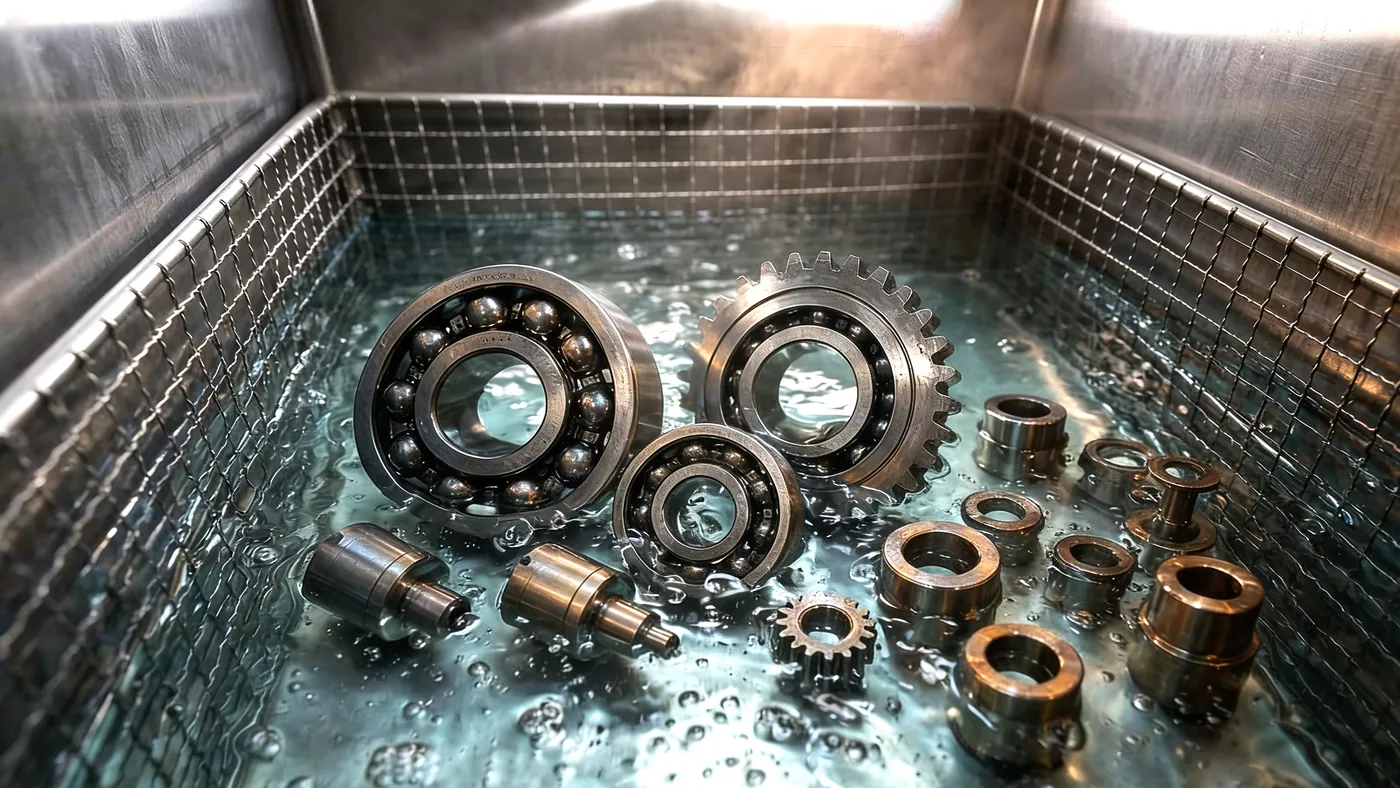
A bearing taken out of a gearbox, a spindle or a conveyor drive is packed with old grease, and in that grease are wear particles, dust and sometimes water. Before anyone can decide whether it runs again, it has to be clean enough to inspect: raceways visible, cage free, no particle left that could be mistaken for damage or cause it. Solvent in a parts washer and a brush do the outside. Ultrasonic cleaning also clears the space between the rolling elements, the cage pockets and the seal lips, where the brush does not go.
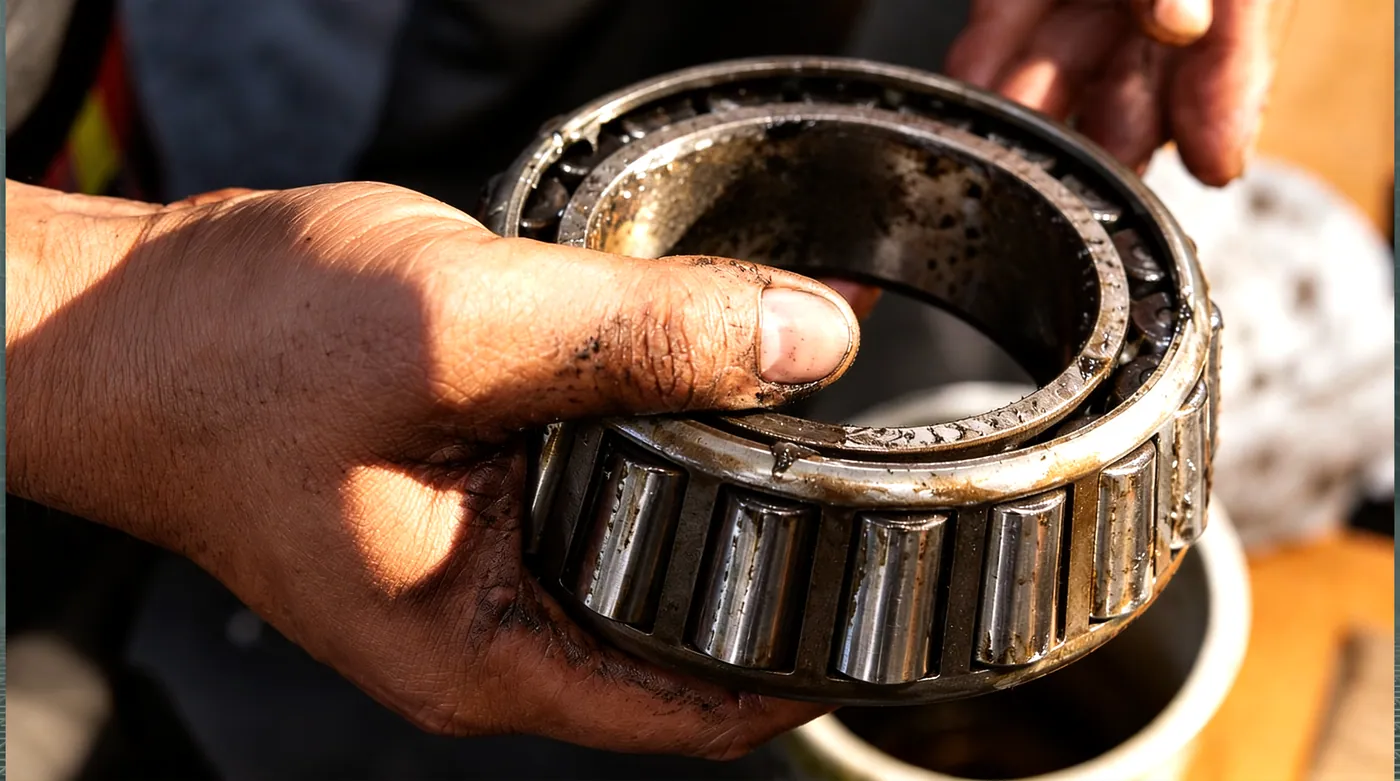
Clean or replace?
| Part | Cleaning makes sense |
|---|---|
| Large and expensive bearings (spindle, mill, roll, gearbox, slewing) dismounted for inspection | Yes, the standard case |
| Open bearings from a maintenance overhaul, to be inspected and regreased | Yes |
| Gears, shafts, couplings, housings and bearing seats from the same overhaul | Yes, in the same bath |
| Sealed and shielded bearings (2RS, ZZ) | No. The cleaner enters behind the seal, washes out the grease and cannot be removed again. Replace them |
| Small standard bearings | Usually no. A new one costs less than the labour of cleaning and inspecting |
| New bearings | Never. They are protected with a preservative that is compatible with normal greases. Washing it off removes the protection and adds a risk of contamination |
Before the bath
- Mark the bearing and note its position and orientation; inspection results are only useful if you know where the bearing ran.
- Wipe off the bulk grease with a spatula or a lint-free cloth. Grease in the bath is grease the skimmer has to remove.
- Separate what can be separated where the design allows it: tapered roller cones from cups, cylindrical roller inner rings from the outer ring and roller set.
- Hang or rack large bearings so they stand on edge and the liquid flows through; do not lay them flat on the basket bottom.
The bath
| Parts | Liquid | Temperature | Frequency | Time |
|---|---|---|---|---|
| Steel bearings with grease | alkaline cleaner with corrosion inhibitor, 3 to 5 % | 55 to 65 °C | 28 kHz | 10 to 20 min |
| Heavily hardened, dried grease | same, or a heavy-duty degreaser | 65 to 70 °C | 28 kHz | 20 to 30 min, turn once |
| Bearings with brass or polyamide cages | mild alkaline cleaner | 50 to 55 °C | 40 kHz | 10 to 15 min |
| Gears, shafts, housings | alkaline cleaner | 55 to 65 °C | 28 kHz | 10 to 20 min |
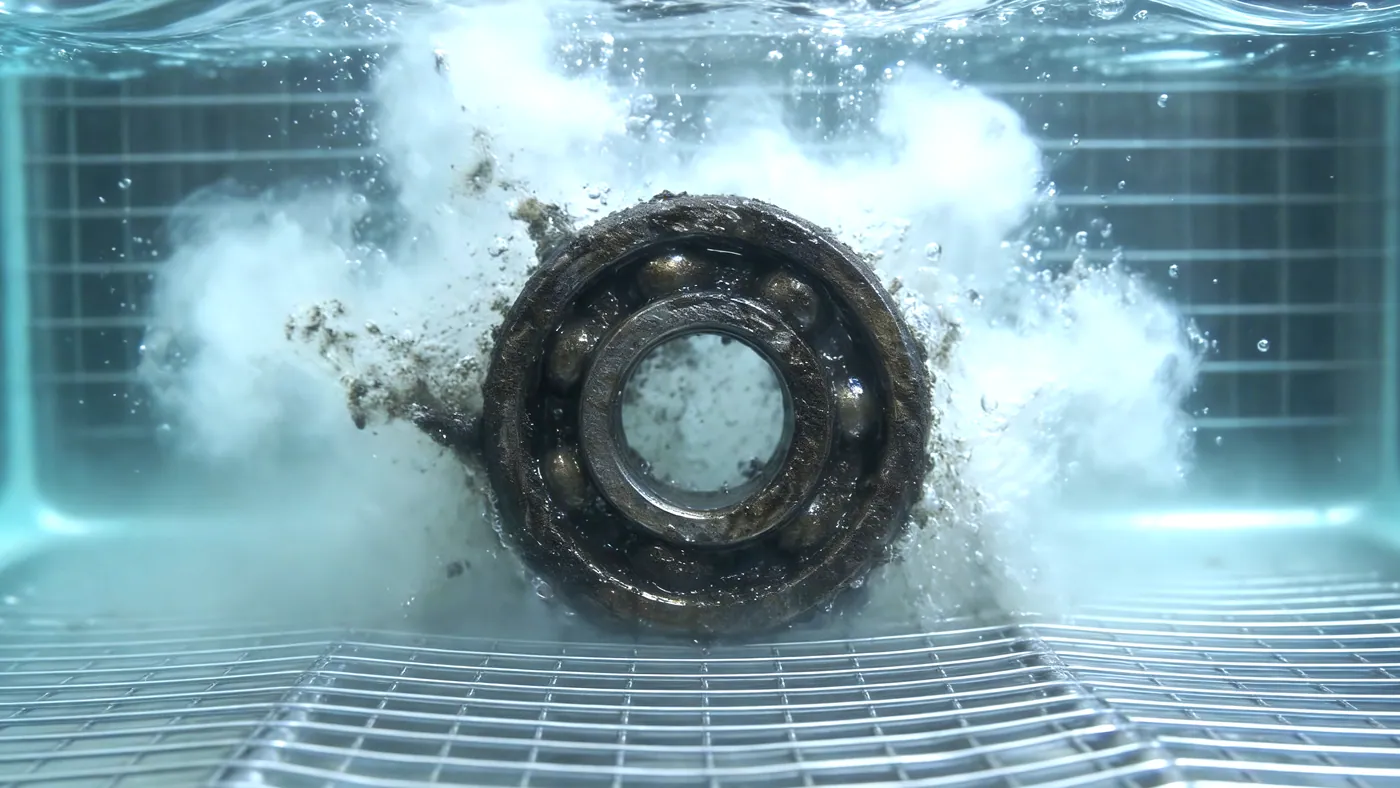
Polyamide cages soften above their temperature limit; keep them below 60 °C. See removing oil and grease for the chemistry.
Grease and wear particles load the bath quickly. A filtration loop removes the metal fines before they settle into the next bearing, and an oil skimmer takes off the grease that floats up. For regular bearing work this is not an option but the process; see ST or SF.
After the bath
Clean bearing steel has no protection at all. It rusts from the humidity in the air within hours, and a fingerprint leaves a mark in a day.
- Rinse in clean warm water with a corrosion inhibitor.
- Dry at once with hot air or a dryer. Do not spin a bearing with compressed air: an unloaded, dry bearing spun by air damages its raceways, and a spinning bearing that comes apart is dangerous.
- Protect at once. Oil lightly with a preservative or the operating oil, or grease if it goes straight back in.
- Inspect the raceways, rolling elements and cage under good light: spalling, pitting, false brinelling, discoloration from heat, cage wear. Cleaning shows the damage; the inspection decides.
- Store wrapped in VCI paper or oil paper until it is fitted.
Which machine
| Work | Set-up |
|---|---|
| Maintenance workshop, bearings and gearbox parts now and then | ST-65 or ST-96 at 28 kHz, rack or hanging fixture, rinse tank |
| Overhaul shop, bearings daily | SF-225 or SF-310 with filtration and skimmer, rinse tank, DT dryer |
| Large bearings (mill, wind, slewing rings), heavy loads | AL-400 to AL-1000 with lift, or a custom tank sized to the ring diameter |
| Small precision bearings, instrument and spindle | UMX Pro 50L or 62L at 40 kHz, fine basket |
Large ring bearings are often the reason for a custom tank: the diameter sets the tank length and width, not the volume. See how to size a tank and custom units.