
Process and parameters · 8 min read · Updated 2026-11-16
Cleaning aluminium parts without staining
Why aluminium turns grey or spotty after ultrasonic cleaning, how to tell etching from residue, contact marks and water stains, and what to change.
Technical guide. Figures are taken from our own spec tables; for your process we confirm the settings with a cleaning trial.
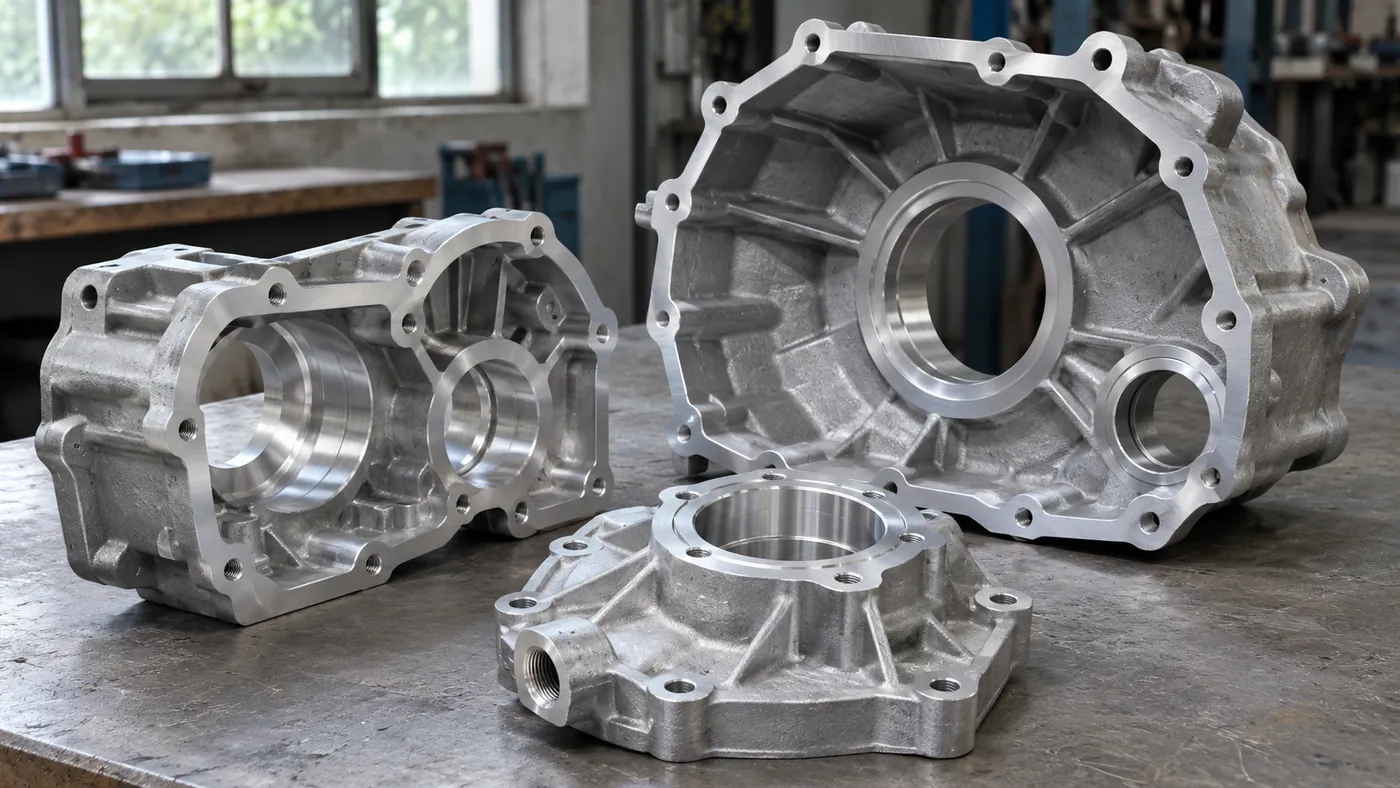
Aluminium often leaves the bath free of oil but marked: grey on the machined faces, white spots after drying, or a dark patch where the part touched the basket. Each mark has a different cause, and the fix for one can make another worse. This guide explains where the marks come from, how to tell them apart and what to change.
How do you clean aluminium without staining? Use a cleaner its maker rates for light alloys, usually pH 9 to 11 with inhibitors, at 40 kHz, with the temperature and time kept lower than for steel. Rinse before the cleaner dries, use demineralised water for the final rinse, keep parts apart in the basket and dry them promptly.
Why does aluminium stain in an ultrasonic bath?
Aluminium stains in an ultrasonic bath for four main reasons: a cleaner too alkaline for the alloy etches the metal grey, dried cleaner or tap-water minerals leave white marks, contact with another metal marks it locally, and water left standing stains it. Light-alloy cleaners are usually formulated at pH 9 to 11 with inhibitors and used at 40 kHz.
Alkaline attack. Aluminium owes its corrosion resistance to a thin natural oxide layer. That layer is stable in near-neutral water but dissolves in strong alkali, and the alkali then attacks the metal underneath. Strong alkali etches aluminium and zinc die castings grey within minutes. Heat, time and concentration all speed the attack; the inhibitors in a light-alloy cleaner slow it. On castings, alloying elements such as silicon and copper do not dissolve with the aluminium and stay behind as a dark film, which is why cast parts often turn darker than machined bar stock.
Dried residue. Hard tap water leaves white spots as it evaporates. Cleaner carried over into a spent rinse dries to streaks or a dull film. Both sit on top of the metal.
Metal contact. Where wet aluminium touches steel, stainless steel or a copper alloy, the aluminium is the metal that corrodes at the contact. A mark that sits exactly at a basket wire, a steel insert or a neighbouring brass part points to contact, not to the cleaner.
Slow drying. Water held in a pocket or between nested parts stays on the bare surface for a long time and can leave a stain that follows the outline of the water.
How do you tell etching from residue on aluminium?
Etching changes the aluminium itself: the grey or matt area stays after wiping and a fresh rinse in demineralised water. Residue sits on top and wipes or rinses away. If the bath is more alkaline than the usual pH 9 to 11, suspect etching first. Frosted patches on polished faces point to cavitation erosion instead; 40 kHz keeps it low.
Inspect the part dry and cold, next to an untreated part from the same batch, under the same light. Then use the pattern of the mark:
| What you see, and where | Likely cause | What to change |
|---|---|---|
| Even grey or matt surface that does not wipe off, on all wetted faces, worst on machined faces and cast skin | Alkaline attack | Light-alloy cleaner with inhibitors, concentration checked, lower temperature, shorter time |
| White spots where drops dried | Tap-water minerals | Demineralised final rinse |
| Streaks or a dull film on large flat faces | Cleaner carried over, rinse spent | Change the rinse on a schedule tied to the wash |
| Local dark mark at basket contact, a steel insert or next to brass parts | Metal contact | Non-metallic supports, mixed metals washed separately |
| Tide marks or outlined stains in pockets, blind holes or between nested parts | Slow drying | Drain, dry promptly with hot air, no stacking |
| Frosted patches on the polished faces exposed longest | Cavitation erosion | 40 kHz, lower ultrasonic power, shorter cycle |
Source: Sonixtek guides cleaning-liquids (alkali, water quality), rinsing-and-drying (spots, streaks) and 28-khz-or-40-khz (erosion); oxide layer and metal contact are general corrosion chemistry.
An etched surface cannot be washed back. Longer or stronger cleaning removes more metal around the mark, so stop and correct the chemistry instead. A dark film on an etched casting may wipe off, but the matt surface beneath it stays; restoring the finish is a separate polishing or blasting step.
Which cleaner and settings suit aluminium?
Aluminium needs a cleaner its maker rates for light alloys, usually pH 9 to 11 with inhibitors, used at 40 kHz with the temperature and time kept lower than for steel. Anodised aluminium needs a milder cleaner and a shorter cycle. The cleaner's data sheet lists the materials it is rated for; the alloy should be on it.
More concentrate is not better. Above the maker's recommended concentration a cleaner gains little, attacks more and leaves more residue to rinse off. Check the concentration weekly with the supplier's titration kit and top up with solution at working strength, not with water alone. The cleaning-liquids guide covers chemistry by material.
At 40 kHz the cavitation bubbles are smaller and collapse more gently, which keeps erosion on soft metals low and reaches threads and fine bores. 28 kHz suits heavy soil on robust castings but is the wrong choice for polished or anodised faces; the frequency guide explains the difference.
Ultrasound warms the bath by itself, so a long run can drift above the temperature you set. Measure the bath during a full shift. Where it drifts, a cooling coil or an external chiller holds it at the set value. The right temperature and time for your alloy and soil come from the cleaner's data sheet and a trial on real parts.
Which tank figures matter for an aluminium load?
For an aluminium load, the basket and the ultrasonic power matter most. The ST-96 heated ultrasonic tank (96 L
| Item | Figure | Use for aluminium |
|---|---|---|
| Frequency | 40 kHz | Machined, polished and anodised faces |
| Light-alloy cleaner | pH 9 to 11 | Usual range with inhibitors; the data sheet decides |
| ST-96 volume | 96 L |
Bath size |
| ST-96 basket L × W × H | 580 × |
Parts laid out apart, pockets draining |
| ST-96 basket load | 100 kg |
Mechanical rating, not a batch size |
| ST-96 ultrasonic power | 1440 W, adjustable | Turn down for polished faces |
Source: Sonixtek options.json (frequency); guide cleaning-liquids (pH); products.json and live ST-96 product page (volume, basket, load, power), read 16 Nov 2026.
Lay parts apart so they neither touch each other nor rub against the stainless basket wire. Put plastic supports or a plastic-coated rack under machined faces, and wash steel or brass parts in a separate load. Turn pockets and blind holes down so they drain; see loading the basket. The ST industrial tanks and UMX Pro compact cleaners are both available at 40 kHz.
Rinsing and drying aluminium without marks
Move the basket to the rinse before the cleaner dries on the parts; a film that dries on warm aluminium is harder to remove and keeps working on the surface. Use clean water for the first rinse and demineralised water for the final rinse of visible, coated or bonded parts. Change the rinse on a schedule tied to the wash, because a spent rinse carries cleaner onto the parts.
Dry straight after the final rinse with hot air. The DT-96 hot-air dryer (96 L
Frequently asked questions
Can a grey stain on aluminium be cleaned off?
Only if it is residue. Etching removes metal, and more cleaning removes more around the mark. A dark film on an etched casting may wipe off, but the matt surface stays; restoring the finish needs polishing or blasting.
Does 28 kHz damage aluminium?
Not as a rule. 28 kHz suits heavy soil on robust aluminium castings. For machined, polished or anodised aluminium, 40 kHz is the usual choice, because its smaller bubbles collapse more gently and keep erosion low.
Can aluminium and steel parts be cleaned in the same load?
It is better to separate them. Steel tolerates stronger alkali than aluminium, the cleaner must be rated for both, and wet contact between the two metals can mark the aluminium. Wash mixed assemblies with a light-alloy cleaner.
Why do white spots appear only after drying?
The minerals in tap water stay on the surface when the water evaporates, so the spots appear as the part dries. A final rinse in demineralised water removes them before drying. Streaks or a dull film point instead to carried-over cleaner.
What to send us for a quote
- Alloy (cast or wrought, grade if known) and finish: machined, polished, anodised or painted.
- Inserts, bushes or other metals in the part.
- Soil to remove and the next step: assembly, coating, bonding or storage.
- Size of the largest and smallest part and parts per day.
- Photos of any marks and the data sheet of your current cleaner.
Send this through the quote form. Our technical team proposes the frequency, tank, rinse and dryer for your parts.