
Process and parameters · 8 min read · Updated 2026-11-16
Drying blind holes and threads after washing
Blind holes can stay wet after the outside dries. Set part orientation, draining and hot-air exposure, then check the feature that holds water.
Technical guide. Figures are taken from our own spec tables; for your process we confirm the settings with a cleaning trial.
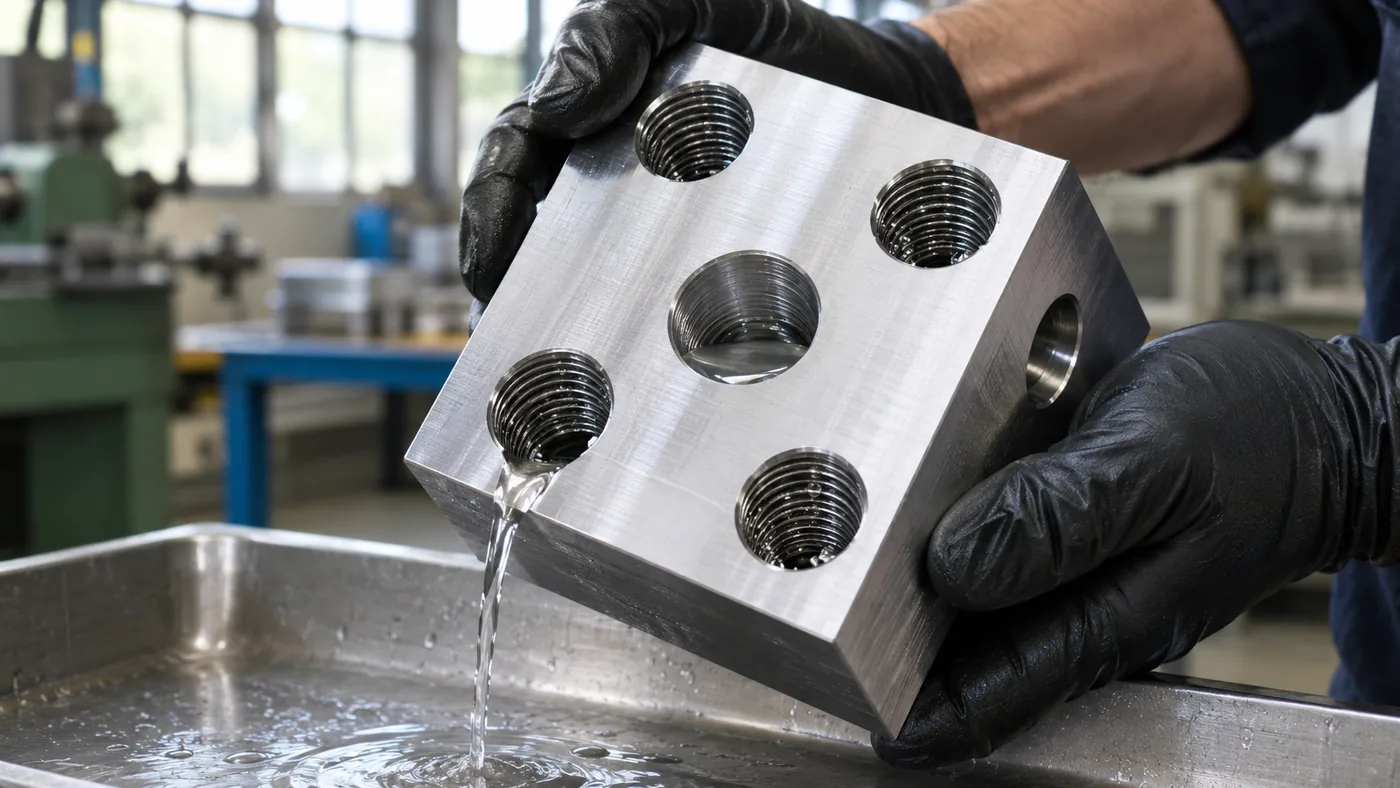
A housing looks dry on the bench. Turn it over and a drop comes out of a tapped hole. The dryer has removed the exposed film, but the feature that matters to assembly still contains water.
The rinse and drying guide covers the process sequence. This article follows the retained water: why it stays, how to give it a way out, and how to check the result before releasing the basket. So how do you dry blind holes and threads consistently, without simply raising the air temperature and extending every batch?
Blind holes and threads dry consistently when the water is drained first and heated second. Angle each mouth downward with a clear path below it, rinse warm at 40 to 60 °C
Why do blind holes and threads stay wet after the outside dries?
Blind holes and threads stay wet because the water in them has no through-flow path. Air passes the mouth while the bottom sits in nearly saturated air, and evaporation cools that bottom. A DT hot-air dryer set anywhere from 30 to 100 °C
A deep, narrow passage exchanges vapour with the chamber more slowly than an exposed face. Threads add small grooves and contact lines where droplets cling. Surface tension can hold a film even when the main pool has drained. A counterbore or intersecting passage can leave a pocket behind a lip. Dirt, detergent residue and the surface finish also change how water spreads; drying cannot compensate for an inadequate rinse.
Map the whole internal path on the drawing. A hole that appears to point down can connect to a cross-drilling that still points up. Ask assembly which features must be dry and which can be inspected. That list becomes the acceptance map for the trial.
Which way should a part face to drain its blind holes?
A part should face so that each blind hole's mouth points downward with a clear path below it, chosen by turning a wet sample over a tray before heating. In a DT hot-air dryer, lay the parts in one shallow, separated layer so that no part shields or drips into another; the basket sizes are in the table further down.
The basket-loading guide recommends tilting cup-shaped parts. Apply the same reasoning to machined holes: give the mouth a downward path during draining and keep it clear of the rack. A flat plate directly beneath the opening can catch the drop and hold it against the part.
Do not assume that turning a part completely upside down empties every hole. A narrow mouth can retain water, and a horizontal cross-passage may need another angle. Turn a representative wet part over a clean collection tray and watch where water emerges. Use that observation to choose the draining orientation before heating.
If parts can move during transfer, the rack must preserve their orientation without marking the functional surfaces.
Does a warm rinse help blind holes dry?
Yes, a warm rinse helps blind holes dry when the part and the rinse chemistry allow it. Rinse water at 40 to 60 °C
Warm rinsing also changes the trial conditions, so record it. A drying programme established after a warm rinse cannot be assumed to work after a cold one. Rinse quality matters too: when a retained drop contains detergent, evaporation concentrates that detergent at the bottom of the hole rather than removing it. A clean wash bath helps as well: parts lifted out through a laminar flow surface carry less floating oil and dirt into the rinse.
The DT range described in the dryer overview uses air settings from 30 to 100 °C
Expose the feature, then change orientation if needed
Position the basket so that air can reach the hole mouths, while leaving the circulation paths open. In the DT the heated air is driven through the basket from below and leaves through the lid, so a mouth angled downward for draining is not turned away from the air stream. Packing parts tightly to fill the tank can reduce useful air exchange. The important quantity is dry, accepted parts leaving the station, not parts loaded at the start.
The direction of the air through an internal passage can matter as much as its temperature. In one installation, washed filter cartridges with internal rods are dried at about 50 °C
For pockets that cannot all drain in one position, a planned change of orientation at half time can help. It releases a pool and exposes a different face. This is manual repositioning under the machine's stopping and handling instructions, not an automatic rotation feature of the DT. Do not reach into an operating chamber or turn a heavy wet part without a suitable fixture.
Record which face starts down, which finishes down and how the basket is supported during the change. If the interruption makes the cycle impractical, compare a different rack or a separate draining step before adding more heater time.
Which DT hot-air dryer suits the basket?
A DT hot-air dryer is chosen by the basket the parts need: take the smallest basket that holds the parts in one separated layer. The DT-206 has a larger basket than the DT-96 and twice its heating; the DT-300 is configured on request.
| Model | Volume (L) | Heating (kW) | Air temperature (°C) | Basket (mm) | Supply | Chamber |
|---|---|---|---|---|---|---|
| DT-96 | 96 |
3 | 30–100 |
580 × |
400 V | AISI 304, from 2 mm |
| DT-206 | 206 |
6 | 30–100 |
730 × |
400 V | AISI 304, from 2 mm |
| DT-300 | 300 |
on request | up to 100 |
on request | 400 V | AISI 304, from 2 mm |
For US sites the DT dryers are quoted for 480 V or 208–240 V three-phase, 60 Hz, with 60 Hz motors.
Source: Sonixtek product data, Nov 2026.
A larger basket only helps if the extra floor is used to separate the parts, not to stack them.
Diagnose the wet feature
| Observation | Likely mechanism | First adjustment to trial |
|---|---|---|
| A drop appears only when the part is turned | Trapped pool | Change draining angle and support |
| Thread root stays wet while the face dries | Retained film and poor air exchange | Expose the mouth and reduce crowding |
| Hole dries but leaves a ring | Dissolved residue | Review rinsing before extending drying |
| Lower part is wet beneath a dry upper part | Dripping from above | Separate levels or change the rack |
| Wetness returns during cooling | Water from another passage or condensation | Inspect connected features and cooling conditions |
These are diagnostic starting points, not a fault diagnosis made from appearance alone. Change one process condition at a time so the next inspection tells you whether that change helped.
How do you check that a blind hole is really dry?
Check a blind hole on the most difficult representative part once it has cooled enough to handle. Turn the part over a clean, dry surface, look for released drops, and use a light, a borescope or a clean absorbent indicator where the bottom is accessible. An air reading of 100 °C
An absorbent indicator must not shed fibres or damage the feature. Choose the method with the next process owner.
Weighing a whole basket can compare residual water between trials, but it cannot prove that a particular thread is dry. Likewise, compressed air may move a drop out of sight into an intersecting passage. In one plant, a DT-96 placed after the plant's own ultrasonic cleaner replaced drying of small and medium parts with compressed-air guns. Define where the inspection happens and whether turning or dismantling is necessary.
Keep the passing load arrangement, draining method, rinse condition, air setting, duration and any half-time repositioning together in the work instruction. Recheck after a basket change or a new housing variant.
Frequently asked questions
Does the DT turn the parts automatically?
No. Turning pocketed parts at half time is a manual step, done under the machine's stopping and handling instructions. The DT hot-air dryer has no automatic rotation feature, so plan a fixture for heavy wet parts and record which face starts down.
Can compressed air replace the dryer for threads?
Not reliably for blind features. Compressed air can push a drop out of sight into an intersecting passage instead of removing it. In one plant, a DT-96 placed after the plant's own ultrasonic cleaner replaced drying of small and medium parts with compressed-air guns.
Can a DT dryer be added to an existing washer?
Yes. A DT hot-air dryer does not have to come with a new washer. Of five dryer installations we know, three added the dryer alone after a washer that was already in place.
What to send us for a quote
Send a drawing marking the blind features, the material limits and the required basket output through the quote form. Our technical team can assess the DT series around that geometry; an inaccessible wet passage needs a process discussion before a larger dryer is selected.