
Parts and contaminants · 5 min read · Updated 2026-09-30
Ultrasonic cleaning of surgical instruments before sterilisation
A steriliser only works on a clean instrument. What the ultrasonic step in reprocessing removes, how instruments are loaded and how the result is checked.
Technical guide. Figures are taken from our own spec tables; for your process we confirm the settings with a cleaning trial.
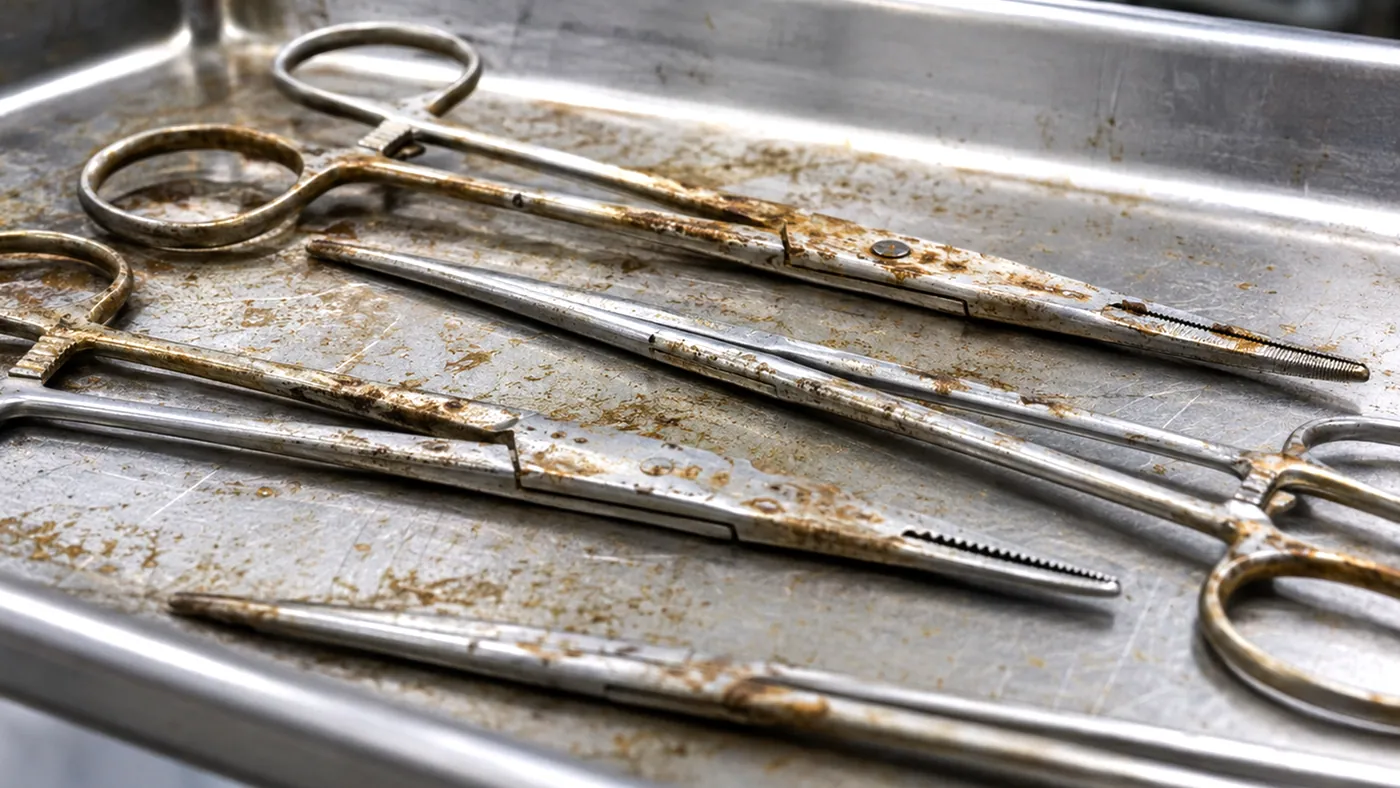
A steam steriliser kills microorganisms on the surfaces the steam reaches. Blood, tissue or bone dust dried into a box lock is a surface the steam does not reach: the soil shields what lies beneath it. That is why every reprocessing cycle starts with cleaning, and why jointed, serrated and cannulated instruments often get an ultrasonic stage before they go into the washer-disinfector.
Regulatory note. In the EU, products specifically intended for the cleaning, disinfection or sterilisation of medical devices are themselves medical devices under Regulation (EU) 2017/745, Article 2(1). Reprocessing surgical instruments in hospitals and clinics therefore uses equipment certified for that purpose and follows the instrument maker's reprocessing instructions, which EN ISO 17664 requires the maker to supply. Washer-disinfectors fall under EN ISO 15883. Sonixtek machines are industrial cleaning equipment and are not certified as medical devices. This article explains the cleaning step; it does not recommend one of our machines for it.
Where cleaning sits in reprocessing
| Step | Purpose |
|---|---|
| Point of use | Wipe off gross soil, keep instruments moist, do not let blood dry |
| Transport | Closed container to the sterile services department |
| Sorting and dismantling | Open joints, take apart what the maker's instructions say to take apart |
| Pre-cleaning | Manual and, where specified, ultrasonic cleaning of difficult geometry |
| Cleaning and disinfection | Washer-disinfector, or a validated manual method where the maker allows it |
| Drying, inspection, care | Magnified inspection, lubrication of joints, function test |
| Packaging and sterilisation | Usually steam, by a validated cycle |
Ultrasonic cleaning removes soil. It neither disinfects nor sterilises, and it does not replace either step. What it does is make them reliable: a disinfectant or steam cycle validated on clean instruments cannot be expected to work through a layer of dried protein.
What the ultrasonic stage removes
| Soil | Where it hides | What matters |
|---|---|---|
| Blood and protein | Box locks, serrations, ratchets, hinges | Keep moist after use; protein denatures and bonds to steel when heated, so the wash stays below about 45 °C |
| Tissue and bone fragments | Drill flutes, rasps, rongeur jaws, cannulations | Brush first where the maker says so; lumens must fill with liquid |
| Saline and body fluids | Joints and crevices | Chlorides left to dry cause pitting corrosion on stainless steel |
| Bone cement | Tips and jaws | Removed at the point of use before it cures; cured cement does not come off in a bath |
Some disinfectants, particularly aldehyde- and alcohol-based ones, also fix protein to the surface. This is one reason cleaning comes before disinfection and not the other way round.
Loading
Most failures of the ultrasonic step are loading failures. The rules that instrument care guides agree on:
- Open everything. Box locks, scissors and clamps opened, ratchets released, so cavitation reaches the joint surfaces.
- Dismantle multi-part instruments as far as the maker's instructions say.
- One layer in a wire-mesh tray. Stacked instruments shadow each other and scratch each other. See loading the basket.
- Fully immersed, no trapped air. Cannulated instruments go in at an angle so the lumen fills; air in a channel means no cleaning inside it. See threaded parts and blind holes.
- Separate the delicate. Microsurgical instruments go in their own racks, never under heavy sets; see microsurgical instruments.
- Do not mix metals. Chrome-plated and stainless instruments are kept apart, because damaged plating and contact between different metals lead to corrosion.
- Check what may go in at all. Optics, powered instruments, cables and some plastics are excluded by their makers.
The lid stays closed while the bath runs, to keep aerosols from contaminated instruments in the tank.
Chemistry, temperature and time
Instrument reprocessing uses cleaning agents made and marketed for it: neutral, enzymatic or mildly alkaline, dosed at the concentration on the label. The instrument maker's instructions say which types their instruments tolerate.
- Temperature. Below about 45 °C for the ultrasonic stage, because of the protein. The ultrasound itself warms the bath during a working day, so the temperature is checked, not assumed.
- Frequency. Instrument baths usually run in the 35 to 40 kHz range; see 28 kHz or 40 kHz.
- Time. As given by the detergent and instrument makers and fixed in the department's procedure, commonly a few minutes.
- Fresh bath. A new solution is degassed before use, and the bath is changed at least every working day and whenever it is visibly soiled. A loaded bath cleans less and puts soil back on the next batch.
- Water. Softened or demineralised water for the bath and the final rinse, or minerals leave spots and deposits.
Rinsing and what follows
After the bath, instruments are rinsed to remove detergent and loosened soil, then go to the washer-disinfector or the next validated step. After drying they are inspected, joints receive a steam-permeable instrument lubricant, and each instrument gets a function test before packaging and sterilisation.
Verifying the cleaning
- Visual inspection of every instrument under a magnifying lamp, with attention to joints, serrations and tips.
- Protein residue tests on sample instruments at a fixed frequency, with the results recorded.
- Bath performance checks at intervals the department sets, with cavitation indicators or a foil test, so a failing transducer is found before the instruments show it.
- Records of batch, programme, operator and bath change, as the department's quality system requires.
Where Sonixtek machines fit
Our machines are industrial cleaning equipment. In the medical field they belong where the regulation on reprocessing equipment does not apply: in the manufacture of instruments and implants before the maker's own final cleaning, packaging and sterilisation, in laboratories, in hospital technical services for non-medical items, and in veterinary practices. The medical industry overview sets out the whole picture.