
Parts and contaminants · 5 min read · Updated 2026-09-30
Ultrasonic cleaning of orthopaedic implants in production
Implants carry coolant, polishing compound and particles on their way to packaging. The cleaning sequence, what ISO 19227 asks for, and the equipment.
Technical guide. Figures are taken from our own spec tables; for your process we confirm the settings with a cleaning trial.
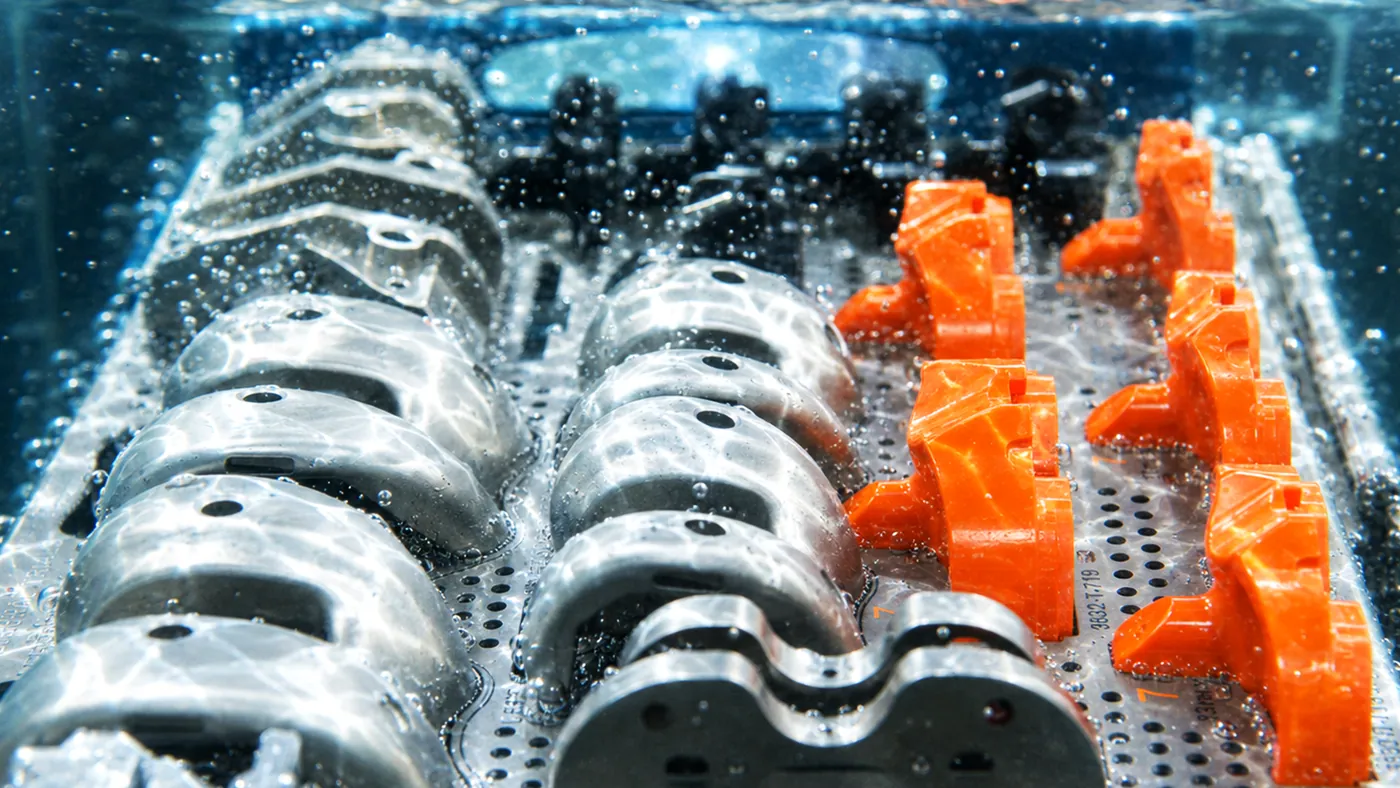
An implant stays in the body for decades, and whatever manufacturing left on its surface stays with it. A hip stem or a tibial tray passes through turning, milling, grinding, polishing, blasting and laser marking before it is packed, and each step leaves its own residue. Cleaning an implant is therefore not one wash at the end but a sequence of cleaning steps between processes, finishing with a validated final clean before the implant goes into the cleanroom for packaging and sterilisation.
This is manufacturing: the implant maker cleans under its own quality system (ISO 13485), validates the process and then packs and sterilises the implant. Industrial ultrasonic equipment is used for it; the regulation on reprocessing equipment in hospitals does not apply here.
Residues along the route
| Process step | Residue | Cleaning approach |
|---|---|---|
| Turning and milling of Ti-6Al-4V, CoCrMo, 316L | Water-miscible coolant, chips, fines in threads and cannulations | Alkaline cleaner with inhibitor, 50 to 60 °C, 28 or 40 kHz, 5 to 10 min, lift agitation |
| Grinding and polishing of bearing surfaces | Polishing compound: waxes and fatty binders carrying abrasive | Cleaner made for polishing compounds, 60 to 70 °C, 40 kHz, often two wash stages |
| Grit blasting | Loose blasting media, fines in the roughened surface | Ultrasonic wash and rinse remove loose grit; embedded grit is a blasting-process issue |
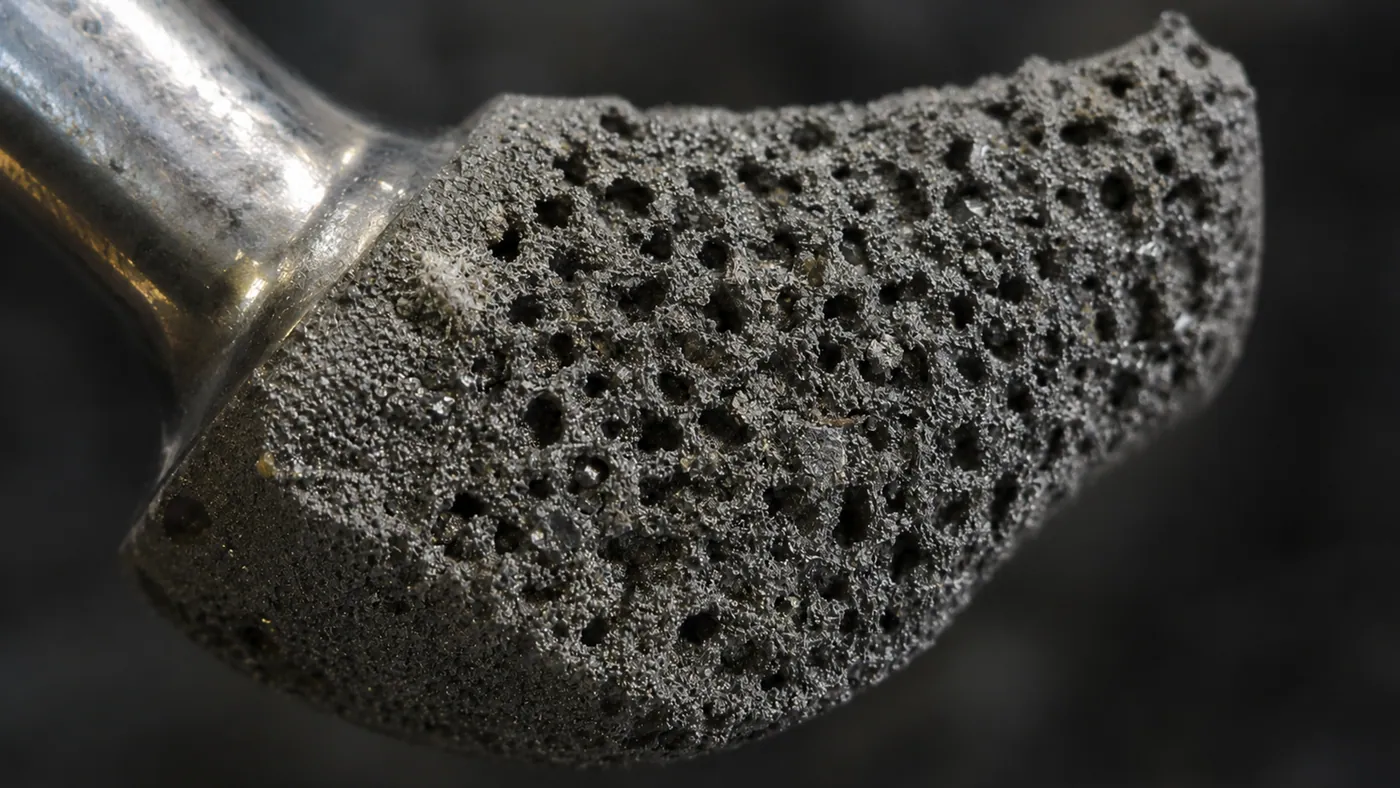
| Porous coatings and additively made lattices | Loose powder and partly sintered particles deep in the pores | Longer cycles with agitation, alternating wash and flushing, verified by extraction |
| PEEK and UHMWPE components | Machining chips, static-bound particles, handling residue | Neutral or mild alkaline cleaner, 40 to 50 °C, 40 kHz |
Polishing compound should be cleaned off soon after polishing. Left for days, it hardens in radii and recesses. For the physics of fine particles versus frequency, see particle size versus frequency.
Before passivation or anodising
Stainless implants are passivated, for example to ASTM A967 or ASTM F86, and titanium parts are often anodised for colour coding. Both treatments act on the metal surface, so any oil, compound or fingerprint left on it gives uneven results and stains. The order is: clean, rinse, passivate or anodise, rinse in purified water, then final clean. Passivation acids run in their own acid-resistant tanks, not in the ultrasonic cleaning tank; see tank material.
Final cleaning before packaging
| Station | Purpose | Typical setting |
|---|---|---|
| Final wash | Last traces of organic residue and particles | Neutral or mild alkaline cleaner with a known composition, 50 to 60 °C, 40 kHz, or 80 kHz for polished surfaces and fine particles |
| Rinse cascade | Carry-out of cleaner | Purified water, two or three stages, conductivity monitored |
| Final rinse | Residue-free surface | Purified water of controlled quality |
| Drying | No water spots, no recontamination | Filtered hot air |
| Transfer | Into the packaging area | Covered carriers, gloves, no intermediate storage in the open |
The cleaner itself becomes a possible residue. Choose one with a known, short list of ingredients that rinses off readily, and get its composition and rinsing data from the supplier: the biological evaluation of the implant under ISO 10993 has to show that residues of manufacturing agents, the cleaner included, are not a hazard. Where bacterial endotoxin is an acceptance criterion, the final rinse water and the tanks that hold it are part of the validation too: purified water, sampled regularly, and tanks that are drained and cleaned rather than topped up.
What ISO 19227 asks for
ISO 19227 covers the cleanliness of orthopaedic implants. It does not give one universal limit. It asks the manufacturer to identify the contaminants each manufacturing step can leave, to set acceptance criteria for the cleaned implant, to validate the cleaning process against those criteria, and to evaluate the biological safety of what remains. Typical test methods on sample implants are an extraction, often in a laboratory ultrasonic bath, followed by total organic carbon or gravimetric residue on the extract, particle counting after membrane filtration, and identification of residues where needed.
The cleaning line itself measures none of this; it has to be stable enough that sample implants keep passing.
What the line must hold
- Temperature of every tank, within a set range.
- Cleaner concentration, checked by titration or conductivity at a fixed interval.
- Time per station and ultrasonic power, which a programme controller fixes.
- Load pattern: the same fixture, the same number of parts, implants not touching each other.
- Rinse water quality, monitored by conductivity.
- Bath change intervals, set in the validation and kept.
- Periodic checks of cavitation, for example with the foil test.
These go into the installation, operational and performance qualification (IQ, OQ, PQ). A change of cleaner, fixture or machine is a change to a validated process and goes through change control. Automated lines help, because the carriage times every station identically; see multi-tank lines.
Which machine
| Work | Set-up |
|---|---|
| Development, prototypes, small batches between machining and polishing | UMX Pro 50L or 62L, 28/40 kHz, programmes per part family, rinse tank, DT dryer |
| Series production after machining and polishing | AL-150 or AL-300 with lift, filtration and skimmer, rinse stations, DT dryer |
| Final clean of small implants: screws, heads, plates | MT-75: 75 L wash at 40 or 80 kHz with rinse and dry stations in one frame |
| Full line from compound removal to dry parts | MT multi-tank line with wash, rinse cascade, purified-water final rinse and dryer under one carriage |
Fixtures matter as much as the machine: every implant held individually, polished surfaces free of contact, cannulations angled so they fill and drain. See also components before assembly and the medical industry overview.