
Parts and contaminants · 4 min read · Updated 2026-09-30
Ultrasonic cleaning of laboratory glassware
The detergents, temperatures and rinses that get beakers, flasks, pipettes and sieves clean enough for the next analysis, and the care volumetric glass needs.
Technical guide. Figures are taken from our own spec tables; for your process we confirm the settings with a cleaning trial.
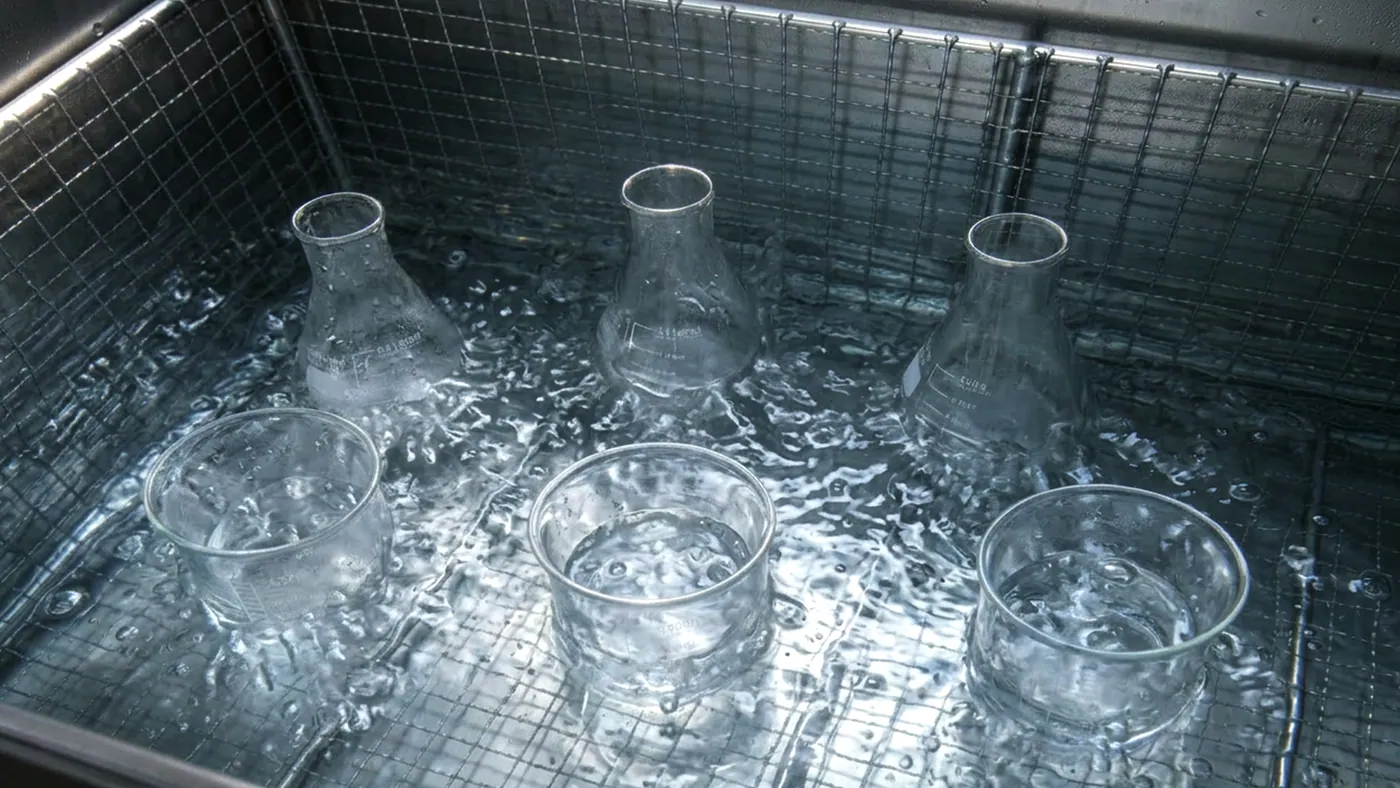
In a laboratory, clean means that nothing on the glass interferes with the next analysis. A film of grease makes water bead inside a burette and the reading wrong. A trace of detergent disturbs a surfactant-sensitive assay or a cell culture. A few nanograms of metal ruin a trace analysis. Ultrasound gets residues out of ground-glass joints, sintered frits, narrow necks and pipette tips; the chemistry and above all the rinse do the rest.
Laboratory ware is not a medical device, so the rules for reprocessing equipment do not apply to it. The laboratory's own quality system and biosafety rules do. Items that carried biological material are decontaminated first, usually by autoclaving, as the biosafety procedure specifies. Ultrasonic cleaning removes residue; it does not disinfect or sterilise.
What comes off and with what
| Residue | Cleaner | Temperature |
|---|---|---|
| Organic residues, oils, most sample residues | Alkaline laboratory detergent | 50 to 60 °C |
| Proteins, culture media, blood samples (after decontamination) | Enzymatic or mild alkaline detergent | Below about 45 °C first, so protein is not baked on |
| Salts, precipitates, metal traces | Acidic laboratory cleaner | 40 to 50 °C, in a beaker or insert |
| Stopcock and silicone grease | Detergent made for silicone residues | 50 to 60 °C, longer cycle |
Acidic cleaners go in a glass beaker or plastic insert standing in the water-filled tank, not in the tank itself; see direct and indirect cleaning. Flammable solvents such as acetone or ethanol never go into an ultrasonic tank: the bath warms, the solvent evaporates, and the heater and electronics sit underneath. Solvent rinses are done separately, in a fume cupboard. See cleaning liquids.
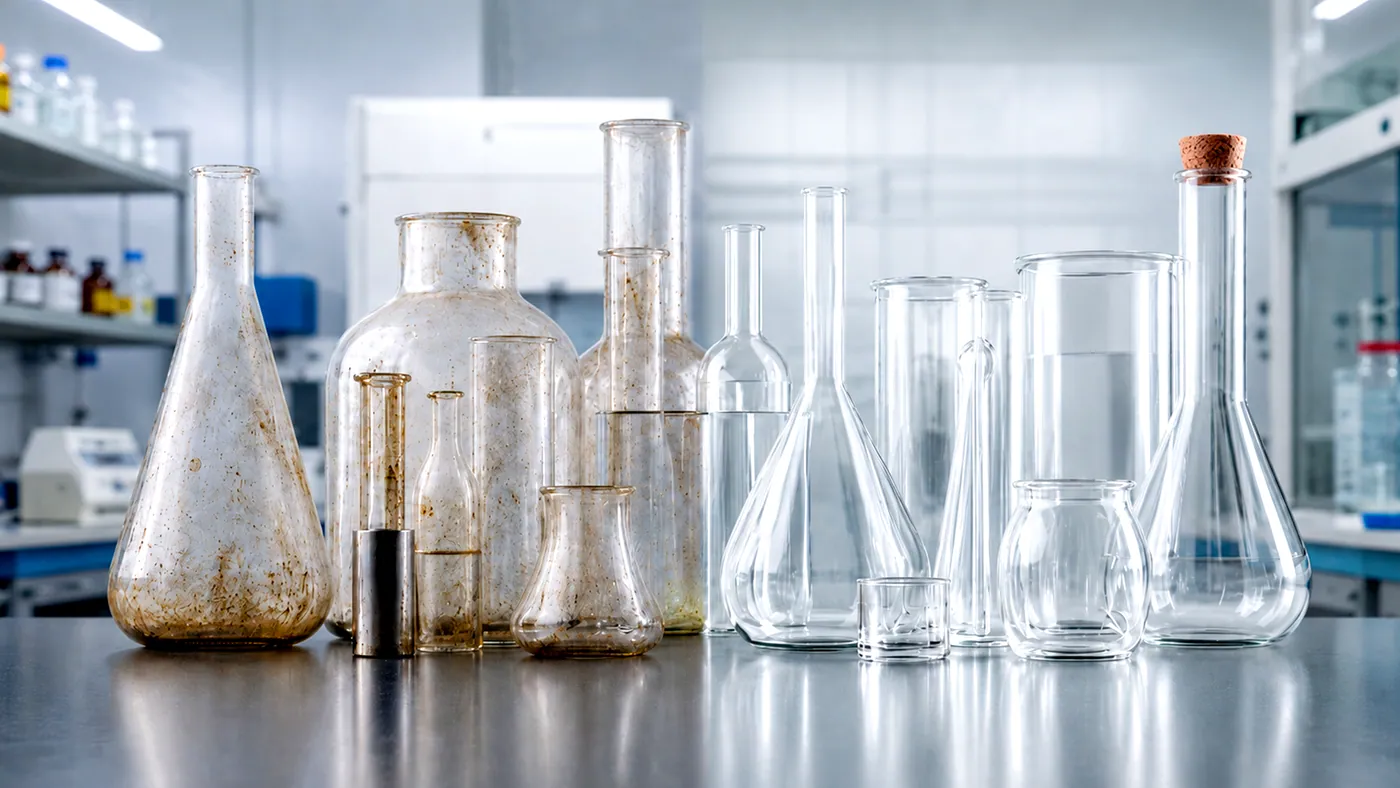
Loading and thermal shock
- Fill and submerge. Flasks, cylinders and pipettes are tilted as they go in so air escapes and the liquid reaches the inside. An air bubble trapped in a flask means the inside is not cleaned.
- Hold the glass. Glassware stands in the basket or in racks and holders, never on the tank floor and never touching other glass, or it chatters against steel and chips. See accessories.
- Inspect first. Cavitation can complete a crack or a star fracture that was already there. Damaged glass is discarded before cleaning, not after it breaks in the bath.
- Avoid sudden temperature changes. Borosilicate glass tolerates temperature changes far better than soda-lime glass, but thick-walled items and cold glass going into a 60 °C bath can still crack. Let glass reach room temperature first, and do not move hot glass into a cold rinse.
- Degas a fresh bath before the first load; see sweep and degas.
Volumetric glassware
Volumetric flasks, class A pipettes and burettes are calibrated, and cleaning must not change their volume. Two things do: heat and alkali. Hot alkaline detergent slowly dissolves glass, which over many cycles etches the surface and changes the volume. So calibrated ware is cleaned with short cycles at moderate temperature, 40 to 50 °C, with a mild detergent, and it is not dried in a hot oven. Air drying at room temperature is the safe default; the glassware maker states any higher limit. The ultrasound itself does not harm sound glass.
Rinsing
Most lab cleaning problems are rinsing problems.
- Tap water rinse, two or three changes, to remove detergent and loosened residue.
- Purified water rinse, at least two or three changes, with the water quality the lab uses for its analyses, for example grade 3 to ISO 3696 or better.
- For trace metal work, an acid soak in a separate container and a final rinse in ultrapure water.
Two quick checks. A clean glass surface drains as a continuous water film; droplets that bead up show a grease film. And the conductivity or pH of the last rinse water, compared with fresh rinse water, shows whether detergent is still coming off.
Drying
Inverted on a draining rack, covered against dust, is the standard. For general glassware in volume, a hot-air dryer at 60 to 90 °C shortens the wait; volumetric ware stays out of it. Plastic labware such as polypropylene, PMMA and polystyrene is dried below its temperature limit, and polystyrene and PMMA are checked against the detergent, as some cleaners make them craze.
Other laboratory parts
- Test sieves: particles lodged in the mesh come out without brushing. Fine sieves are delicate, so short cycles at 40 kHz, one sieve at a time, and the sieve maker's instructions.
- Sintered glass frits and filter holders: the ultrasound works through the depth of the frit; flush the frit afterwards so the loosened residue leaves.
- Quartz cuvettes, NMR tubes, stirrer bars, spatulas and small metal parts from lab instruments: in holders or beakers so they do not rattle.
Which machine
| Work | Set-up |
|---|---|
| Bench, a few beakers and small parts | SX benchtop, 3 to 28 L, 37 kHz with sweep and degas, or an STS benchtop, 2 to 30 L at 40 kHz |
| Sieves, long pipettes, larger parts | STS-200 or STS-300 with a 500 × 300 mm tank |
| Glass washing room: racks of flasks and cylinders | ST-40 or ST-65 at 40 kHz, a rinse tank or sink with purified water, a DT dryer for general glassware |
See benchtop or industrial for where the line between the two lies, and the chemical industry page and medical industry overview for the wider context.