
Parts and contaminants · 4 min read · Updated 2026-09-30
Ultrasonic cleaning in hospital technical services
Castors, trolley parts, kitchen filters and grilles: what a hospital's technical service can clean in an industrial tank, and the line it must not cross.
Technical guide. Figures are taken from our own spec tables; for your process we confirm the settings with a cleaning trial.
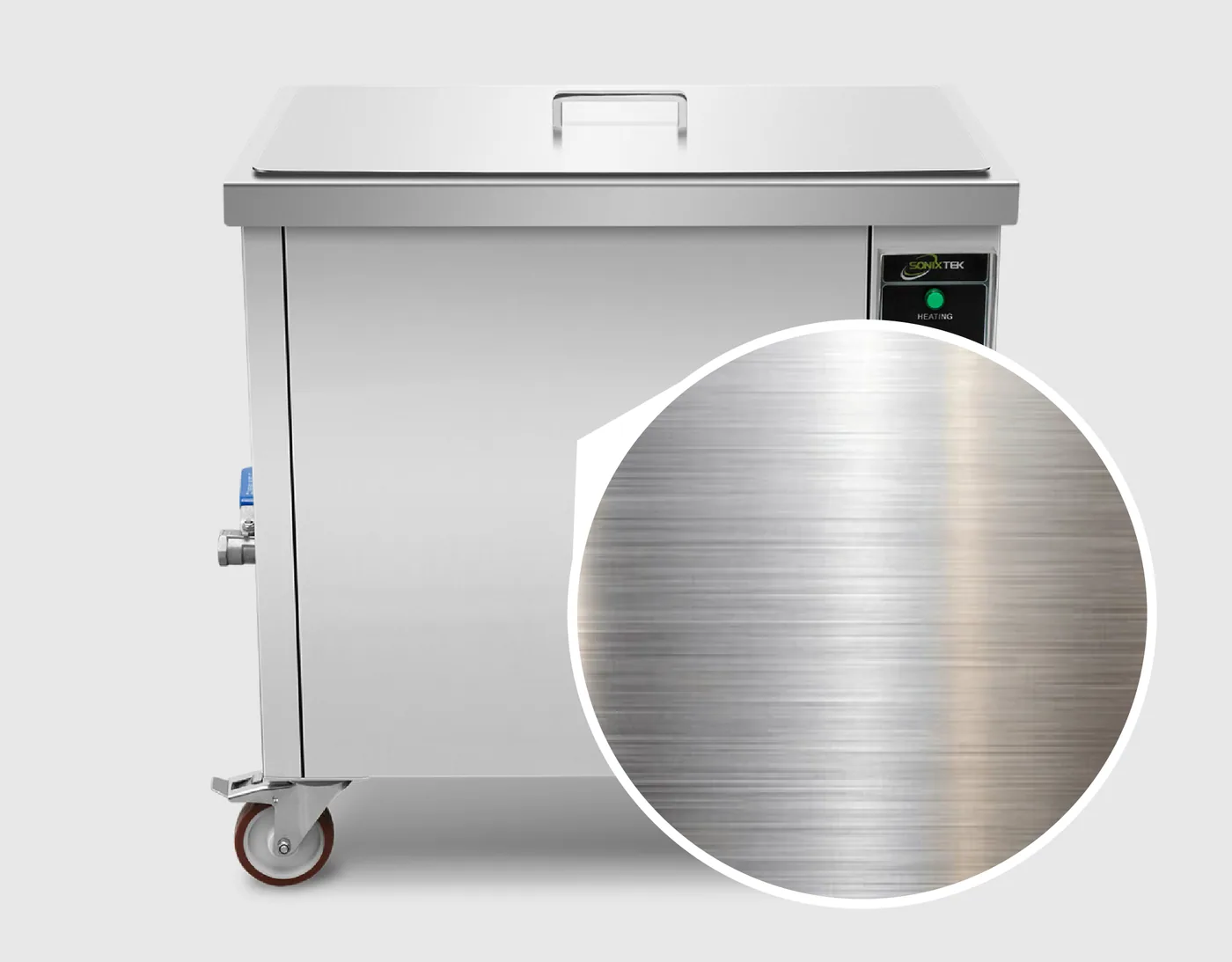
A hospital is also a large building with a workshop and a kitchen. Castors on trolleys wind up with hair and thread, extract filters over the kitchen ranges load with grease, ventilation grilles and washable filters gather dust, and pumps, valves and fans from building services come apart for repair. None of this is patient-contact equipment, and cleaning it is industrial work for technical services and catering. An ultrasonic tank does it faster and more thoroughly than a sink and a brush, and it reaches axles, bearings, filter mesh and louvres that a brush does not.
The boundary
The line is set by what a part is and where it goes next.
| In the technical services tank | Not in the technical services tank |
|---|---|
| Castors, wheel forks and axles of transport, linen and catering trolleys | Surgical, dental and microsurgical instruments |
| Trolley shelves, handles, brackets, fittings | Endoscopes and other lumened devices |
| Kitchen extract filters, fryer baskets, gastronorm pans, kitchen machine parts | Anything reprocessed for use on a patient |
| Ventilation grilles, diffusers, washable metal filters | Parts of medical devices, unless the device maker's service instructions allow it |
| Pump, valve, fan and gearbox parts from building services, workshop tools |
Instruments and devices reprocessed for patient use go to the sterile services department. In the EU, equipment specifically intended for cleaning, disinfecting or sterilising medical devices is itself a medical device under Regulation (EU) 2017/745, Article 2(1). That department uses equipment certified for the purpose, washer-disinfectors to EN ISO 15883, and follows the reprocessing instructions of each device maker (EN ISO 17664). Sonixtek machines are industrial cleaning equipment and are not certified as medical devices.
Some equipment the workshop maintains is itself a medical device: electric hospital beds, patient hoists and wheelchairs, for example. For these, the device maker's service instructions decide which parts may be removed and cleaned and how. A castor taken off such a bed for repair can be a workshop part, but the bed as a whole goes back through the hospital's cleaning and disinfection routine before it returns to a ward.
Ultrasonic cleaning never disinfects. Items coming from wards are handled by the infection prevention team's rules, which usually means surface disinfection before they reach the workshop, and gloves in the workshop.
Castors and trolley parts
Hair and thread wound around an axle are cut and pulled off first; ultrasound loosens what is left but does not unwind a wrapped fibre. What remains, old grease, floor-care residue and dirt, comes off in an alkaline cleaner at 55 to 60 °C, 28 kHz, in 10 to 15 minutes. Castors with sealed bearings can take on water past the seals, so they are dried with hot air and blown out, and relubricated before they go back on. Polyurethane and rubber treads stay within the temperature their maker gives. See removing oil and grease.
Kitchen parts
Extract filters, fryer baskets and gastronorm pans carry polymerised cooking fat, which is sticky and hard to remove by hand. A heavy-duty alkaline cleaner at 60 to 70 °C with 28 kHz takes it off in 15 to 30 minutes, depending on how long the filter has been in service. Parts that touch food are cleaned with food-safe chemistry and rinsed in potable water; see stainless steel food contact parts and food industry filters. Fat loads a bath quickly, so a skimmer or a filtration unit keeps it working for more than a few filters.
Filters and grilles
Washable metal mesh pre-filters from air handling units and supply and extract grilles collect fine dust bound by moisture and grease. A mild alkaline cleaner at 40 to 50 °C and short cycles are enough. Powder-coated grilles are checked on a sample first: a sound coating is not affected, but a coating that already has poor adhesion will lift. Paper, glass-fibre and synthetic filter media are not cleaned; they are replaced. See industrial filters for the principles.
Workshop parts
Pump impellers and casings, valve internals, fan parts and small gearboxes from heating, water and ventilation systems are cleaned as in any maintenance workshop: alkaline cleaner at 55 to 65 °C, 28 kHz for heavy parts, 40 kHz for small and fine parts, then rinse, dry and oil. Seals and gaskets are replaced, not cleaned.
Which machine
| Work | Set-up |
|---|---|
| Castors, small workshop parts | ST-40 or ST-65 at 28 kHz with a basket, a rinse sink and compressed air |
| Kitchen filters and gastronorm pans | The tank must take the largest filter lying flat and fully immersed: a 500 × 500 mm filter needs an ST-206 (750 × 550 × 500 mm) or larger |
| Heavily loaded kitchen filters in volume | SF-225 or SF-310 with filtration and skimmer |
| Mixed workshop use with stored programmes | UMX Pro 88L or 162L |
A hospital that runs one tank for workshop and kitchen parts keeps the two apart in time and chemistry: food-contact parts never in a bath that has just cleaned oily pump parts. See how to size a tank and the medical industry overview.