
Parts and contaminants · 3 min read · Updated 2026-09-26
Ultrasonic cleaning of food processing moulds
Chocolate and confectionery moulds, cheese moulds, depositor plates and pasta dies hold product in cavities, perforations and die holes. How ultrasonic cleaning reaches them, the gentle chemistry polycarbonate and bronze need, and the loading that keeps moulds from being scratched.
Technical guide. Figures are taken from our own spec tables; for your process we confirm the settings with a cleaning trial.
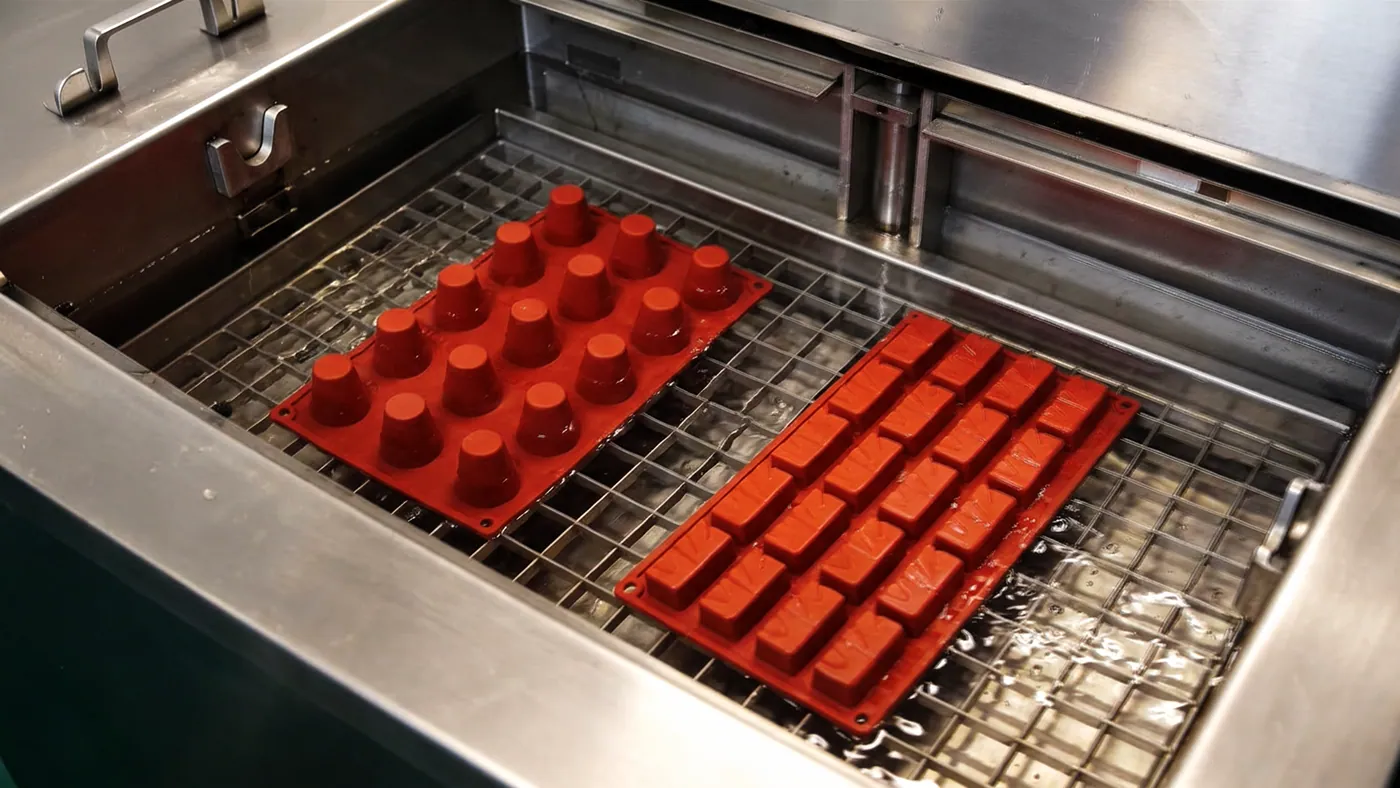
A food mould shapes the product, so every scratch, residue film or blocked hole shows up in the product or in the next hygiene audit. Moulds are also awkward to clean: deep cavities, fine perforations, engraved logos and die holes a few tenths of a millimetre wide. Spray washers clean the open surfaces and miss the rest. Ultrasonic cleaning reaches cavities, perforations and die holes evenly, at temperatures low enough for plastic moulds.
Types of mould and what they need
| Mould | Material | Soil | Wash |
|---|---|---|---|
| Chocolate and praline moulds | Polycarbonate | Cocoa butter, sugar, colour transfers | Neutral detergent, around 40 to 45 °C, within the mould maker's limits |
| Confectionery depositor moulds and plates | Silicone, polycarbonate, stainless | Sugar, gelatine, starch | Warm water with mild detergent, 45 to 55 °C |
| Cheese moulds (micro-perforated) | Polypropylene, polyethylene | Curd, whey protein, fat | Enzymatic or mild alkaline, 40 to 50 °C |
| Pasta and extrusion dies | Bronze, stainless, often with plastic inserts | Dough in every die hole | Soak to soften, then neutral or mild cleaner at 40 to 50 °C |
| Baking and forming moulds | Stainless, aluminium, coated steel | Fat, burnt-on residue | See bakery equipment |
Polycarbonate is the material to be careful with. Strong alkaline cleaners, high temperatures and some disinfectants cause stress cracking and a cloudy surface, and a cloudy chocolate mould gives dull chocolate. Use the mould maker's approved detergent, usually neutral, and stay within their temperature limit. Ultrasound itself does not harm polycarbonate at normal cleaning times; the chemistry and the temperature do.
Bronze pasta dies tarnish in alkaline cleaners. A neutral cleaner and a long soak do most of the work; the ultrasound clears the die holes that the soak has softened.
The process
- Knock out or scrape off product residue where it comes off easily. For pasta dies, soak in water until the dough in the holes is soft, often overnight.
- Ultrasonic wash at 40 kHz, 5 to 15 minutes, in a food-safe cleaner that suits the mould material.
- Rinse in potable water. For chocolate moulds, the final rinse is often demineralised water, so no water spots mark the mould surface.
- Disinfect if the plant's hygiene plan requires it for that mould type.
- Dry fully before stacking or storing. Water left in a cavity marks the next product, and moulds stacked wet grow mould.
Loading
- One layer, cavities facing down or on edge. Air trapped in an upward-facing cavity blocks cleaning; a cavity facing down lets air out and soil fall out.
- Separators between moulds. Two polycarbonate moulds rubbing together in a vibrating bath scratch each other, and a scratch shows on every chocolate made in it.
- Plastic-coated or stainless racks, no bare wire contact on the working faces.
- Perforated cheese moulds upright, so liquid can flow through the perforations.
See loading the basket.
Keeping the bath clean
Cocoa butter and cheese fat float when the bath rests, and sugar and starch dissolve into it. A skimmer and a filter loop keep a bath usable through a shift; sugar-laden baths should be changed daily, because sugar in a warm bath ferments. See filtration and bath life.
Which machine
| Work | Set-up |
|---|---|
| Artisan chocolatier, small moulds | UMX Pro 50L or 62L at 40 kHz with a mould rack, rinse sink |
| Confectionery or cheese plant, moulds by the rack | ST-157 to ST-300 at 40 kHz, racks, rinse tank with demineralised water, drying |
| Moulds in volume, heavy mould stacks | AL-300 to AL-600 with lift and filtration, rinse and drying stations |
| Pasta dies | ST-65 or ST-96, soak and ultrasonic wash in the same tank |
Tank size follows the largest mould or rack, not the volume; see how to size a tank. The food industry overview covers chemistry and hygiene in general.