
Parts and contaminants · 4 min read · Updated 2026-09-26
Ultrasonic cleaning of knives in food processing plants
Hand knives, steels, scabbards and knife baskets collect fat and protein in the handle joint and along the edge, where a quick rinse leaves them. How a knife-cleaning station with an ultrasonic tank fits the shift, the temperatures that keep protein from baking on, and the steps before disinfection.
Technical guide. Figures are taken from our own spec tables; for your process we confirm the settings with a cleaning trial.
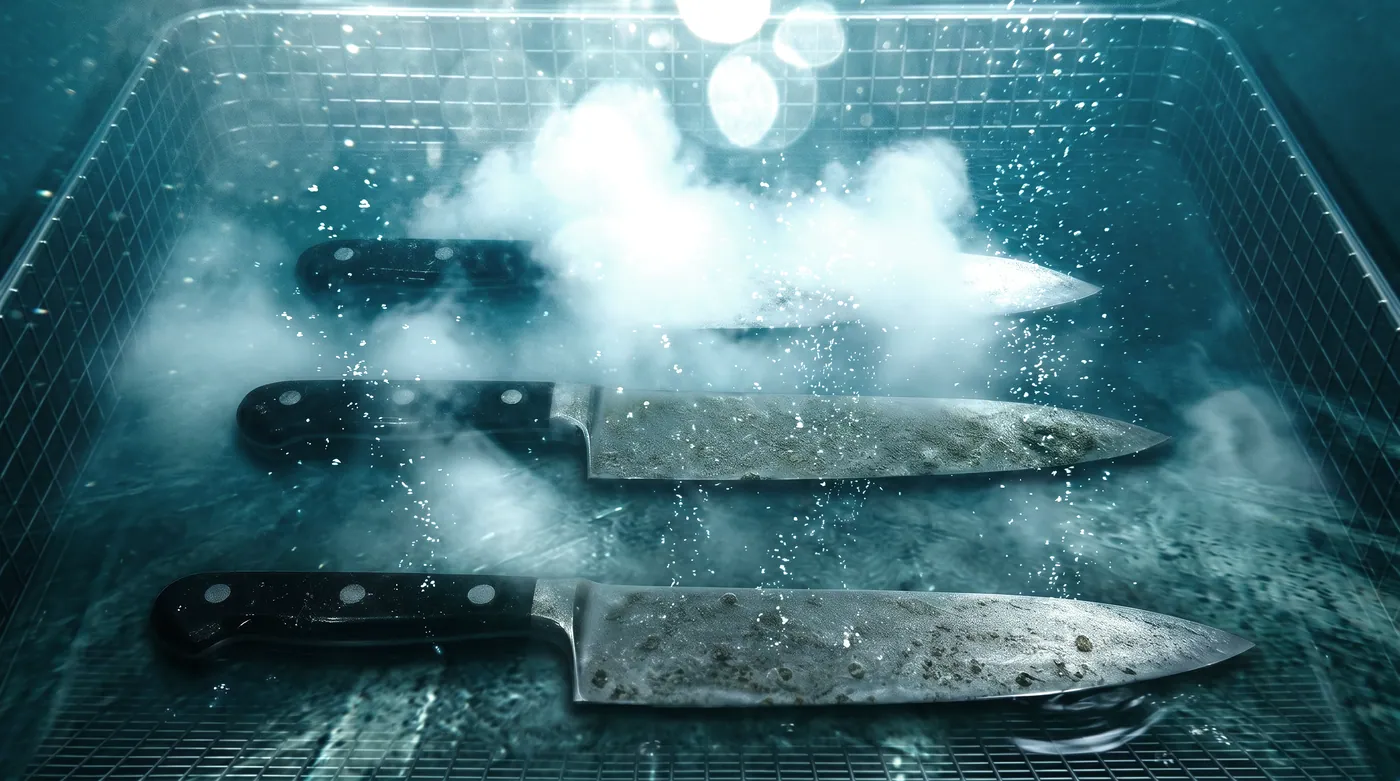
A meat, fish or vegetable plant can have hundreds of hand knives in use on a shift, plus steels, scabbards, mesh gloves and the baskets they are carried in. Each is rinsed at the workstation many times a day, and each goes through a proper clean at the breaks and at the end of the shift. The weak points are always the same: the joint between blade and handle, the bolster, the rivets or the moulded handle seam, and the scabbard's inside. Fat and protein collect there, dry on, and become the place where bacteria survive the disinfection that follows. Ultrasonic cleaning reaches those joints without anyone scrubbing each knife by hand.
What is on a knife
| Soil | Where it sits | What removes it |
|---|---|---|
| Animal fat | Blade surface, handle, scabbard | Mild alkaline cleaner above the fat's melting point, 45 to 55 °C |
| Protein: blood, meat, fish | Edge, bolster, handle joint | Enzymatic or mild alkaline cleaner at 35 to 45 °C, below the temperature where protein bakes on |
| Starch and plant juices | Blade, handle | Warm water with detergent, 45 to 55 °C |
| Mineral film from hard water | Blade, after repeated drying | Mild acidic cleaner, occasionally, in a separate step |
The temperature matters more than anywhere else in food cleaning. A knife with blood or meat protein on it that goes into a 65 °C bath comes out with the protein cooked onto the steel. Start cooler, or pre-rinse cold, and keep the wash around 40 °C when protein dominates.
The knife-cleaning station
- Cold pre-rinse at the station or a sink, to take off the bulk of meat and blood.
- Ultrasonic wash, 3 to 8 minutes at 40 kHz, in a food-safe enzymatic or mild alkaline cleaner approved for food contact surfaces. Knives stand in a rack, blade down and apart, so the edges do not touch each other or the basket wall.
- Rinse in potable water, warm, to remove cleaner and loosened soil.
- Disinfect by the plant's validated method: hot water at 82 °C in a knife steriliser, or a chemical disinfectant, as the HACCP plan specifies.
- Dry and store in a clean rack or cabinet, not back in a wet scabbard.
The ultrasonic step does not replace step 4. Ultrasonic cleaning removes soil; disinfection kills what is left, and it works reliably only on a surface that is already clean. See the food industry overview.
Keeping the bath clean
A knife tank in a meat plant takes a lot of fat and protein in a shift. Without filtration the bath is spent within hours and starts putting soil back on the knives.
- Skimmer and filter loop: fat floats up when the bath rests; the skimmer removes it, and a bag filter takes out meat particles. The SF series has both built in; see ST or SF.
- Bath change: at least once a day, and after any contamination incident. Log it with the cleaning record.
- Cover on when the tank stands, to keep aerosols and splashes out.
Knives, edges and the tank
A knife edge is fine steel, and ultrasound does not dull it in normal cleaning times. What does damage edges is contact: knives thrown into a basket in a heap knock against each other while the bath vibrates. Use a rack that holds each blade apart. Mesh gloves and aprons go in a separate load; their chain links hold fat and protein even more than knives do, and they clean well at 28 or 40 kHz in 5 to 10 minutes.
Plastic handles and scabbards stay below their temperature limit, usually 60 °C. Wooden handles have no place in a food plant, and ultrasonic cleaning would not change that.
Which machine
| Plant | Set-up |
|---|---|
| Small plant or butchery, one knife station | UMX Pro 50L or 62L at 40 kHz with a knife rack, rinse sink, knife steriliser |
| Medium plant, knives from several lines | ST-65 or ST-96 at 40 kHz with skimmer, rinse tank, drying rack |
| Large meat or fish plant, knives, steels, mesh gloves and scabbards in volume | SF-225 or SF-310 with filtration and skimmer, rinse tank, then the plant's disinfection step |
All tanks are AISI 304 stainless with the heating to hold 35 to 60 °C. For machine blades from slicers, mincers and bowl cutters, see meat processing blades.
Checking the result
Plants that clean knives centrally check them the same way they check surfaces: a visual check under good light, and ATP swabs on a sample of knives after cleaning, before disinfection. A falling ATP reading after an ultrasonic step is introduced is the most direct evidence that the joints are now clean.