
Parts and contaminants · 3 min read · Updated 2026-09-26
Ultrasonic cleaning of packaging equipment components
Filling nozzles, dosing pistons, forming sets, sealing jaws, cutting knives and vacuum cups collect product, film residue and dust between format changes. Which packaging parts are cleaned in an ultrasonic tank, how to treat heat-sealing jaws and coated parts, and how cleaning fits a format or allergen changeover.
Technical guide. Figures are taken from our own spec tables; for your process we confirm the settings with a cleaning trial.
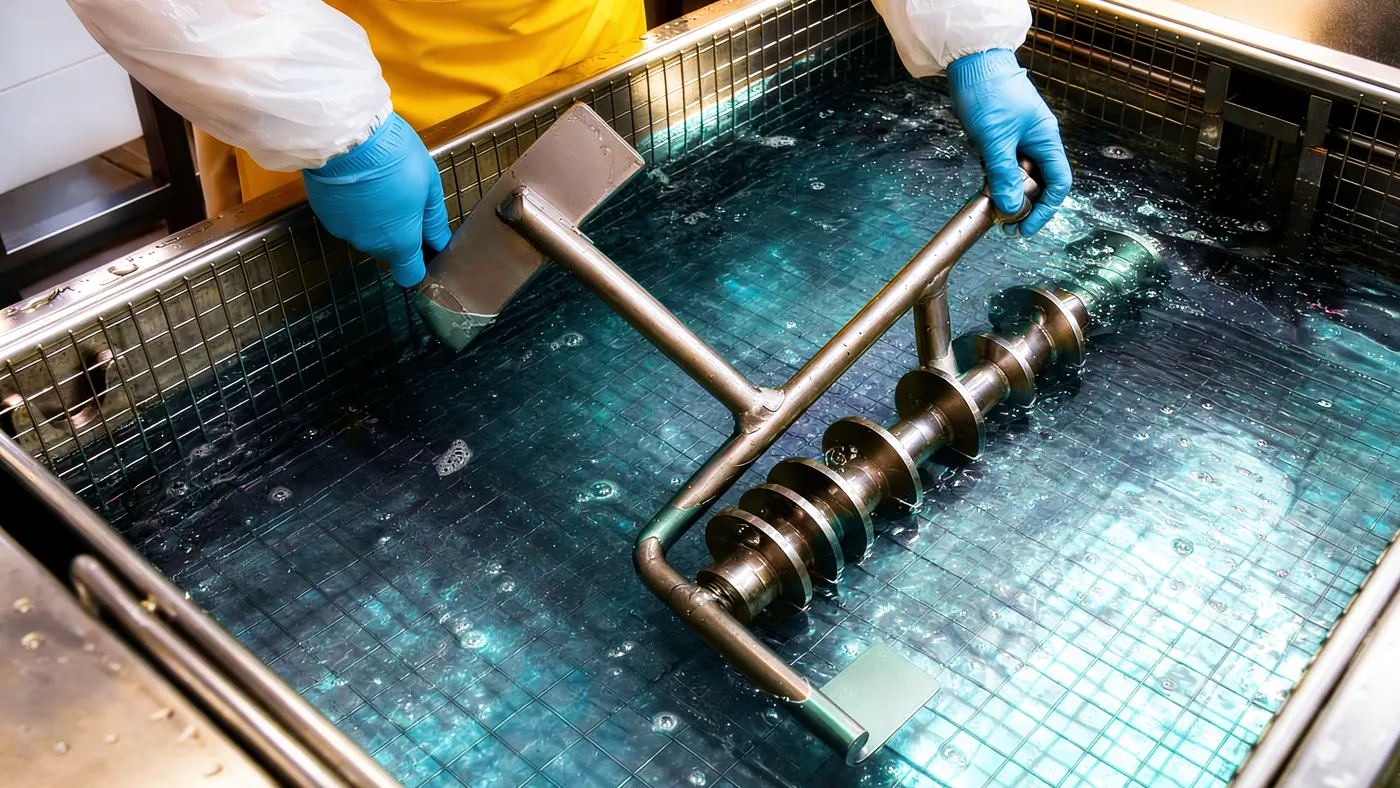
A packaging line touches the product at a few points: the filler, the dosing unit, the forming and sealing station and the cutter. Those parts come off at every format change, product change or deep clean, and they have to be clean before the next product runs, especially when the change involves an allergen. They are small, precise and full of bores, grooves and channels. An ultrasonic tank next to the line cleans a full set in minutes, which is what makes a short changeover possible.
Parts and soil
| Part | Soil | Care point |
|---|---|---|
| Filling nozzles, valves, dosing pistons and cylinders | Liquid or pasty product, powder | Bores and seal grooves; pistons are matched to their cylinders |
| Auger fillers for powders | Powder caked with humidity | Flight roots, shaft bore |
| Forming sets and forming shoulders | Product dust, film debris | Polished forming surfaces must not be scratched |
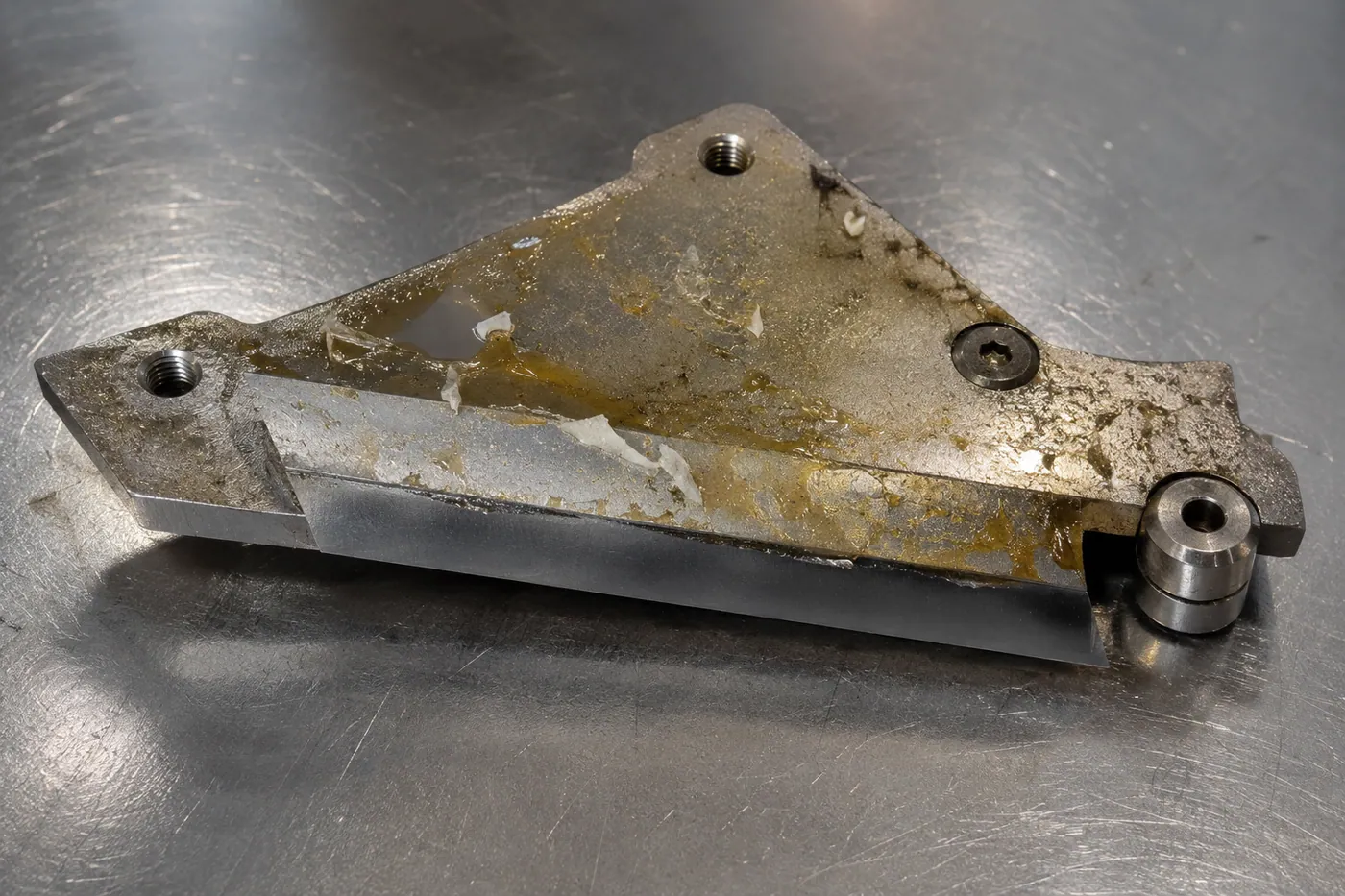
| Heat-sealing jaws | Burnt product, melted film residue | Serrations; many jaws are coated |
| Cutting knives and perforating blades | Product, film fragments | Edges |
| Vacuum cups and pick-and-place grippers | Product dust, crumbs | Rubber parts at low temperature only |
| Change parts: star wheels, guides, screws | Product spills | Plastic parts within their temperature limit |
Cleaning settings
| Soil | Cleaner | Temperature | Frequency | Time |
|---|---|---|---|---|
| Liquid and pasty food, fat, protein | Food-safe mild alkaline or enzymatic | 40 to 55 °C | 40 kHz | 5 to 10 min |
| Powder, sugar, starch | Warm water with detergent | 45 to 55 °C | 40 kHz | 3 to 8 min |
| Burnt product and film residue on sealing jaws | Mild alkaline, longer time | 50 to 60 °C | 40 kHz | 10 to 20 min, repeated if needed |
Sealing jaws are often PTFE-coated or hard-coated, and their serrations must stay sharp to seal. Use a mild cleaner, 40 kHz and several short cycles rather than a long aggressive one, and never scrape the serrations with metal tools. Jaws with heating cartridges and thermocouples fitted must have them removed, unless the maker states they may be immersed.
Matched parts such as dosing pistons and cylinders are cleaned as a pair, in a divided basket, and reassembled together. See loading the basket.
Fitting cleaning into a changeover
A changeover is time the line does not produce. Cleaning is usually its longest part, so it is worth organising:
- A second set of format parts: while one set runs, the other is cleaned, dried and ready.
- A cleaning trolley or rack per format, loaded straight into the tank, so no part is handled twice.
- A programme per part set on the cleaner, so the same result comes out regardless of shift.
- Rinse, disinfect as required, dry and store covered in the format cabinet.
- Verification after an allergen change: visual check and allergen protein swabs, per the plant's validated procedure. See stainless food contact parts.
Which machine
| Work | Set-up |
|---|---|
| One line, small format parts | UMX Pro 50L or 62L at 40 kHz with programmes, rinse sink, drying rack |
| Several lines, format sets daily | ST-96 to ST-157 at 40 kHz with skimmer, rinse tank, hot-air drying |
| Large change parts and full format trolleys | AL-300 to AL-600 with lift, sized to the trolley rack |
For bottling-line parts such as filling valves and capping heads, see bottling equipment. The food industry overview covers chemistry and hygiene in general.