
Parts and contaminants · 3 min read · Updated 2026-09-26
Ultrasonic cleaning of stainless steel food contact parts
Valves, pump rotors, fittings, nozzles, sieves and change parts in AISI 304 and 316 stay hygienic only if their surface stays clean and passive. How ultrasonic cleaning fits between dismantling and disinfection, the chemistry that protects stainless, the mistakes that make it rust, and how the result is verified.
Technical guide. Figures are taken from our own spec tables; for your process we confirm the settings with a cleaning trial.
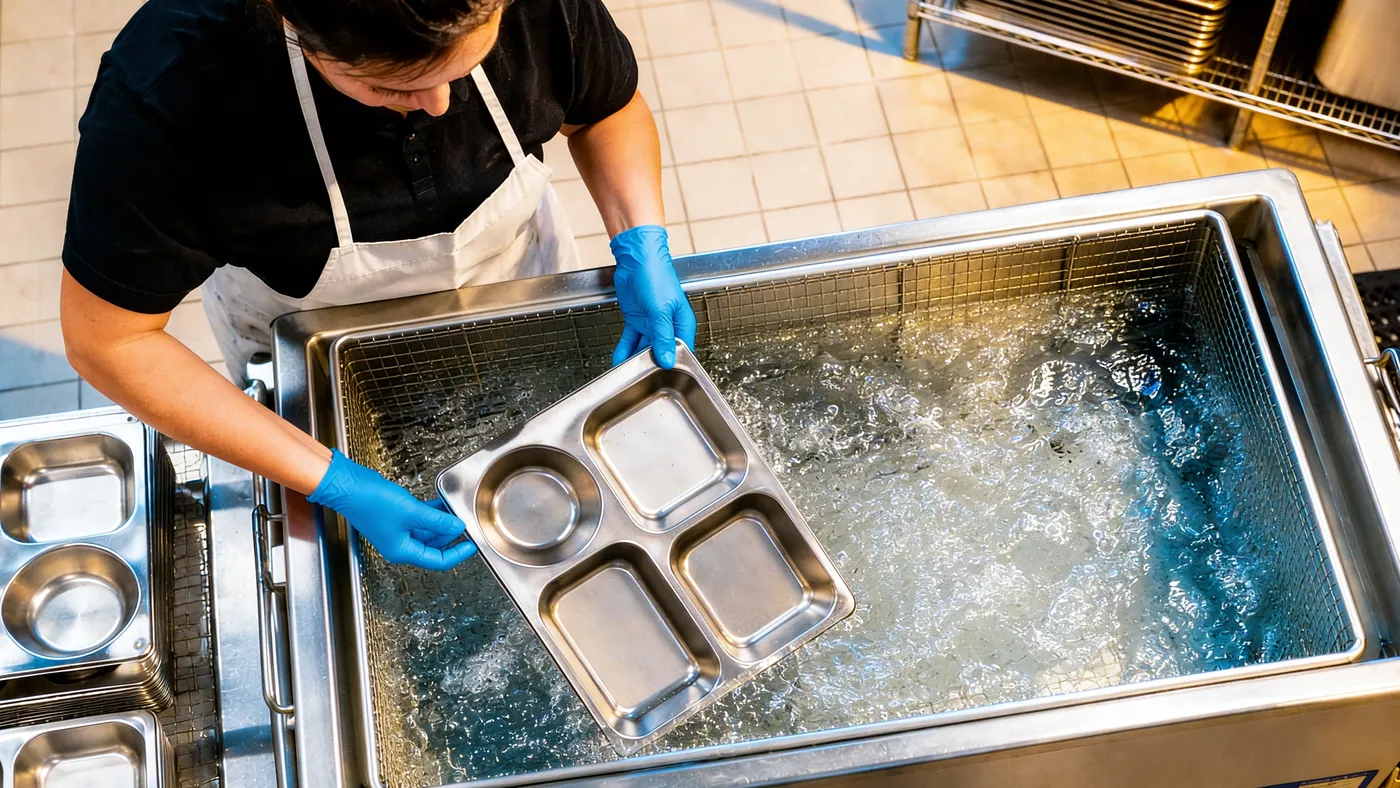
Almost everything that touches food in a plant is stainless steel, usually AISI 304 or 316L. Stainless is chosen because a clean, smooth, passive surface is easy to keep hygienic. The condition is that it stays clean and passive. Residue left in a thread, a seal groove or a pump rotor becomes a place for biofilm, and a surface damaged by the wrong chemistry or by carbon-steel contamination starts to pit and rust. Ultrasonic cleaning handles the removable parts with internal geometry, the ones that cleaning in place does not reach well.
The parts
- Valve internals: plugs, stems, seats, and the seal grooves around them.
- Pump parts: lobe and impeller rotors, casings, mechanical seal parts.
- Fittings: clamps, ferrules, elbows, tees, sight glasses.
- Filling and dosing parts: nozzles, pistons, cylinders; see also bottling equipment.
- Sieves, strainers and screens; see food industry filters.
- Change parts: star wheels, guides and format parts removed at a product change.
The sequence
- Dismantle the part fully; remove gaskets and O-rings, which are cleaned separately or replaced.
- Pre-rinse with cold or lukewarm water to remove loose product.
- Ultrasonic wash in a food-safe cleaner approved for food contact surfaces:
| Soil | Cleaner | Temperature |
|---|---|---|
| Protein (meat, dairy, egg) | Enzymatic or mild alkaline | 35 to 45 °C |
| Fat and oil | Mild alkaline | 50 to 60 °C |
| Sugar, starch | Warm water with detergent | 45 to 55 °C |
| Mineral scale, milk stone | Acidic descaler, in a separate step | 40 to 60 °C |
40 kHz, 5 to 15 minutes, parts loaded so that bores and grooves are open to the liquid. 4. Rinse in potable water. 5. Disinfect by the plant's validated method. 6. Dry and store covered, or reassemble at once.
Ultrasonic cleaning removes soil; it does not disinfect. It makes the disinfection reliable, because disinfectants lose most of their effect on a surface still carrying organic soil.
Protecting the stainless
Stainless steel is stainless because of a thin passive oxide layer. The cleaning step should not damage it:
- Chlorides are the enemy. Chlorinated cleaners, chlorine-based disinfectants left too long, and even salt-laden product residue cause pitting, especially in 304 and in crevices. Rinse disinfectant off as the procedure specifies, and never let chlorinated solutions stand in the cleaning tank; see tank material.
- No carbon steel contact. Steel wool, carbon-steel brushes and a basket shared with carbon-steel parts leave iron particles on the surface, which rust and look like the stainless is corroding. Keep stainless parts in stainless baskets, cleaned only with stainless or plastic tools.
- Acids with care. Descalers based on phosphoric, citric or nitric acid are compatible with stainless at the right concentration and temperature, and nitric acid is also used to repassivate. They are used in a separate step, in an insert or a 316 tank, and rinsed off fully.
- Dry parts. Water left in a crevice with chlorides from tap water is where pitting starts.
Verifying the result
A hygiene plan does not accept "looks clean". The usual checks after the cleaning step, before disinfection:
- Visual inspection under good light, including grooves and bores with a torch.
- ATP swabs, which show residual organic material within a minute.
- Allergen protein swabs where a product change involves allergens; the cleaning has to be validated for each allergen changeover.
Track the results. A clean trend after the ultrasonic step is introduced is the evidence an auditor wants, and a drift shows when the bath needs changing or the procedure is slipping.
Which machine
| Work | Set-up |
|---|---|
| Small parts: nozzles, fittings, valve internals | UMX Pro 50L or 62L at 40 kHz, stainless baskets, rinse sink |
| Pump and valve parts from several lines | ST-96 to ST-157 at 40 kHz with skimmer, rinse tank, drying |
| Change parts and larger parts in volume | SF-225 or SF-310 with filtration, or an AL system with lift |
The tanks are AISI 304 with welds ground flush; AISI 316 where acidic descaling or chloride-containing chemistry is used in the tank. See the food industry overview.