
Parts and contaminants · 9 min read · Updated 2026-11-16
Cleaning injection moulds: cavities, vents and inserts
Injection mould cleaning with ultrasound: what to strip, which bath and frequency suit polished and textured cavities, and how to dry and protect the steel.
Technical guide. Figures are taken from our own spec tables; for your process we confirm the settings with a cleaning trial.
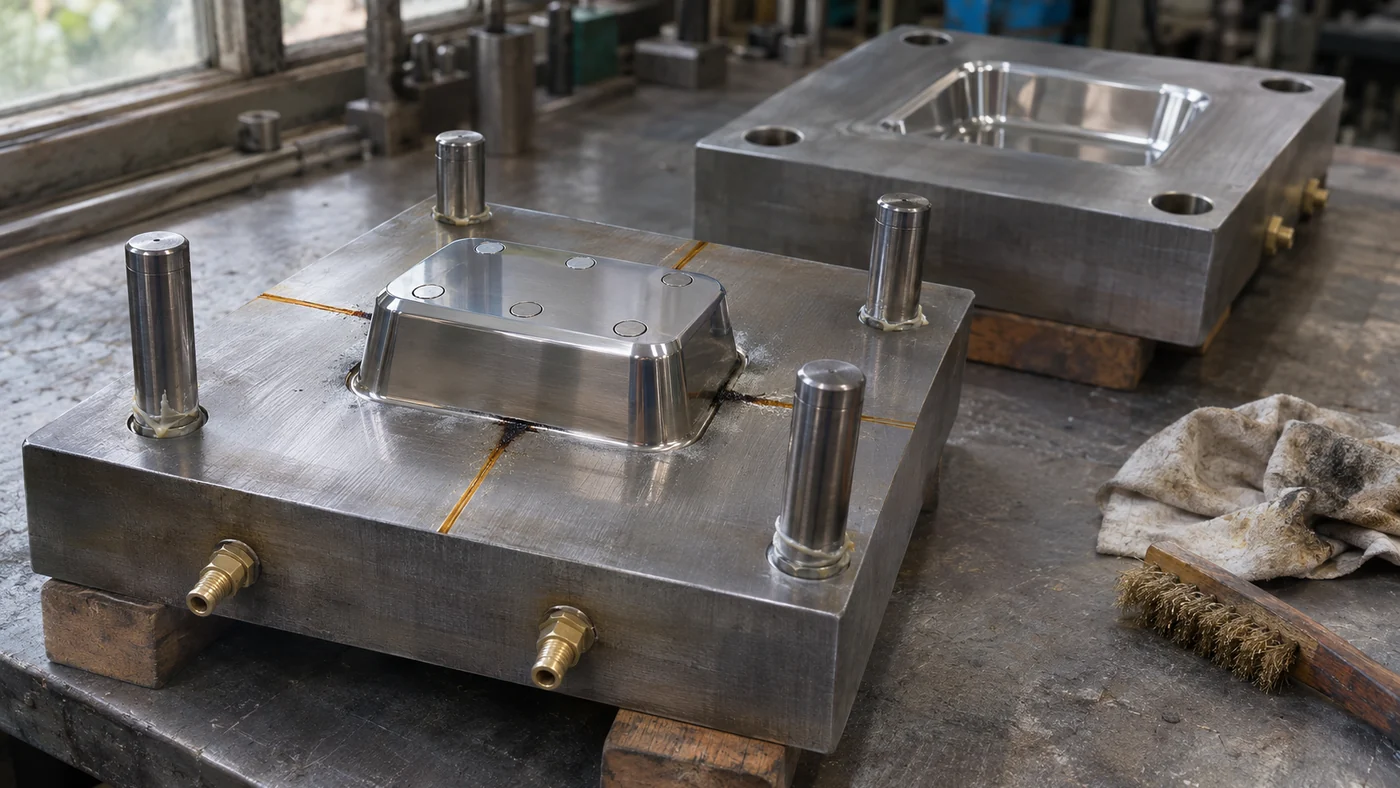
An injection mould gets dirty slowly. Every shot leaves a trace of gas, additive and release agent on the cavity, and most of that trace collects where the melt ends: in the vents, at the parting line and around ejector pins and inserts. After some thousands of shots the vents start to close. The parts show burn marks, short shots or a dull patch, and the mould comes out of the machine for maintenance. So how do you clean cavities, vents and inserts in an ultrasonic tank, with the least possible wear on polished or textured surfaces?
To clean an injection mould in an ultrasonic tank, strip it first, then clean steel plates and inserts at 40 kHz in an inhibited alkaline mould cleaner at 55 to 65 °C
The plastics industry page gives the wider picture. Here we stay with the maintenance procedure on the bench.
What deposits build up on an injection mould?
Injection moulds collect four kinds of deposit: outgassing films from the polymer and its additives, release agent and ejector-pin grease, degraded or charred polymer, and condensation marks or light rust. The deposits gather where the melt ends, in vents, at the parting line and around ejector pins and inserts: narrow gaps that a 40 kHz ultrasonic bath reaches.
- Outgassing deposits. A thin, often glassy or waxy film formed from volatile parts of the polymer and its additives: flame retardants, lubricants, stabilisers, plasticisers. Some materials deposit much more than others. The film collects in the vents and on the cavity surface near the end of fill.
- Release agent and grease. Sprayed release agent on the cavity, and grease from ejector pins, slides and lifters that migrates onto nearby surfaces.
- Degraded polymer. Charred or cross-linked material in vents, on shut-offs and around inserts.
- Corrosion and condensation marks. A cold mould in a humid hall gathers condensation, and some polymers release corrosive gases. Light surface rust appears first on unprotected steel.
Ultrasound is good at the first three because the deposits sit in narrow gaps that a brush or a cloth does not reach. Heavy charred material may still need a soft tool after the bath.
What must come off the mould before ultrasonic cleaning?
Everything electrical or sealed comes off an injection mould before it goes into an ultrasonic tank: hot-runner manifolds, sensors, limit switches, connectors, core-pull cylinders, O-rings and sealed cooling connectors. Inserts, ejector pins, slides and lifters come out, numbered. The mould cools first, because a hot mould half in a 60 °C
- Remove everything electrical or sealed. Hot-runner manifolds with their heaters and thermocouples, cavity pressure and temperature sensors, limit switches, connectors and hydraulic core-pull cylinders stay out of the tank. So do O-rings and the cooling connectors with seals.
- Take out inserts, ejector pins, slides and lifters. Number them or lay them in a numbered tray. Every part must go back to its own bore.
- Note the surface finish of each part: high polish, texture (EDM or etched), coating (nitride, PVD, hard chrome, nickel) or plain machined. That decides frequency, cleaner and time.
Cooling channels are a separate subject. Short bores in an insert are reached by the bath. Long closed channels in a plate need flushing with a circulating cleaner, which a tank does not do.
Which cleaner, temperature and frequency suit injection moulds?
Steel mould plates and inserts clean in an inhibited alkaline mould cleaner at 3 to 5 %, 55 to 65 °C
| Part | Cleaner | Temperature | Frequency | Starting time |
|---|---|---|---|---|
| Steel plates and inserts, plain or textured | alkaline mould cleaner with corrosion inhibitor, 3 to 5 % | 55 to 65 °C |
40 kHz (28 kHz for heavy deposits on plain machined steel) | 10 to 20 min |
| Highly polished cavities | mild alkaline cleaner with inhibitor | 50 to 55 °C |
40 kHz | short cycles, check, repeat if needed |
| Coated cavities and cores | mild cleaner rated for the coating | 50 to 55 °C |
40 kHz | short cycles |
| Copper-alloy inserts | neutral or mildly alkaline cleaner | 45 to 55 °C |
40 kHz | short cycles |
| Aluminium moulds and inserts | cleaner rated for light alloys, inhibited | 50 to 55 °C |
40 kHz | short cycles |
| Ejector pins, slides, small parts | alkaline degreaser | 55 to 65 °C |
28 or 40 kHz | 8 to 15 min, in a fine-mesh insert |
Source: Sonixtek guides on cleaning liquids, mechanical parts and oil removal; check the cleaner's data sheet.
Why 40 kHz for cavities: the bubbles are smaller and more numerous, they form in narrower gaps such as vents and fine texture, and each collapse releases less energy, which keeps erosion low on polished steel. 28 kHz cleans heavy deposits on plain steel faster.
Ask your cleaner supplier for a product rated for mould steels and for your type of deposit, and ask whether your outgassing film needs a dedicated mould-deposit remover. Keep the bath below about 70 °C
Grease and oily release agent that come off the mould float on the bath. Skim them off before you lift a polished plate out, or use a tank with laminar flow, which pushes the floating film to the overflow so the part leaves through clean liquid.
How should mould plates and inserts go into the basket?
Mould plates go into the basket with cavity and vent faces up or sideways, never face down on the grid, and polished faces rest on plastic strips so they never touch steel. Small parts go in a fine-mesh insert. Mould steel weighs about 7.85 kg
Point the cavity and vent faces towards the free sound field. A coated rack works as well as plastic strips. Keep inserts apart from each other, and sort ejector pins and inserts by number in the fine-mesh insert.
Weight. A 75 kg
| Model | Basket (L × W × H) | Basket load | Suits |
|---|---|---|---|
| ST-157 | 680 × |
100 kg |
plates up to about 640 × |
| ST-206 | 730 × |
100 kg |
plates up to about 690 × |
| ST-300 | 870 × |
125 kg |
plates up to about 830 × |
Source: Sonixtek product data, Nov 2026. Plate size = basket minus 20 mm
For inserts, slides and small moulds, the UMX Pro compact cleaners (50 to 255 L
How do you stop a cleaned mould from rusting?
A cleaned injection mould has no protection and can start to rust within hours in a humid hall. Rinse it in clean water at 40 to 60 °C
- Rinse in clean warm water to take the cleaner off. The demineralised final rinse keeps water spots off polished cavities; a fingerprint on a polished cavity leaves a mark too.
- Dry at once. Drying follows the rinse straight away. A hot-air dryer from the DT series works at 30 to 100 °C
(86 to 212 °F) . The DT-206 takes the ST-206 basket and the DT-96 the ST-96 basket, without repacking. Blow out vents, ejector bores and cooling connections with clean, dry compressed air. Why drying straight after the rinse matters: preventing water spots and flash rust. - Inspect the vents under good light. A vent is clean when its full depth is visible and free of film.
- Protect. Spray a mould preservative on all steel surfaces, grease ejector pins and slides with the specified grease, and reassemble or store the mould closed.
The rinsing and drying article covers the rinse stages in detail, and cleaning liquids explains how to match the cleaner to each metal.
Series for mould maintenance: ST series, UMX Pro series and DT series.
Frequently asked questions
Does ultrasonic cleaning damage polished mould cavities?
At 40 kHz the cavitation bubbles are small and each collapse releases little energy, which keeps erosion low on polished steel. Use a mild inhibited cleaner at 50 to 55 °C
Can cooling channels be cleaned in an ultrasonic tank?
Short bores in an insert are reached by the bath. Long closed cooling channels in a mould plate need flushing with a circulating cleaner, which an ultrasonic tank does not do, so plan channel cleaning as a separate step.
How heavy a mould plate can an ST tank take?
The ST tanks in this guide take 100 to 125 kg
Why should the bath stay below about 70 °C (158 °F) ?
Cavitation weakens as water gets hotter, so a hotter bath does not clean harder. For mould steel, 55 to 65 °C
What to send us for a quote
- The size and weight of the largest mould plate or half you want to clean, and of the smallest inserts.
- The mould steels, surface finishes and coatings, and any copper-alloy or aluminium parts.
- The polymers you mould and what the deposit looks like; a photo of a vent helps.
- How many moulds per week or month, and whether a crane serves the maintenance bench.
- The mains supply and the space at the planned spot.
Send this through the quote form. Our technical team proposes tank size, frequency, rinse and dryer for your moulds.