
Parts and contaminants · 7 min read · Updated 2026-11-16
Mould cooling channels: what ultrasound can clean
Which mould cooling channels an ultrasonic tank can clean, which need circulation with a descaler, the chemistry order and how to check flow afterwards.
Technical guide. Figures are taken from our own spec tables; for your process we confirm the settings with a cleaning trial.
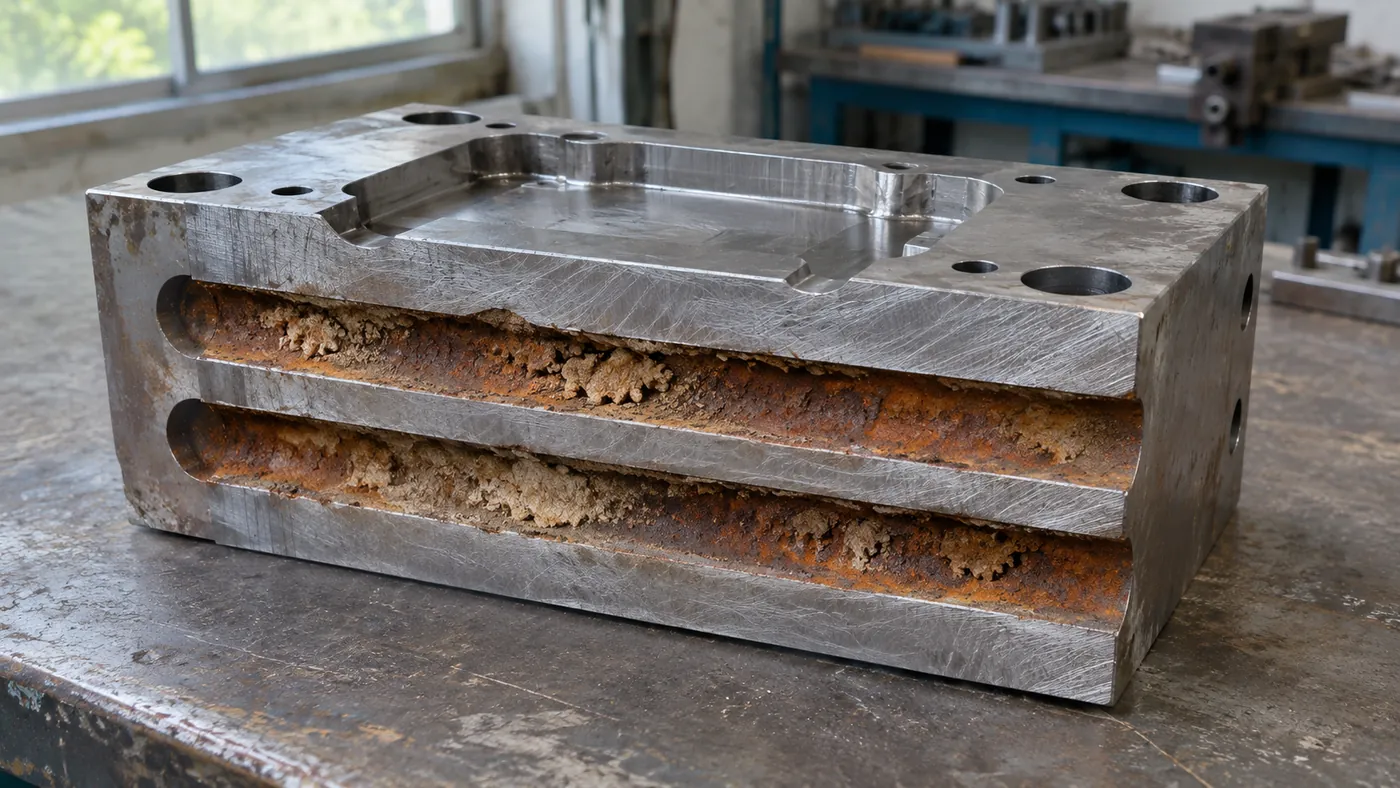
A mould insert comes out of the tank with clean faces, yet the circuit still cools poorly. The bath reached the outside. Inside, the bore held air, stayed blocked by scale, or kept the loosened scale because it had no way out. Cleaning a cavity face and clearing a cooling channel are two different jobs.
Can ultrasonic cleaning clear mould cooling channels? Partly. A 40 kHz bath cleans short, open bores in a removable insert once liquid fills them and the air has escaped. Long or scaled channels in a mould plate need a descaler circulated through the circuit, because loosened scale has no way out. Check the flow of every circuit afterwards.
Does the bath reach the inside of a cooling bore?
A cooling bore is cleaned in the bath only when it is completely filled with liquid and holds no trapped air. Liquid inside a filled bore cavitates, as inside a heat-exchanger tube, and a 40 kHz bath suits small bores. A bore closed by scale takes in no liquid, so immersion does not reach it.
Get the channel drawing before you decide. Mark inlets, outlets, cross-drillings, plugs and blind ends. A short straight bore open at both ends fills and drains easily. A long channel with bends and cross-drillings may fill, but the scale it loosens stays inside unless liquid flows through and carries it out. The EGR valve guide describes the same limit for cooler tubes: soaked and cleaned ultrasonically, then flushed through.
The 28 or 40 kHz guide explains why the smaller bubbles reach fine features, and why ultrasound reaches beyond a brush covers access in general. Neither frequency nor generator power sets a maximum cleanable channel length. That limit comes from your channel layout and deposit.
| Channel situation | 40 kHz immersion | Next step |
|---|---|---|
| Short open bore in a removable insert | Reached once filled and vented | Rinse, then dry at once |
| Long closed channel in a mould plate | Not effective on its own | Circulate a compatible descaler |
| Channel blocked by scale | Does not reach the deposit | Open the path, then circulate |
| Oil film over scale | Alkaline wash removes the oil | Descale as a second step |
Source: Sonixtek guides on heat exchangers, EGR valves and coolers, and removing rust and oxide.
How should a removable insert sit in the tank?
Support a removable mould insert so air can leave its bores: open ends angled upward, 10 to 20 mm
The basket-loading guide gives an upward tilt of about 30 to 45° for blind holes, so the air rises out. For a cooling bore, follow the channel drawing: the end that vents last faces up. Build the angle into a fixture, so every cycle uses the same position.
Take out O-rings and sealed cooling connectors before the insert goes in, or confirm they suit the chemistry. Remove plugs only where the mould maker allows it, and number them. Keep cavity faces off the basket bars. Measure insert and fixture together in the cleaning position; the fixture takes space and adds to the load.
After lifting, tip the insert so liquid and loosened particles drain from every bore.
How much liquid and space should surround the insert?
Keep 30 to 50 mm
| Loading item | Guide value | Purpose |
|---|---|---|
| Gap between parts | 10 to 20 mm |
Less contact and shielding |
| Liquid above parts | 30 to 50 mm |
Faces stay submerged |
| Blind-hole tilt | 30 to 45° | Air rises out |
Source: Sonixtek guide "Loading the basket", spacing, orientation and immersion.
The loading guide's rule of thumb is that parts fill no more than about a third of the working volume and cover no more than about two thirds of the floor area. A single heavy insert usually stays inside that rule. Its limit is the access to the channels, not the tank load.
Choose the chemistry from the deposit and every wetted material
Cooling channels collect mineral scale, rust and often an oil film. Clean in two steps: an alkaline wash first, because an acidic descaler cannot reach scale that is covered by oil, then the descaler. The heat-exchanger guide uses the same order, with phosphoric, citric or sulfamic acid based descalers for scale and iron oxide.
Rust is the surface itself, not a layer on it. The rust and oxide guide explains why: cavitation does not lift oxide off, it keeps fresh chemistry in contact and carries the reaction products away. That is also why a channel without flow cleans poorly.
Every wetted material must tolerate the descaler: tool steel, copper alloy inserts, coatings, seals and fittings. So must the tank. Standard tanks are AISI 304, which suits neutral and mildly alkaline cleaners but not acidic or chloride-bearing baths. Use an acid-resistant insert tank, a separate descaling tank, or a tank in 316L
Time and temperature depend on the deposit and the descaler; test on your part.
When a flushing unit is the separate tool
For long or blocked channels, a flushing unit pumps the descaler through the circuit and carries loosened scale to an outlet. It is a separate tool from the ultrasonic tank. A channel that is completely blocked is opened mechanically first, as heavily blocked heat-exchanger tubes are.
A practical route splits the work. The removed inserts go through the tank for the cavity faces and short bores. The closed circuits in the plates are circulated. Both are rinsed and dried at once, because bare tool steel can flash-rust after an aqueous wash. Keep acidic flushing liquid out of a 304 tank.
Record the flow of each circuit before cleaning and repeat it after, under the same conditions; a clear discharge alone does not show that every branch is open. Leak-test after refitting plugs and connectors, following the mould maker's procedure. Inspect for pitting: cleaning shows corrosion damage that the scale hid, and it does not replace lost metal.
The plastics industry page covers mould maintenance in general. For the removable inserts, compare ST industrial tanks and UMX Pro compact cleaners.
Frequently asked questions
Does a clean cavity prove that the cooling circuit is clean?
No. The cavity face sits openly in the bath, while a channel inside can still hold air or scale. Check the flow of each circuit separately and compare it with the value recorded before cleaning.
Can a stronger generator replace a flushing unit?
No. More ultrasonic power does not move liquid through a long or blocked channel, and loosened scale needs flow to leave it. Circulation does that job. Use the tank for the inserts and short bores.
Does a stainless tank accept every descaler?
No. Standard AISI 304 tanks suit neutral and mildly alkaline cleaners, not acidic or chloride-bearing descalers. Use an insert tank, a separate descaling tank or a 316L
What to send us for a quote
Send the channel drawing, the insert dimensions and weight, photos of the deposit, the steel and any copper alloy or coating, and the descaler data sheet. Add how many inserts you clean per month. Our technical team checks which parts suit the tank and where circulation is the right tool; use the quote enquiry.