
Choosing a machine · 9 min read · Updated 2026-11-16
STS or SX: which benchtop ultrasonic cleaner for a workshop
STS and SX are both heated benchtop cleaners with degas and sweep. The SX adds power steps, pulse, memory and IP54. How to choose for workshop parts.
Technical guide. Figures are taken from our own spec tables; for your process we confirm the settings with a cleaning trial.
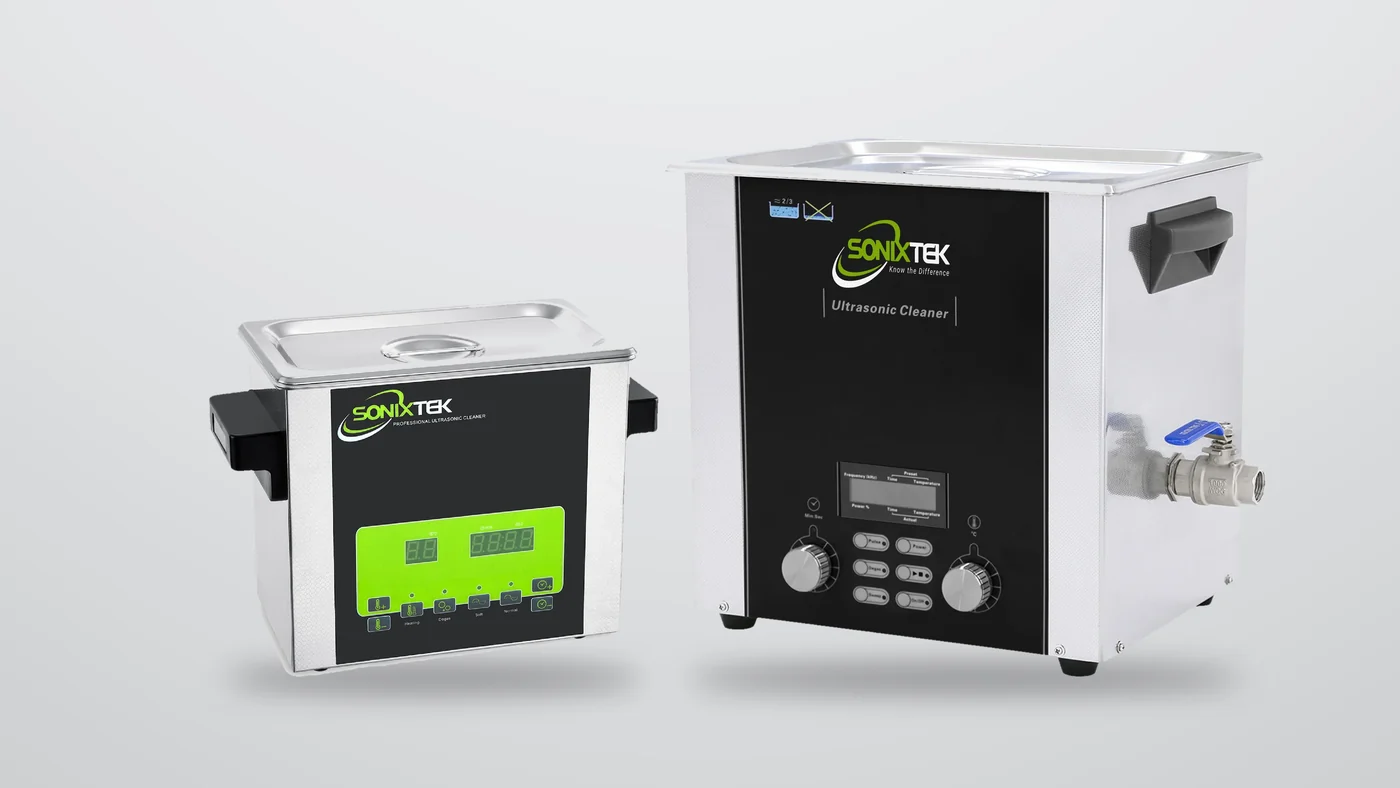
A workshop that cleans carburettor bodies, injectors, small housings and hardware by hand usually ends up with a benchtop ultrasonic cleaner. We offer two ranges, the STS and the SX, and this article compares them with the figures from the product pages.
Which benchtop ultrasonic cleaner suits a workshop? The STS benchtop cleaner, 40 kHz in eight sizes from 2 to 30 litres
How do the STS and SX compare at the same tank size?
At the same tank size, the SX benchtop cleaner carries more ultrasonic power and, up to 15 litres
| Inner tank (mm) | STS model | SX model | Ultrasonic STS / SX | Heating STS / SX |
|---|---|---|---|---|
| 150 × |
STS-020, 2 L |
— | 60 W / — | 100 W / — |
| 240 × |
STS-030, 3 L |
SX-3L, 3 L |
120 W / 160 W | 100 W / 300 W |
| 300 × |
STS-060, 6 L |
SX-6L, 6 L |
180 W / 240 W | 300 W / 450 W |
| 300 × |
STS-090, 9 L |
SX-10L, 10 L |
240 W / 320 W | 300 W / 450 W |
| 330 × |
STS-150, 15 L |
SX-15L, 15 L |
360 W / 480 W | 400 W / 600 W |
| 330 × |
STS-150-PRO, 15 L |
— | 360 W / — | 500 W / — |
| 500 × |
STS-200, 20 L |
— | 480 W / — | 800 W / — |
| 500 × |
STS-300, 30 L |
SX-28L, 28 L |
600 W / 640 W | 800 W / 750 W |
Source: Sonixtek product data, Nov 2026.
The liquid you actually use below the fill line is less than the nominal litres, so size by the tank: the largest part plus about 20 mm
| STS | SX | |
|---|---|---|
| Sizes | 2 to 30 L |
3 to 28 L |
| Frequency | 40 kHz | 37 kHz |
| Degas and sweep | Yes | Yes |
| Power steps | — | 40, 70 or 100 % |
| Pulse | — | Bursts up to 120 % of rated output |
| Memory of the last cycle | — | Yes |
| Temperature setting | 0 to 80 °C |
20 to 80 °C |
| Rated basket load | 5 to 50 kg |
Not stated; ask us to confirm the fit |
| Drain valve | From the STS-060 (6 L |
From the SX-10L; on request for 3 and 6 L |
| Housing protection rating | Not stated | IP54 |
| Noise | Not stated | About 60 dB(A) in operation (indicative) |
Source: Sonixtek product data, Nov 2026.
What do the STS and SX benchtop cleaners both do?
Both the STS and the SX benchtop cleaners heat the bath to 80 °C
A workshop bath gets dirty fast and is changed often, and every fresh fill is full of dissolved air. That air cushions the cavitation, so the bath cleans noticeably worse until it is driven out. Run degas after every fresh fill or change of cleaner, before the first load.
At a fixed frequency the sound field forms standing waves, with stripes of strong and weak cleaning about 18 to 20 mm
When is the SX the better benchtop cleaner?
The SX is the better benchtop cleaner when several people share one machine or one bench cleans steel and aluminium parts. The SX adds power steps of 40, 70 or 100 %, pulse up to 120 % of rated output, memory of the last cycle, an IP54 housing and, at 3 litres
Power steps. In a workshop that cleans steel injector parts in the morning and aluminium carburettor bodies in the afternoon, the lower step is gentler on soft metals and makes the bath quieter. The STS has no power steps.
Pulse. For stubborn soil, the SX adds bursts up to 120 % of rated output in the first minutes of a heavy cycle. It is not meant for soft metals, coated parts or fine electronics.
More heat on the small and mid sizes. A benchtop heater is sized to bring the bath up and hold it, not to fight a stream of cold parts, so heat-up time is what you notice. Up to 15 litres
| Model | Bath | Heating | Heat-up 20 to 50 °C |
|---|---|---|---|
| STS-030 | 3 L |
100 W | about 60 min |
| SX-3L | 3 L |
300 W | about 20 min |
| STS-090 | 9 L |
300 W | about 60 min |
| SX-10L | 10 L |
450 W | about 45 to 50 min |
Source: Sonixtek product data, Nov 2026. Heat-up: 1.16 Wh per litre and kelvin, nominal volume, before losses.
Memory. The SX stores time, temperature and power of the last cycle, so one press on Start repeats it. When several people share the machine, the cycle stays the same from one user to the next.
When is the STS the better benchtop cleaner?
The STS is the better benchtop cleaner for one job done the same way every day, for heavy baskets and for sizes the SX does not offer. The STS states basket loads from 5 kg
- More sizes. The 20-litre STS-200 has a 500 ×
300 mm (19.7 × footprint; the STS-150-PRO has a deeper 180 mm11.8 in) (7.1 in) tank for taller parts. - Rated basket loads, from 5 kg
(11 lb) on the STS-020 to 50 kg(110 lb) on the STS-300. For a basket of steel fittings or brake components, a stated rating is useful. - A drain valve from 6 litres
(1.6 US gal) . A ball valve at the side empties the bath into a container without lifting the unit. On the SX it is standard from 10 litres(2.6 US gal) . - Simpler operation. Degas, sweep, time and temperature: for a fixed daily job, that is all the machine needs.
How do you choose between an STS and an SX?
Choose a benchtop ultrasonic cleaner by tank size first: measure the largest part and add about 20 mm
- Look at your mix of parts. One type of part and one cleaner: the STS covers it. Steel and aluminium, light and heavy soil from one bench: the power steps and pulse of the SX earn their place.
- Count the users. Several people on one machine favour the SX memory.
- Check the heat-up. If the bath has to be ready quickly, compare the heating power per size.
- Check the weight. For heavy baskets, use the STS load ratings, or ask us about the SX.
Above 30 litres
Whichever range you choose, plan the sequence as clean, rinse, dry: rinse the cleaning liquid off in clean water, then dry the parts straight away. For the drying step we propose a hot-air drying tank from the DT series; preventing water spots and flash rust after washing explains why wet parts should not wait.
Frequently asked questions
Can I spray the SX with water or put it under water?
No. The SX housing is rated IP54: protected against dust and splashing water, which helps on a bench next to a parts washer. The unit must not be sprayed or immersed. The STS has no housing protection rating stated.
How long does a benchtop ultrasonic cleaner take to heat up?
It depends on the heating power per litre. Ignoring losses, a 3-litre bath goes from 20 to 50 °C
Should I use pulse on aluminium parts?
No. SX pulse adds bursts up to 120 % of rated output in the first minutes of a heavy cycle and is not meant for soft metals, coated parts or fine electronics. For aluminium, the lower power steps of 40 or 70 % are gentler.
When is a benchtop ultrasonic cleaner too small?
A benchtop unit is too small above 30 litres
Ordering, and what to send us for a quote
The STS-020 and STS-030 can be ordered from their product pages, and our in-stock page shows what is ready to ship. Other STS sizes and every SX go through a quote. Send us:
- The largest part, with dimensions, and the weight of a full basket.
- What is on the parts: oil, carbon, coolant, fuel varnish.
- Parts per day, and how often you expect to change the bath.
- Any soft metals or coated parts in the mix.
Use the quote form. The ranges: STS series and SX series. More workshop applications are on our automotive page.