
Choosing a machine · 3 min read · Updated 2026-09-25
Benchtop or industrial: where the 30-litre line sits and why
Below 30 litres a benchtop cleaner on a 230 V socket does the job. Above it, the tank needs a frame, three-phase heating, a drain and a real basket. What changes at the boundary, with the figures from our STS, ST and UMX Pro ranges.
Technical guide. Figures are taken from our own spec tables; for your process we confirm the settings with a cleaning trial.
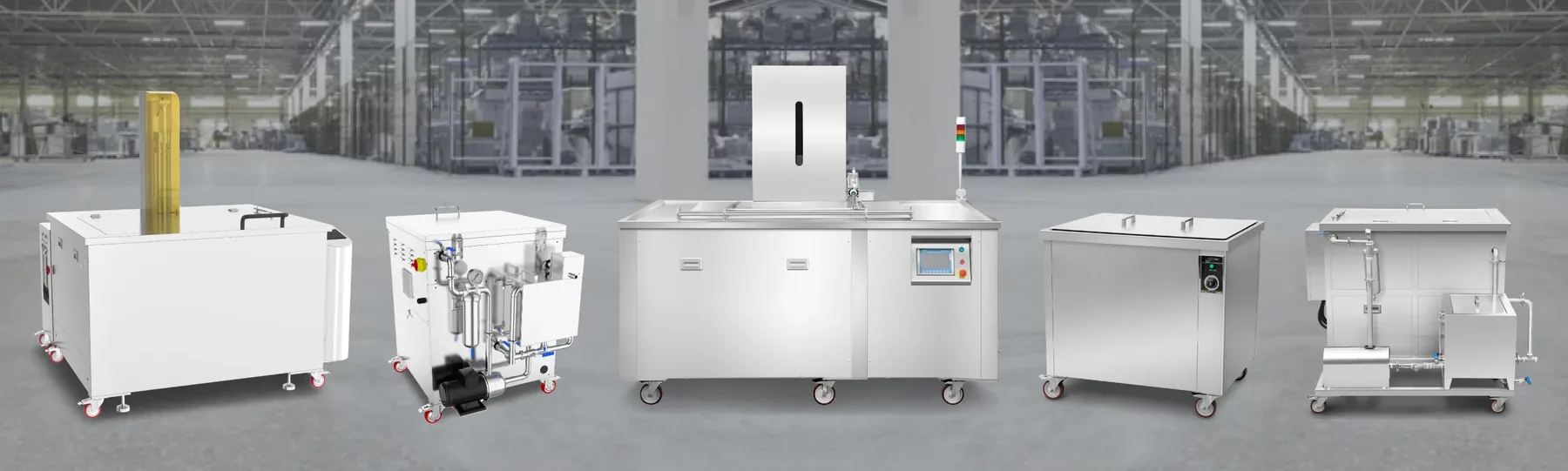
Our range has a gap between 30 and 40 litres, and it is not an accident. The STS benchtop series stops at 30 litres; the ST industrial series starts at 40. Between those two figures almost everything about the machine changes.
What a benchtop cleaner is
The STS range runs from 2 to 30 litres. The tank is welded into a case that stands on a bench, plugs into a 230 V socket, and draws between 160 W and 1400 W in total.
| Model | Tank | Ultrasonic | Heating | Basket load |
|---|---|---|---|---|
| STS-020 | 2 L, 150 × 140 × 100 mm | 60 W | 100 W | 5 kg |
| STS-030 | 3 L, 240 × 140 × 100 mm | 120 W | 100 W | small parts |
| STS-090 | 9 L, 300 × 240 × 150 mm | 240 W | 300 W | small parts |
| STS-150 | 15 L, 330 × 300 × 150 mm | 360 W | 400 W | 30 kg |
| STS-300 | 30 L, 500 × 300 × 200 mm | 600 W | 800 W | 50 kg |
The heater is sized to bring the bath to 50 °C in twenty to thirty minutes from cold and to hold it; it is not sized to fight a constant stream of cold parts. The tank depth of 100 to 200 mm suits parts that lie flat: injectors, carburettor bodies, surgical and dental instruments, laboratory glassware, small machined parts, optics.
A benchtop unit is right when the largest part fits the basket with clearance, the daily batch count is in the tens rather than the hundreds, and nobody needs a drain, a lift or filtration.
What an industrial tank is
From the ST-40 upwards the machine is a free-standing stainless steel unit on a frame with castors, a ball-valve drain, an external generator cabinet and three-phase power.
| Model | Tank | Ultrasonic | Heating | Basket load | Mains |
|---|---|---|---|---|---|
| ST-40 | 40 L, 400 × 300 × 330 mm | 720 W | 2000 W | 75 kg | 2.7 kW |
| ST-96 | 96 L, 600 × 400 × 400 mm | 1440 W | 4000 W | 100 kg | 5.4 kW |
| ST-206 | 206 L, 750 × 550 × 500 mm | 2520 W | 6000 W | 100 kg | 8.5 kW |
| ST-400 | 400 L, 1100 × 600 × 600 mm | 5760 W | 10 000 W | 150 kg | 15.8 kW |
Three things change at once:
- Depth. Industrial tanks are 330 to 600 mm deep and the standard ST basket 200 to 260 mm, so parts up to that height sit in it with the sound reaching all faces. Taller gearboxes, cylinder heads or moulds need a deeper basket or a lift model from the AL series.
- Heating power. 2 to 10 kW of heating keeps the bath at temperature while cold, oily parts go in every few minutes. A benchtop heater cannot; the bath temperature sags and cleaning time doubles.
- Load. Baskets are rated at 75 to 150 kg on the ST series and up to 1000 kg on the AL lift systems. The basket has lifting lugs for a hoist or fits the lift.
The UMX Pro in between
The UMX Pro series, 50 to 255 litres, is the compact industrial answer: a cabinet unit with a digital generator, programmable cycles, sweep and degas as standard, 2 to 6 kW heating, and a filtration module as an option. It suits a workshop or a laboratory that has outgrown a benchtop unit but has no room for a floor tank and a separate generator cabinet. The UMX Pro or ST article compares the two.
Deciding
- Measure the largest part and add 20 mm each side; the sizing guide does the rest.
- Count parts per day and the time between batches. More than about one basket every fifteen minutes with oily parts points to an industrial heater.
- Ask whether the bath will need filtering. Machining swarf and heavy grease load a bath quickly; a benchtop bath is emptied, an industrial one is filtered.
- Check the supply. The larger industrial tanks and every AL and AU system want a 400 V three-phase connection; the STS range runs on a 230 V socket. The product page of each model lists its supply.
Or use the machine finder, which asks the same four questions.