
Choosing a machine · 7 min read · Updated 2026-11-16
Sizing a hot-air dryer for basket and cycle time
Size a hot-air dryer around the loaded basket, water carried from the rinse and required output. Compare DT sizes without assuming a drying time.
Technical guide. Figures are taken from our own spec tables; for your process we confirm the settings with a cleaning trial.
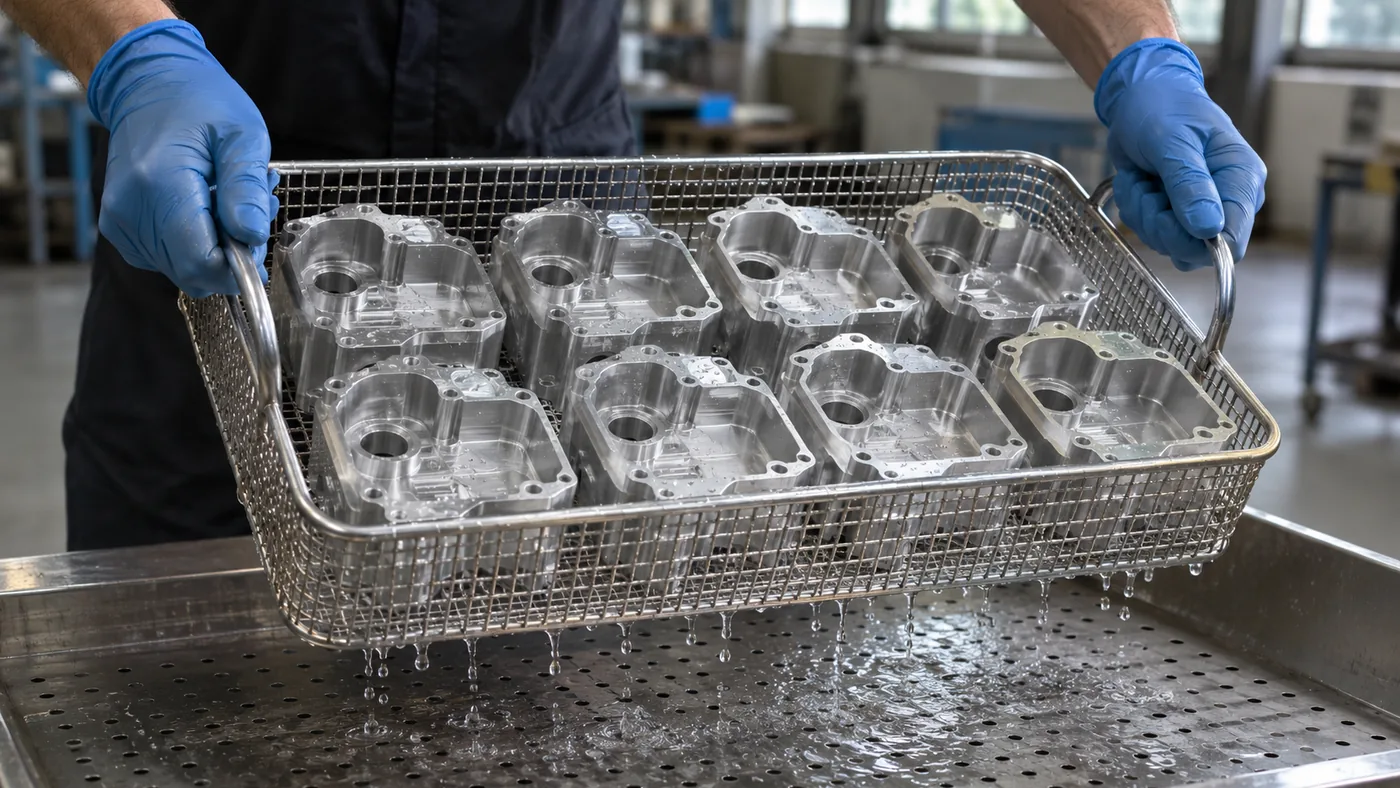
A dryer can accept the basket and still hold up the line. The parts fit, the lid closes, but the next washed batch arrives before the previous one is dry. Nominal tank litres alone do not tell you either thing. The DT overview introduces the equipment; this article starts from your actual basket, the water it carries and the time between batches.
How do you size a hot-air dryer for basket and cycle time? Check two things. The loaded basket must fit inside the dryer's basket size, measured with handles and the tallest parts; the smallest model, the DT-96, takes a 580 ×
Which DT dryer fits my loaded basket?
A DT hot-air dryer fits when the loaded basket, measured with handles, lifting eyes, inserts and the tallest parts, stays inside the published basket size with room to lower it. The DT-96 and DT-206 take the same baskets as the ST-96 and ST-206 heated ultrasonic tanks; the DT-300 basket size is on request.
A drawing of the empty basket can miss a lifting eye that stops the lid from closing. Include the space needed to lower the load onto its supports without striking the tank or blocking the air path. The published figures are basket dimensions, not a promise that every part with those overall dimensions fits. A rack, feet and clearance take room. Send the loaded arrangement to our technical team rather than choosing a tank from the part length alone.
The catalogue pairs the DT-96 with the ST-96 heated ultrasonic tank (96 L
How do the DT dryer sizes compare?
The three DT hot-air dryers differ in volume, basket size and heater rating; all three heat to 100 °C
| Model | Volume (L) | Basket (mm) | Heater (kW) | Temperature (°C) |
|---|---|---|---|---|
| DT-96 | 96 |
580 × |
3 | 30–100 |
| DT-206 | 206 |
730 × |
6 | 30–100 |
| DT-300 | 300 |
on request | on request | up to 100 |
Source: Sonixtek product data, Nov 2026.
All three models are made of AISI 304 stainless steel from 2 mm
For US sites the DT dryers are quoted for 480 V or 208–240 V three-phase, 60 Hz, with 60 Hz motors.
For layout, request an installation drawing. Allow space for lid travel, hoist access, unloading and maintenance. A tank that fits against a wall on a plan may be awkward to load when a wet basket hangs above it.
How many baskets per hour must the dryer release?
A hot-air dryer must release one basket within every arrival interval. Divide the required good parts per hour by the parts in one evenly dried basket to get baskets per hour; 60 min divided by that number gives the interval. Compare the interval with the full station occupation, not with the timer setting alone.
Station occupation covers loading, any warm-up or recovery after opening, drying, unloading and preparing for the next basket. Counting only the timer hides handling time. If drying occupies the station longer than the arrival interval, wet work queues upstream. Use your measured production figures and keep the time units consistent.
Do this separately for each part family. Open brackets and deep housings can fill the same basket and still need different drying times. A shift average can hide a run of difficult housings that blocks the rinse station. The wash, rinse and dry line guide covers the wider layout; here the question is whether the measured dryer occupation fits that layout.
Does a higher heater rating dry faster?
A higher heater rating dries faster only where heat supply is the limit. The 3 kW heater of the DT-96 and the 6 kW heater of the DT-206 are heater ratings, not evaporation capacity or cycle consumption. More heat does not empty a water-filled blind hole or push air through a packed basket.
The heater warms the basket and parts, replaces heat lost through the enclosure and openings, and evaporates the water. The circulating air must then carry the vapour away. The heater switches or modulates as the controller demands, and the turbine uses energy as well. Heater ratings therefore cannot be converted into parts per hour. If energy matters to the choice, measure consumption over representative production.
Measure the water load as well. Weigh a consistently drained wet basket and compare it with the same basket and parts after drying and cooling, on the same scale and with the same handling. The difference estimates retained water. Changes in oil, loose material or basket contents would distort it, so use the result to compare loading arrangements, not as a laboratory moisture test.
How do you reduce the water carried into the dryer?
Drain the parts before they enter the dryer: water that runs back into the rinse does not have to be evaporated in the DT dryer. Tilt housings so pockets empty, open gaps between nested parts and give draining a fixed place in the transfer. A warm rinse of 40 to 60 °C
A rack that dries fewer parts predictably can release more good parts per shift than a crowded basket that keeps going back for extra drying. The rinse guide describes the 40 to 60 °C
How do you prove the dryer has enough capacity?
Prove dryer capacity with the most difficult basket: the heaviest normal load and the geometry that holds the most water, from a cold start and over repeated batches. One plant dries washed filter cartridges with internal rods in a DT-206 at about 50 °C
Record rinse condition, draining method, air setting, loading pattern, station occupation and the inspection result at the difficult feature. A dry outside face is no evidence for a dry internal passage. In that plant the cartridges lie horizontally. Turning the same load through 90° can change the result at the inner core without any change to the cycle, so orientation belongs in the record as firmly as temperature.
Set the acceptance method before you adjust the cycle. Our guide to threaded parts and blind holes explains why orientation and draining before the dryer matter. Repeat the trial after any rack change and keep the successful arrangement with the process instructions.
Frequently asked questions
Can I use the basket from my existing washer?
Often, but measure it first. Three of five dryer buyers added only the dryer to a running washer, so basket, rack and transfer height came from that line. Compare the loaded basket, with handles and the tallest parts, with the DT basket sizes in the table; ST-96 baskets fit the DT-96, ST-206 baskets the DT-206.
Which ST tank pairs with which DT dryer?
The catalogue pairs the DT-96 with the ST-96 and the DT-206 with the ST-206, so one basket can travel through wash, rinse and dry. A basket from another machine still needs measuring with its handles, rack and tallest parts in place.
What temperature range does a DT dryer cover?
All three DT dryers heat to 100 °C
How do I estimate the water a basket carries into the dryer?
Weigh a consistently drained wet basket, then the same basket and parts after drying and cooling, on the same scale. The difference estimates the retained water. Use it to compare loading arrangements, not as a laboratory moisture measurement.
What to send us for a quote
Send basket drawings, part materials, batch mix, the measured arrival interval and available services through the quote form. The DT series page is the equipment starting point; our technical team needs your production sequence to size the drying station around it.