
Choosing a machine · 8 min read · Updated 2026-11-16
Hot-air dryer or compressed-air blow-off?
Compare compressed-air blow-off, a drip rack and a hot-air dryer through water retention, operator time, air use and the required handover.
Technical guide. Figures are taken from our own spec tables; for your process we confirm the settings with a cleaning trial.
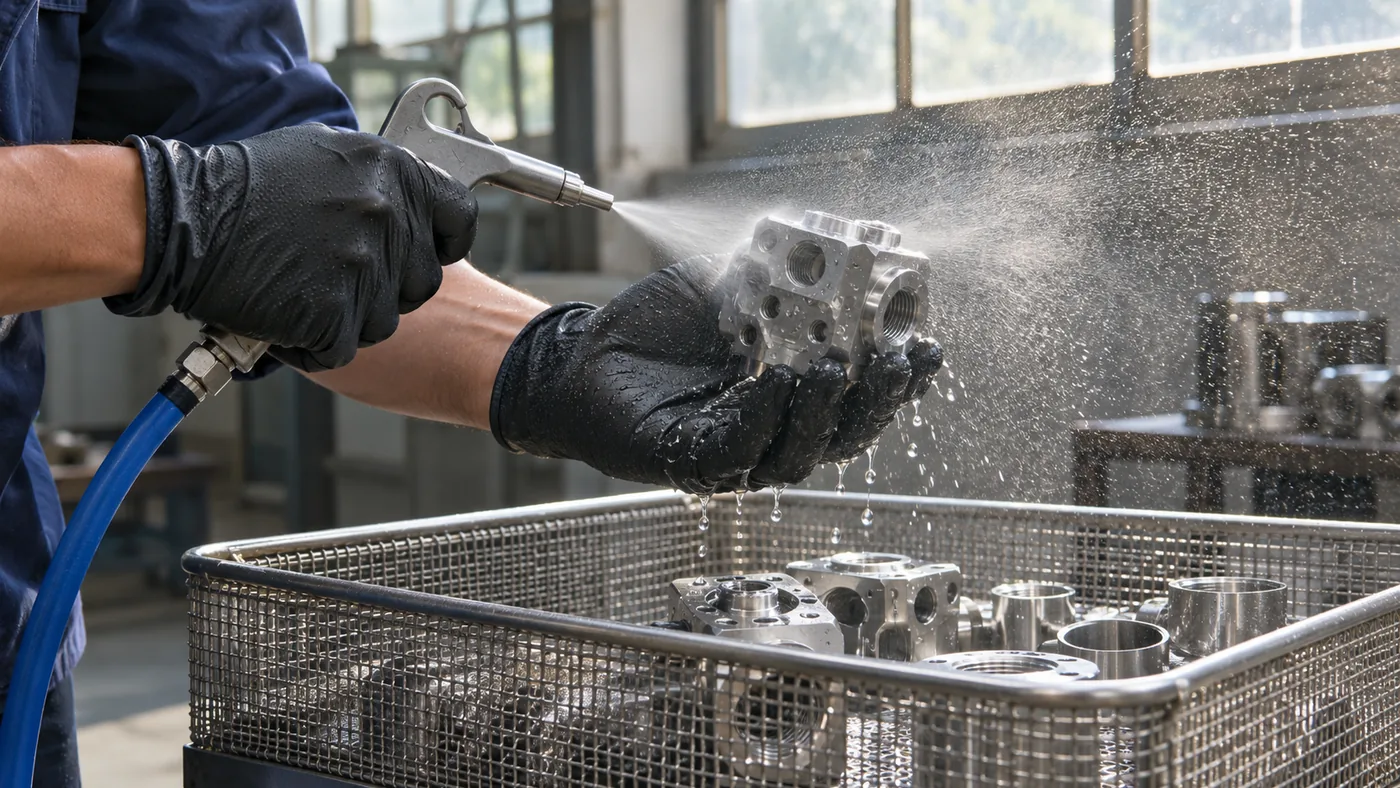
A nozzle clears visible water quickly. A drip rack needs little equipment. A hot-air dryer takes floor space and runs a heater and a fan. None of those observations alone decides which method fits a basket of parts. What counts is the required dry condition at the required rate, including handling and the water you cannot see.
The rinse and drying guide introduces these methods. Here we compare the work each one does, how to measure it and when a combined sequence beats one method for everything.
So, hot-air dryer or compressed-air blow-off? Blow-off suits small quantities of parts whose water sits on faces a jet can reach. A hot-air dryer suits repeat baskets: a DT hot-air dryer evaporates the remaining film with moving air at 30 to 100 °C
Begin with the retained water and the deadline
Identify the features that hold water and the next operation's tolerance. An open bracket that is machined again later differs from a threaded housing going straight to assembly. Inspect after turning and cooling, not only while the outside is warm and looks dry.
The final rinse also affects the choice. Evaporation leaves dissolved minerals and detergent behind, whichever method supplies the heat or the waiting time. The basket-loading guide explains why orientation and nesting matter. Fix avoidable pools before comparing equipment; otherwise the comparison mainly measures a poor loading arrangement.
State the interval between baskets and the total work per shift. A hand method suits occasional parts but struggles when several batches arrive together.
What does compressed-air blow-off remove?
Compressed-air blow-off removes bulk water from the faces and openings the jet can reach. Blow-off moves the liquid rather than evaporating it, so the water can end up in another hole, on the next part or as spray. Unlike the 30 to 100 °C
A directed nozzle can drain an opening that general airflow misses. But a feature without a drop at its mouth may hold water deeper inside. Define a collection area and the jet direction, and check the critical passages afterwards. Our article on drying blind holes and threads covers those features in detail.
Air quality matters when you blow a cleaned surface. Water, oil or particles from the supply can land on the part. Specify the air quality the application needs and verify it at the point of use; a clean-looking hose says nothing about the air leaving it.
Blow-off also brings noise and exposes the operator to the jet and the spray. Use suitable nozzles, pressure control and the site's working instructions.
How do you measure blow-off work and air use?
Measure blow-off work as the operator's complete task per part: pick up, aim at each feature, turn, check and put down. Measure air use from nozzle flow, pressure, trigger time and the plant's compressor system. On the dryer side, the 3 kW heater of the DT-96 hot-air dryer (96 L
Time the whole task, not only the trigger, over the normal part mix so the awkward housing is included. Take the air values from the installed equipment or measure them; leaks and an idle open nozzle add demand without drying anything.
Do not compare the purchase cost of a nozzle with a dryer's total operating burden. Compare the same scope: labour, energy, maintenance, floor space, rejects and repeat handling over your production pattern. Without those inputs there is no useful general saving figure.
When is a drip rack enough?
A drip rack is enough for open, freely draining parts that may wait wet and have no short handover deadline. Gravity removes the bulk water; the film then evaporates at the shop's temperature, air movement and humidity, without the 30 to 100 °C
Count the rack's occupied time and space; a full rack is process inventory. If bare steel starts to corrode while it waits, low equipment use is not a useful result. Protect drained parts from splash and dust and inspect them at the intended handover time.
A rack is also a useful stage before blow-off or hot air. Giving free water an exit first reduces the work of the next station without changing the final drying method.
What does a hot-air dryer change?
A hot-air dryer replaces hand drying with a timed basket cycle: heated moving air at 30 to 100 °C
The DT overview describes the settings. Select within the limits of the complete part; the upper setting does not solve every trapped-water feature. Do not treat the timer duration as the operator's labour time or as the whole station occupation.
All three DT models have a chamber of AISI 304 stainless steel sheet, from 2 mm
| Model | Volume (L) | Basket (mm) | Heating (kW) | Air temperature (°C) | Supply |
|---|---|---|---|---|---|
| DT-96 | 96 |
580 × |
3 | 30–100 |
400 V |
| DT-206 | 206 |
730 × |
6 | 30–100 |
400 V |
| DT-300 | 300 |
on request | on request | up to 100 |
400 V |
Source: Sonixtek product data, Nov 2026.
Opening losses, warm-up, incoming part temperature and retained water all affect consumption. If energy is part of the decision, measure a representative sequence, including any repeat drying.
A case: replacing air-gun drying after an existing washer
A food-supplement plant cleaned small and medium parts in its own ultrasonic cleaner and then dried them by hand with compressed-air guns. It kept the washer and added a DT-96 after it, so the dryer replaced the air-gun step, not the cleaning. That pattern is common: of five buyers of our dryers, three added the dryer alone to a washer they already ran.
Two points carry over to other plants. First, the change was confined to the drying step. Changing only that step keeps a trial readable: same parts, same rinse, a different way of removing the water. Second, a hot-air station is equipment that has to appear in the plant's own documents. For its GMP and IFS audits, the plant asked for the instruction manual, a cleaning and maintenance plan, the wiring diagram and the spare-parts list. A hand-held nozzle rarely appears in such a file; a dryer does. Our article on drying and documentation in audited plants explains how those documents connect the station to the plant's procedures.
Before a similar change, check that the parts lie loosely in the basket, so that water can drain and air can reach the wet features.
Which drying method fits which parts?
The drying method follows the part and the handover. A drip rack fits open parts with time to wait, blow-off fits small quantities with reachable water, and a hot-air dryer at 30 to 100 °C
| Method | Suits | Limitation to check |
|---|---|---|
| Drip rack | Open parts with time to drain and dry | Wet waiting, humidity and retained pockets |
| Compressed-air blow-off | Small quantities and accessible water | Operator work, air quality, hidden displaced water |
| Hot-air dryer | Repeat baskets requiring controlled evaporation | Material limits, airflow access and verified cycle |
| Drain, targeted blow-off, then hot air | Parts carrying pools and difficult features | Added handling must earn its place in the sequence |
Test the same part family with the same acceptance method in each candidate arrangement. Record hands-on time separately from elapsed time, and inspect blind features after cooling. A method that wins on a flat plate may fail on the real housing.
Keep the chosen arrangement, the nozzle practice if used, the air setting and the inspection together in the work instruction. Our article on dryer sizing and cycle time explains how that measured cycle becomes a capacity decision.
Frequently asked questions
Does blow-off prove that a blind hole is dry?
No. Blow-off can push water deeper into a blind hole or into a cross drilling, and a mouth without a drop says nothing about the inside. Check critical passages after cooling, whichever drying method you use.
Is the heater rating the energy used per basket?
No. The heater rating, 3 kW on the DT-96 and 6 kW on the DT-206, is not the energy per accepted basket. Opening losses, warm-up, incoming part temperature and retained water decide consumption, so measure a representative sequence.
Can I add a dryer to the ultrasonic cleaner I already have?
Yes. Of five buyers of our dryers, three added the dryer alone to a washer they already ran. Check that your parts lie loosely in the basket, 580 ×
For US sites the DT dryers are quoted for 480 V or 208–240 V three-phase, 60 Hz, with 60 Hz motors.
Should the dryer always run at 100 °C (212 °F) ?
No. Choose the air temperature within the 30 to 100 °C
What to send us for a quote
Send the parts, the daily pattern, your existing air supply, the drying requirement and your observations through the quote form. On that basis we compare the DT series with your current process, with the retained water and the accepted output visible in the decision. Our technical team then reviews the parts, the current method and the required handover with you.