
Ultrasonic cleaning basics · 3 min read · Updated 2026-09-25
Direct and indirect cleaning: parts in the bath, or in a beaker inside it
Direct cleaning puts the part in the tank liquid; indirect cleaning puts it in a beaker or tray of its own liquid standing in the tank. Indirect keeps aggressive chemistry and small parts out of the main bath. When each makes sense.
Technical guide. Figures are taken from our own spec tables; for your process we confirm the settings with a cleaning trial.
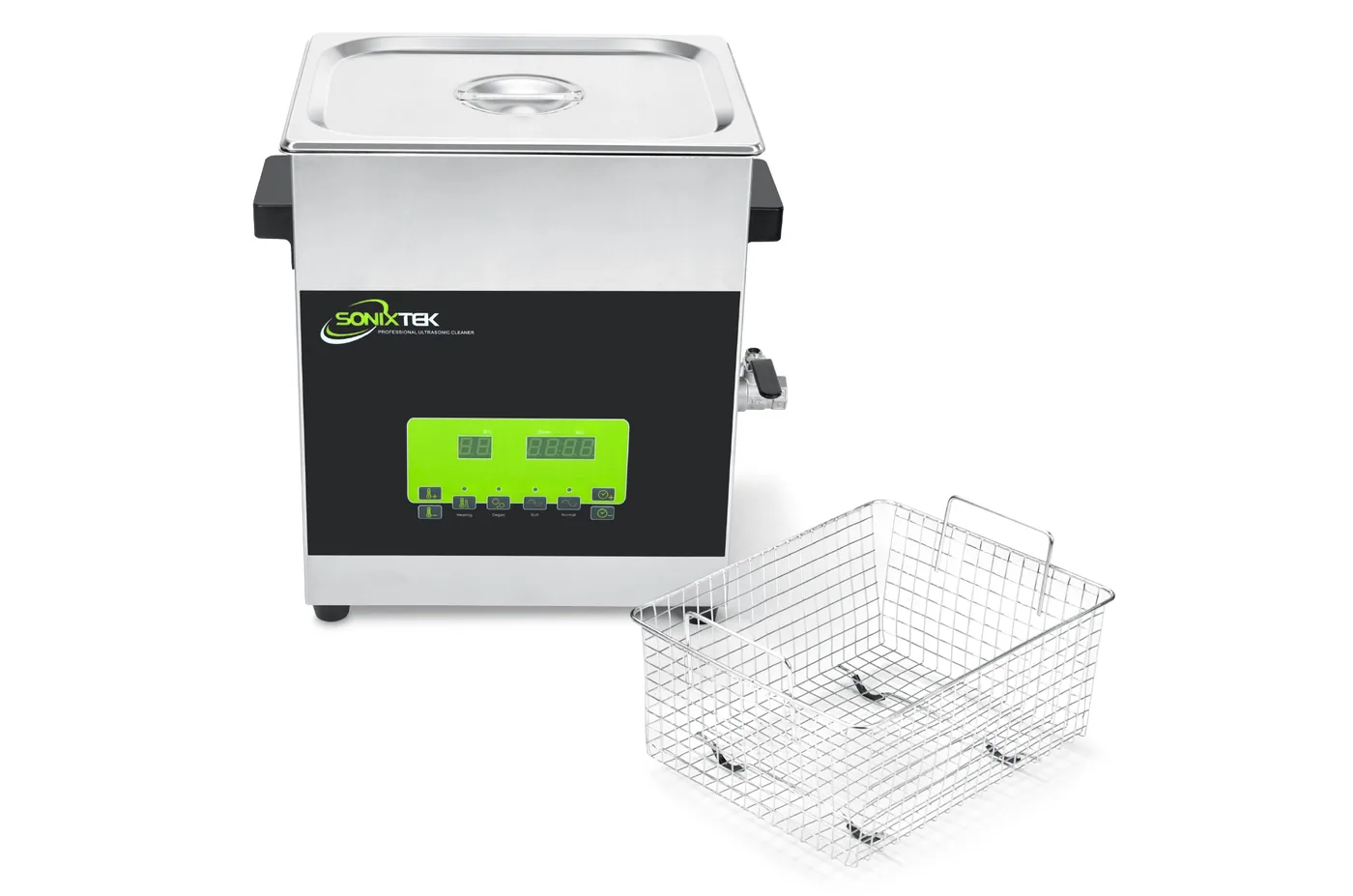
There are two ways to put a part into an ultrasonic cleaner. Most industrial work uses the first; laboratories, workshops with many small jobs and anyone using a solvent use the second more than they expect.
Direct cleaning
The part sits in a basket in the tank liquid. The sound reaches it through the bath, the lifted soil goes into the bath, and the bath is filtered or changed when it is loaded. This is the normal mode for the ST, UMX, AL and AU series and for most benchtop use: highest cleaning power, simplest handling, and one liquid to manage.
Rules that make it work:
- The part must be fully submerged, with 30 to 50 mm of liquid over the top of it, so the surface layer does not shield it.
- The part must be in a basket, never on the tank floor. A part on the floor damps the transducers under it, and a hard part rattling against the floor scars the tank. Our baskets stand on feet that hold the load 10 to 30 mm above the floor.
- Parts must not overlap. Where two surfaces touch, neither is cleaned; see the loading article.
- The bath liquid has to be compatible with the tank. Stainless steel AISI 304 tolerates alkaline and neutral aqueous cleaners well; strong acids and chlorides attack it.
Indirect cleaning
The part sits in a beaker, a tray or an insert tank that holds its own liquid, and that container stands in the main tank, which is filled with plain water and a little surfactant. The sound passes through the water and the container wall into the inner liquid. Cavitation inside the container is somewhat weaker than in the bath, roughly 60 to 80 % of the direct field through a thin stainless or glass wall, less through thick plastic.
It is the right choice when:
- the chemistry must not touch the tank: acids for descaling or de-rusting, solvents for flux or resin, enzyme cleaners in a laboratory;
- the batch is small and the liquid is expensive: a 250 ml beaker of solvent instead of a 6-litre bath;
- several jobs share one machine: three beakers, three liquids, one 15-litre tank;
- cross-contamination matters: laboratory samples, dental and precision optics work, where the part must not see the previous batch's soil;
- the parts are tiny: watch components or fasteners that would fall through a basket mesh are cleaned in a beaker or a fine-mesh insert.
Water in the main tank still needs degassing and still warms up; heating passes through the container wall with a delay of several minutes.
Which accessories
For the benchtop STS range, beaker holders with two or three positions replace the lid, and glass beakers of 250 to 1000 ml sit in them at the right depth. A stainless insert tank with a drain, sized to the main tank, turns any STS or ST model into an indirect cleaner for a full batch. The accessories article lists what exists per series.
A common mistake
Standing a beaker on the tank floor instead of in a holder. The glass base damps the transducers beneath it, the beaker walks across the floor with the vibration, and it can crack. Beakers hang from the holder with their base 20 to 40 mm above the tank floor, never touching it, and are filled so the liquid inside stands about 20 mm below the bath surface outside; the sound then reaches the whole of the inner liquid.