
Parts and contaminants · 4 min read · Updated 2026-09-30
Ultrasonic cleaning of battery components before assembly
Cell cans, lids, tabs, busbars, housings and cooling plates carry oil and particles into welding and bonding. How to clean them; cells never go in a bath.
Technical guide. Figures are taken from our own spec tables; for your process we confirm the settings with a cleaning trial.
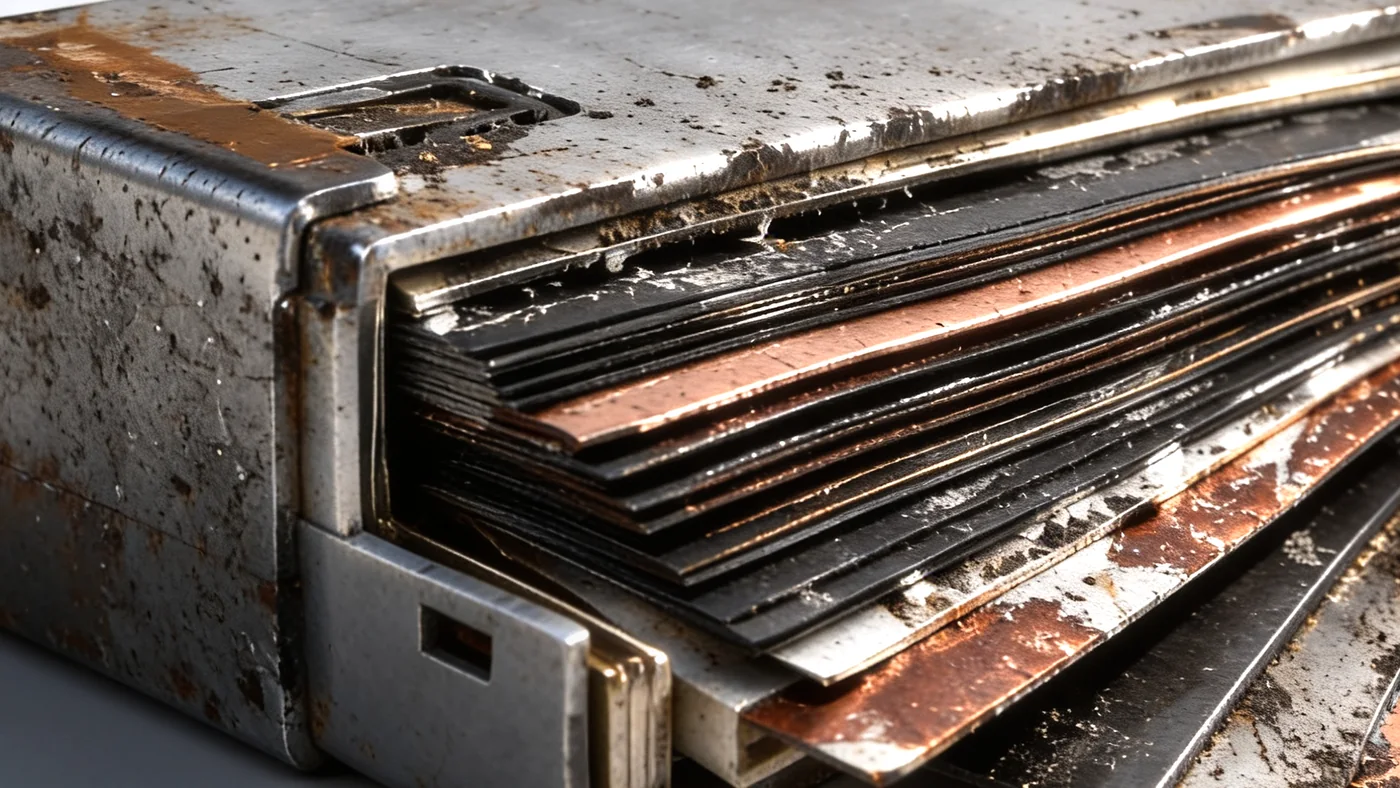
This article is about the manufacture of battery parts: the metal and plastic components that are drawn, stamped, machined or brazed before a cell or a pack is built. It is not about cleaning batteries.
Charged cells, modules and packs never go into a liquid bath. Not for cleaning, not after a leak, not "just briefly". Liquid between the terminals or inside a damaged casing causes short circuits and corrosion, and a short-circuited lithium cell can go into thermal runaway. A contaminated cell or pack is handled by the battery maker's procedure, not by an ultrasonic cleaner.
Which parts, which soil
| Part | Typical material | Soil | What comes next |
|---|---|---|---|
| Cell cans | Deep-drawn nickel-plated steel or aluminium | Drawing oil, particles | Cell assembly, often in a dry room |
| Lids and cap assemblies | Aluminium, steel, stamped | Stamping oil, burr flakes | Laser welding to the can |
| Tabs | Aluminium, nickel, nickel-plated copper | Stamping oil, particles, fingerprints | Ultrasonic or laser welding |
| Busbars | Copper, aluminium, often plated | Stamping or machining oil, burrs, oxide | Welding or bolting to cell terminals |
| Module and pack housings | Die-cast or extruded aluminium, steel | Coolant, chips, release agent | Sealing, bonding, assembly |
| Cooling plates | Brazed or welded aluminium with internal channels | Forming oil, particles in the channels | Leak test, bonding of thermal interface |
Why the cleaning matters
Welding. Oil on a tab, a lid or a busbar burns in the laser or arc and causes porosity, spatter and inconsistent weld depth. A weld that should be repeatable becomes a quality problem that is only found at the electrical test or later.
Bonding and sealing. Adhesives, thermal interface materials and gaskets need a surface free of oil and release agent. The water-break test and test inks described in cleaning parts before coating apply here in the same way.
Particles. A metallic particle that ends up inside a cell can pierce the separator and cause an internal short. A particle in a module can bridge the gap between two conductors at different voltage. Particle cleanliness is therefore specified for battery parts as it is for hydraulic and fuel-system parts, usually with the test methods of VDA 19.1 and ISO 16232: extraction, filtration, then counting and sizing the particles on a membrane. The limits, especially for metallic particles, come from the cell or pack maker's specification.
Moisture. Lithium-ion cell assembly runs in dry rooms because moisture reacts with the electrolyte. Parts that go into a dry room after cleaning must be completely dry, and the moisture requirement comes from the cell maker.
The cleaning sequence
| Station | Purpose | Typical setting |
|---|---|---|
| Ultrasonic wash | Oil, particles, burr flakes | Mild alkaline cleaner rated for the material (light-alloy cleaner for aluminium), 50 to 60 °C, 28 or 40 kHz, 5 to 10 min, filtration on |
| Ultrasonic rinse | Cleaner and loosened particles | Clean water, 40 kHz, 2 to 3 min |
| Final rinse | Salts, spot-free surface | Demineralised water, conductivity monitored |
| Dry | No water in folds, channels or seams | Hot air, 60 to 80 °C depending on material and seals |
Aluminium etches in strong alkali and copper tarnishes, so the chemistry is chosen by material, with a short cycle; see cleaning liquids. Avoid rinse additives that leave a film if the part is welded or bonded next: a corrosion inhibitor that protects steel parts in storage can interfere with a weld or an adhesive. Agree the final rinse with the welding and bonding process owners.
Filtration is not optional when the specification is a particle limit. The bath collects every burr flake the parts bring in and will put them back on the next batch if it is not filtered; see filtration and bath life.
Loading
- Cans: open end down or on their side, so they drain and do not trap air; never nested inside each other.
- Tabs and small stamped parts: a single layer in a fine-mesh basket, or spread over two baskets, so parts do not stack and shield each other.
- Busbars: on edge or on a rack, not flat against each other.
- Cooling plates: at an angle so the channels vent and drain; a lift system that moves the plate up and down pumps liquid through the channels. See when to choose a lift system.
- Housings: openings down, as for other machined parts before assembly.
After cleaning
Clean parts are handled with gloves and packed in closed, clean containers. They are not stored next to machining or grinding. Parts for a dry room go through its lock in the packaging they were cleaned into. A part that passed the particle test and then sat open in the stamping hall has not passed.
Which machine
| Work | Set-up |
|---|---|
| Samples, prototypes, small batches of tabs and busbars | ST-40 or ST-65, 40 kHz, fine-mesh basket, rinse tank, drying |
| Housings and busbars in batches | UMX Pro 88L to 255L or ST-96 to ST-206 with filtration, rinse, DT-96 or DT-206 dryer |
| Cooling plates and large housings | AL-150 to AL-600, lift and filtration, rinse and demineralised rinse stations, dryer |
| Series production to a particle specification | MT multi-tank line: wash, rinse, demineralised rinse and hot-air dryer under one carriage |
For the filtration choice on a single tank, see ST or SF. The electronics industry page collects the related articles.