Choosing a machine · 3 min read · Updated 2026-09-25
When to choose a lift system
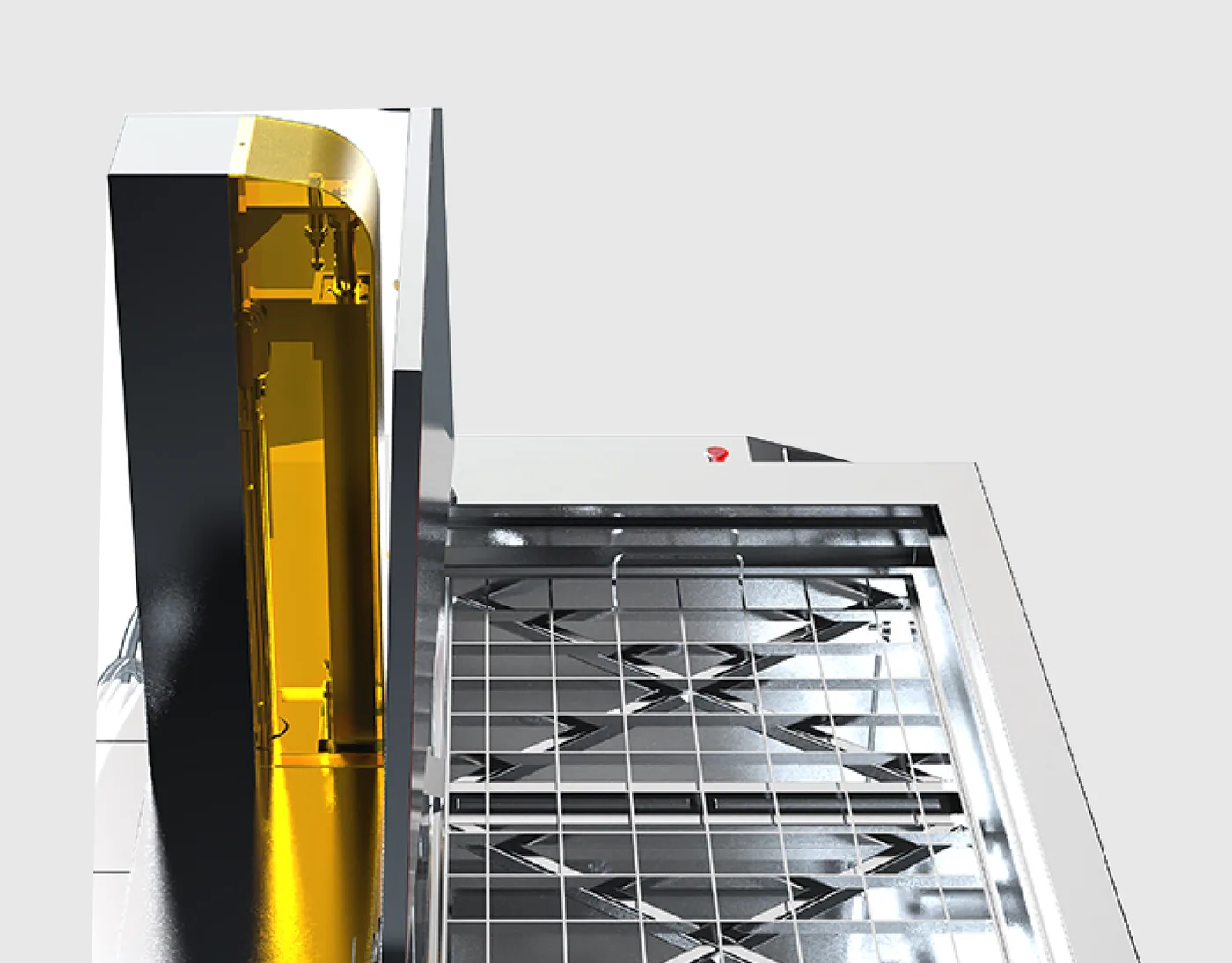
A pneumatic lift raises and lowers the basket and, while the ultrasound runs, moves it up and down in the bath. It is the answer when the load is too heavy to hoist by hand, when parts shadow each other, or when the cycle has to be the same every time. The AL series from 75 to 2000 litres, with its figures.
Technical guide. Figures are taken from our own spec tables; for your process we confirm the settings with a cleaning trial.
A single ultrasonic tank with a basket lowered by hand or by a hoist serves most workshops. Three situations push a buyer to a lift system, and they usually arrive together.
Three reasons
Weight. The basket load ratings on the ST series stop at 150 kg. A gearbox housing, an engine block or a batch of cylinder heads is beyond what two people should lift out of hot liquid, and a crane over an open tank is slow and drips across the floor. The AL series carries 75 kg on the AL-75, 200 kg on the AL-300 and AL-400, 300 kg on the AL-600, 750 kg on the AL-1000 and 1000 kg on the AL-2000, on a pneumatic lift that lowers the basket into the bath and raises it to drain.
Shadowing. In a static basket, every part shields the part behind it and the underside of every part sits in a dead zone. Agitation, a slow vertical oscillation of the basket of some tens of millimetres while the ultrasound runs, changes the geometry continuously so that every face sees the sound field and the lifted soil is flushed away rather than resettling. The agitation article covers the effect; in practice it shortens cycles on dense loads by a third or more and it removes the streaks that a static basket leaves.
Repeatability. With a lift, the cycle is a programme: lower, ultrasound with agitation for a set time, raise, dwell to drain, done. The operator loads and unloads; nothing else depends on them. The PLC and touchscreen on the AL series store the programmes per part family and log the cycles.
The AL series
| Model | Tank volume | Tank inside (L × W × D) | Useful basket space | Ultrasonic | Heating | Load |
|---|---|---|---|---|---|---|
| AL-75 | 75 L | 650 × 355 × 470 mm | 580 × 270 × 250 mm | 1200 W | 3 kW | 75 kg |
| AL-150 | 150 L | 700 × 510 × 540 mm | 630 × 420 × 320 mm | 2040 W | 5 kW | 125 kg |
| AL-300 | 300 L | 900 × 615 × 640 mm | 820 × 520 × 340 mm | 3600 W | 9 kW | 200 kg |
| AL-400 | 400 L | 1100 × 615 × 690 mm | 1020 × 520 × 430 mm | 5760 W | 9 kW | 200 kg |
| AL-600 | 600 L | 1250 × 800 × 770 mm | 1170 × 710 × 470 mm | 7200 W | 12 kW | 300 kg |
| AL-1000 | 1000 L | 1500 × 810 × 875 mm | 1420 × 720 × 570 mm | 12 000 W | 18 kW | 750 kg |
| AL-2000 | 2000 L | 1750 × 1100 × 1080 mm | 1600 × 870 × 750 mm | 20 400 W | 24 kW | 1000 kg |
Note the difference between tank size and useful space: the lift mechanism, the basket walls and the clearance above the transducer floor take 70 to 150 mm in each direction. Size from the useful figure, not the tank.
All AL models run at 28 and 40 kHz with heating to 100 °C, have a diamond-shaped lid that drains condensate back into the tank, and take the modular filtration and laminar-flow options that keep the bath usable on oily loads.
What a lift does not give you
A lift system is still one tank. If the process needs a rinse and a dry, they are separate stations, either as additional tanks next to the AL with the basket moved by hoist, or as an MT multi-tank line where a transport carriage moves the basket through wash, rinse and dry automatically. The AU series is a larger single tank with a servo platform, not a line. The multi-tank article is the next step up.
Deciding
If the largest basket load is above 100 kg, or the parts are dense enough to shadow each other, or the cycle is to be run by different operators on three shifts, specify the lift. If the parts are light and few and the process is occasional, an ST tank with a basket and a hoist does the same cleaning for less floor space.