
Process and parameters · 8 min read · Updated 2026-11-16
Drying temperature by part material
Choose drying air temperature from the limits of the whole part. Compare steel, aluminium, copper alloys, plastics and assemblies with seals.
Technical guide. Figures are taken from our own spec tables; for your process we confirm the settings with a cleaning trial.
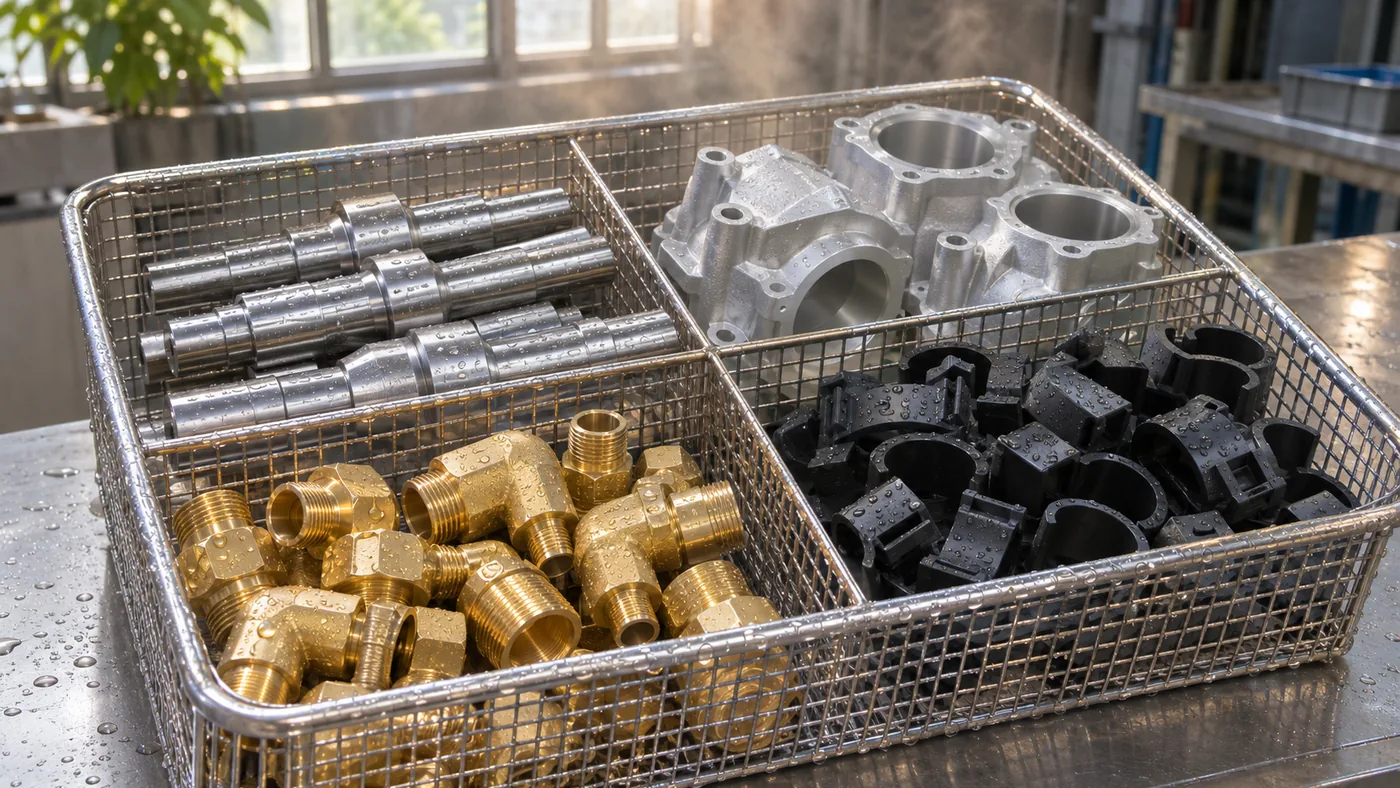
The dryer display shows air temperature, not the temperature of every part in the basket. A thin bracket, a heavy casting and a sealed assembly respond differently to the same setting. So the useful question is not which temperature belongs to each metal name, but which air setting dries the actual part within the limit of its least tolerant component.
The dryer overview describes the DT series; the rinse and drying guide covers the stages before it.
The right drying temperature for a material is set by the lowest limit of the whole part, not by the metal name. Bare steel and cast iron tolerate a warmer setting; seals, plastics and electronics need a lower one. The table below gives a starting point for each material group, and a trial confirms the result.
Why is the dryer air temperature not the part temperature?
The air temperature on a DT hot-air dryer display is not the temperature of the part. Evaporating water cools the wet areas, thick sections warm more slowly than thin ones, and a part that is already dry moves closer to the air setting, which can reach 100 °C
A short trial can miss the thermal limit. Include the recovery after the lid is opened and the load arrangements that change air circulation. An empty or lightly loaded chamber behaves differently from the normal basket. The display alone does not prove the temperature at a seal or an adhesive joint.
Take the maximum permissible temperature from the part drawing, the component data sheets and the owner of the next process. Check whether the limit refers to continuous use, brief exposure or a particular load case. A service temperature in operation is not automatically a cleaning and drying limit.
Which drying temperature suits steel, aluminium, brass and plastics?
Drying temperature by material starts from two reference values in our dryer overview: 80 °C
| Part group | Starting point (°C) | What limits the choice | Trial direction |
|---|---|---|---|
| Bare steel and cast iron | 80 |
Wet period, trapped water, downstream protection | Short wet period, prove dryness at the hardest feature |
| Bare aluminium | No fixed value | Coatings, joints, dimensional checks | Follow the complete part limit, not the alloy alone |
| Aluminium assemblies with seals | 60 |
Seals, lacquer, bonded inserts | Start at 60, raise only within the seal limit |
| Brass and copper | No fixed value | Surface appearance, carried-over chemistry | Clean final rinse first, moderate setting by trial |
| Plastics and electronics | 60 |
Grade, stress, softening, distortion, inserts | Start low; check approval for aqueous processing |
| Mixed assemblies | Lowest component limit | Least tolerant component | Approve the assembly before choosing the cycle |
| DT air range | 30 to 100 |
Dryer setting range | Choose inside the part limit |
Source: Sonixtek dryer overview and product data, Nov 2026.
The table gives starting points, not universal recipes. A change in grade, coating or construction can call for a different process even when the main material stays the same.
What drying temperature for steel and cast iron?
Steel and cast iron need a short wet period more than a high temperature. Our rinse and drying guide gives 5 to 15 minutes at 80 °C
Bare ferrous parts can rust while water and oxygen remain at the surface. Heating a pool that has no draining path does not remove the cause. Orient pockets downwards, space the load and transfer promptly from the final rinse.
The rough surface and pockets of cast iron hold liquid that is less visible than a drop on a machined face. Check those areas and decide whether an inhibitor compatible with the next operation is needed. Drying gives no lasting corrosion protection once the part returns to a humid workshop.
Does a higher temperature help on aluminium, brass and copper?
A higher dryer temperature rarely solves a problem on aluminium, brass or copper. On aluminium, a fitted seal, lacquer or bonded insert often sets the limit before the metal does, and our overview starts such assemblies at 60 °C
Keep bare components and assemblies apart in the process list. Measure dimensions only after the part has cooled to the measurement condition.
Evaporating contaminated water leaves its non-volatile content on the surface. For a coloured ring or haze on brass, check for detergent residue and compare the appearance after controlled cooling. A mark confined to a support points to drainage or contamination rather than temperature. A clean final rinse prevents most of these marks: a laminar flow across the bath surface carries floating oil and dirt to the overflow before they settle back onto the parts.
How low must the temperature be for plastics and mixed assemblies?
Plastics and mixed assemblies set the lowest boundary: the drying temperature stays below the limit of the least tolerant component. Our dryer overview starts plastics and electronics at 60 °C
Treat 60 °C
Support plastic parts so they do not bend under their own weight while warm. Light parts may need restraint against moving air, but a solid cover blocks drying. Our plastics industry page covers cleaning moulded parts in more detail.
Why switch the DT-206 controller from ON/OFF to PID?
The DT-206 hot-air dryer (206 L
In ON/OFF mode the heater switches fully on below the set value and fully off above it. After the auto-tune the air stays close to the setting. That matters most when the part limit sits only a little above the setting you need.
Do not reset the controller to factory defaults. A reset restores the controller maker's settings, not the configuration of the dryer, and the tuning is lost.
Example: a moderate setting chosen for the part
A compressor manufacturer dries washed filter cartridges at about 50 °C
The same order applies to any material: first establish what the part tolerates and how air reaches its inner surfaces, then choose the setting. Starting at the top of the range and working down puts the part at risk during the trial itself.
How do you validate a drying temperature?
A drying temperature is validated against two results: the part is dry at its most difficult feature, and it is undamaged after cooling. Record grade, surface treatment, fitted components, documented limit, rinse condition, loading pattern and inspection method. Increase exposure only within that limit and inside the 30 to 100 °C
Where the risk requires it, measure representative part locations without letting the sensors change the air path. Keep the temperature observation separate from the moisture result: a steady air display can coexist with a wet hole, and a dry part can still have been overheated.
If the permitted temperature cannot deliver the required output, change draining, spacing or the drying method before exceeding the part limit. The loading guide helps when the restriction is air access rather than heater power.
Frequently asked questions
Can plastic and steel parts dry in the same load?
Yes, but only at the setting the plastic tolerates. A mixed load is limited by its least tolerant part, so steel dried at a plastic-safe setting may need longer. Run separate loads when the steel needs the 80 °C
Does drying protect steel parts against rust?
No. Drying removes the water, but it gives no lasting corrosion protection once the part returns to a humid workshop. Decide with the next process owner whether an inhibitor compatible with the next operation is needed.
What air temperature range does a DT hot-air dryer cover?
DT hot-air dryers circulate air at 30 to 100 °C
Should the dryer controller be reset to factory settings?
No. A factory reset restores the controller maker's defaults, not the configuration of the dryer, and the PID tuning is lost. The auto-tune at working temperature with a typical load, about 2 hours including a check run, would have to be repeated.
What to send us for a quote
Send part and component limits, drawings, rinse details and required output through the quote form. The DT series sets the air-temperature range; our technical team needs the whole part specification to turn that range into a workable process.