
Parts and contaminants · 8 min read · Updated 2026-11-16
Drying filter cartridges and parts with internal channels
Washed filter cartridges and channelled parts dry outside first and stay wet inside. Load them flat, guide the air through, filter the intake, check the core.
Technical guide. Figures are taken from our own spec tables; for your process we confirm the settings with a cleaning trial.
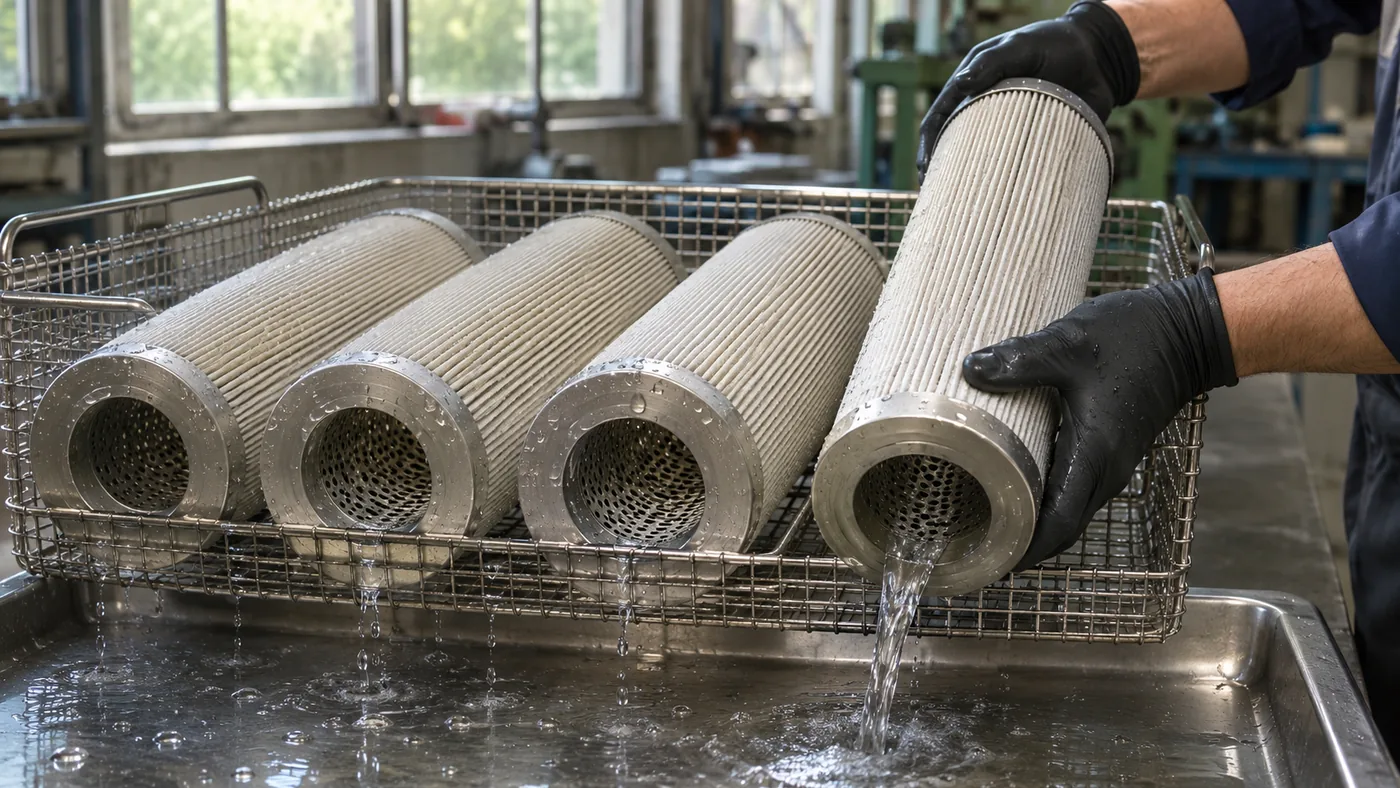
A washed filter cartridge looks dry on the outside long before it is dry inside. Water stays in the perforated core, between the internal rods, in the end caps and in the gaps of the medium. A drilled manifold or valve body behaves the same way: the outer faces dry quickly, while a cross bore still holds a drop that runs out when the part is turned on the assembly bench. Hot air takes the easiest path around a part, not through it.
Washed filter cartridges dry inside when the bulk water is drained first, the cartridges lie flat in a single layer with their open ends free, and hot air is guided through the core at a temperature the cartridge maker allows. A DT hot-air dryer sets that air between 30 and 100 °C
Why does the inside of a filter cartridge stay wet?
The inside of a washed filter cartridge stays wet because narrow gaps hold water by surface tension, the air flows around closed end caps instead of through the core, and the steel core warms last. A dryer display set to 50 °C
- Small gaps hold water. Surface tension keeps water in narrow slots, between rods and in fine perforations. Gravity alone does not empty them.
- The air bypasses the inside. A closed end cap or a channel that points across the air stream sees very little flow. The outside is in moving air; the core is in still air.
- The inside warms last. A steel core and a thick end cap take heat slowly, so the inner surfaces stay cooler than the air setting and evaporate more slowly.
A real case: filter cartridges at a compressor maker
One of our DT customers is a compressor manufacturer that washes filter cartridges and then dries them. The cartridges contain internal rods. They lie horizontally in the basket, and in that application the direction of the airflow through the cartridges matters. The plant runs a DT-206 hot-air dryer (206 L
The plant already had its own washer and bought the DT-206 on its own, to fix the drying step after it. That is a common pattern: of five dryer customers, three added the dryer alone to an existing washer.
We publish no cycle time or result for this case. It depends on the cartridge, the load and the water it carries out of the rinse; test on your own parts.
How should filter cartridges be loaded in a hot-air dryer?
Filter cartridges should lie horizontally in a single layer, with open ends and channel exits kept clear of the basket wall and of the next cartridge. The basket length sets the size limit: the longest basket, 730 mm
In a DT dryer a heating turbine drives the air through the basket from below, and it leaves through the lid (see the DT overview). Loading decides whether that air passes through the parts or around them.
- Horizontal, single layer. A cartridge standing on end collects water at its lower end cap, sitting on the basket floor. Lying flat, the core can drain at both ends and the rods lie across the air stream.
- Ends free. A cartridge whose open end rests against another one does not drain or ventilate.
- Direction. Try the orientation with the open ends or channel exits facing different ways on the first test basket. With some designs the air must enter along the core to dry it; with others it needs to pass across the rods. The test shows which one works for your part.
- Turn once. Turning a cartridge part-way through the cycle moves the water left at the lowest point. Plan that handling step and its time.
The basket height decides whether a second layer fits at all, and a second layer only works if the parts below are not dripped on. All three chambers are AISI 304 stainless steel, from 2 mm
| Model | Volume (L) | Basket (mm) | Heating (kW) | Air temperature (°C) | Supply |
|---|---|---|---|---|---|
| DT-96 hot-air dryer | 96 |
580 × |
3 | 30–100 |
400 V |
| DT-206 hot-air dryer | 206 |
730 × |
6 | 30–100 |
400 V |
| DT-300 hot-air dryer | 300 |
on request | on request | up to 100 |
400 V |
Source: Sonixtek product data, Nov 2026.
More on spacing and orientation is in loading the basket.
Parts with internal channels
Manifolds, valve bodies, pump housings and heat-exchanger parts follow the same rules as cartridges. Before the basket goes into the dryer:
- Drain bulk water: tilt the part so every channel exit points down at least once.
- Mark on the drawing which position empties the cross bores, and load in that position.
- Keep the outlets of channels free; do not lay a part with an outlet on the basket mesh.
- Do not stack a wet part above another part's open bore.
Water that leaves by gravity before drying never has to be evaporated, so it costs no heating energy and no dryer time.
What drying temperature suits filter cartridges?
The right drying temperature for a filter cartridge is the one its maker allows for the medium, seals and bonded end caps, which can be well below the 100 °C
Our guide on industrial filters for reuse gives the same rule for the drying step: the cartridge maker's limit applies, not the dryer's range.
At a moderate setting the temperature also needs to stay close to the set value. The DT-206 controller ships in ON/OFF mode. For tighter control it is switched to PID and auto-tuned once, at the working temperature and with a typical load in the basket; that takes about 2 hours including a check run. Do not reset the controller to factory defaults afterwards: that restores the controller maker's settings, not the machine's.
Does a HEPA-grade intake filter keep dried parts free of dust?
A HEPA-grade intake filter module on the 206 L
If your next step specifies a measured particle level, define how and where it is sampled after drying.
The dryer removes water, not what is dissolved in it. Rinse quality decides whether a dried cartridge carries spots or a film; the guide to rinsing and drying explains when a demineralised final rinse is needed. Floating oil on the wash bath leaves a film too; a laminar flow carries it to an overflow before the basket is lifted out.
Check the core, not the outside
Agree how dryness is checked before the first trial:
- Weigh. Weigh a dry reference cartridge, then the same cartridge after washing and drying. A difference means water is still inside.
- Turn and tilt. After cooling, turn a part through every position over a clean surface and look for drops from the core or the channel exits.
- Look in. Use a light on the channel exits and the perforations of the core.
- Repeat. Run several baskets, including a full one, so the trial covers the normal load and not only a single test part.
If water stays inside, change the orientation or the drain step before raising the temperature. Write the result down as a photographed loading instruction and check it again when the cartridge type or the washer changes.
Frequently asked questions
Can a DT dryer be added to a washer we already run?
Yes. In the real case, a compressor maker bought the DT-206 on its own to follow its existing washer, and of five dryer customers, three added the dryer alone. The basket fit and the air path are checked against your part first.
Should I raise the temperature if cartridges stay wet inside?
Not first. Change the orientation or the drain step before raising the temperature, and never go above the cartridge maker's limit. The dryer display shows the air temperature, not the temperature at the bottom of a channel.
How is a low setting such as 50 °C (122 °F) held steady?
The DT-206 controller ships in ON/OFF mode. For tighter control it is switched to PID and auto-tuned once, at the working temperature with a typical load, which takes about 2 hours including a check run.
Do you publish a drying time for filter cartridges?
No. The drying time depends on the cartridge, the load and the water carried out of the rinse. Run a trial on your own parts, with several baskets including a full one, and check the core by weighing.
Adding a dryer to your washer
The washer can be one of ours, such as an ST ultrasonic tank, or the one you already run. Send us:
- A drawing or photo of the cartridge or part, with length, diameter and channel layout.
- Materials, and the temperature limit of the medium, seals and end caps.
- Your current wash and rinse sequence and how you dry today.
- Parts per batch and batches per shift.
- Any cleanliness requirement of the next step.
Send it through the quote form. The DT series page lists the three sizes; our technical team checks the basket fit and the air path for your part.