
Parts and contaminants · 10 min read · Updated 2026-11-16
One ultrasonic tank for the plant maintenance workshop
Pumps, valves, bearings and gears in one tank: size it from your largest regular part, choose frequency and cleaner, and know when filtration pays.
Technical guide. Figures are taken from our own spec tables; for your process we confirm the settings with a cleaning trial.
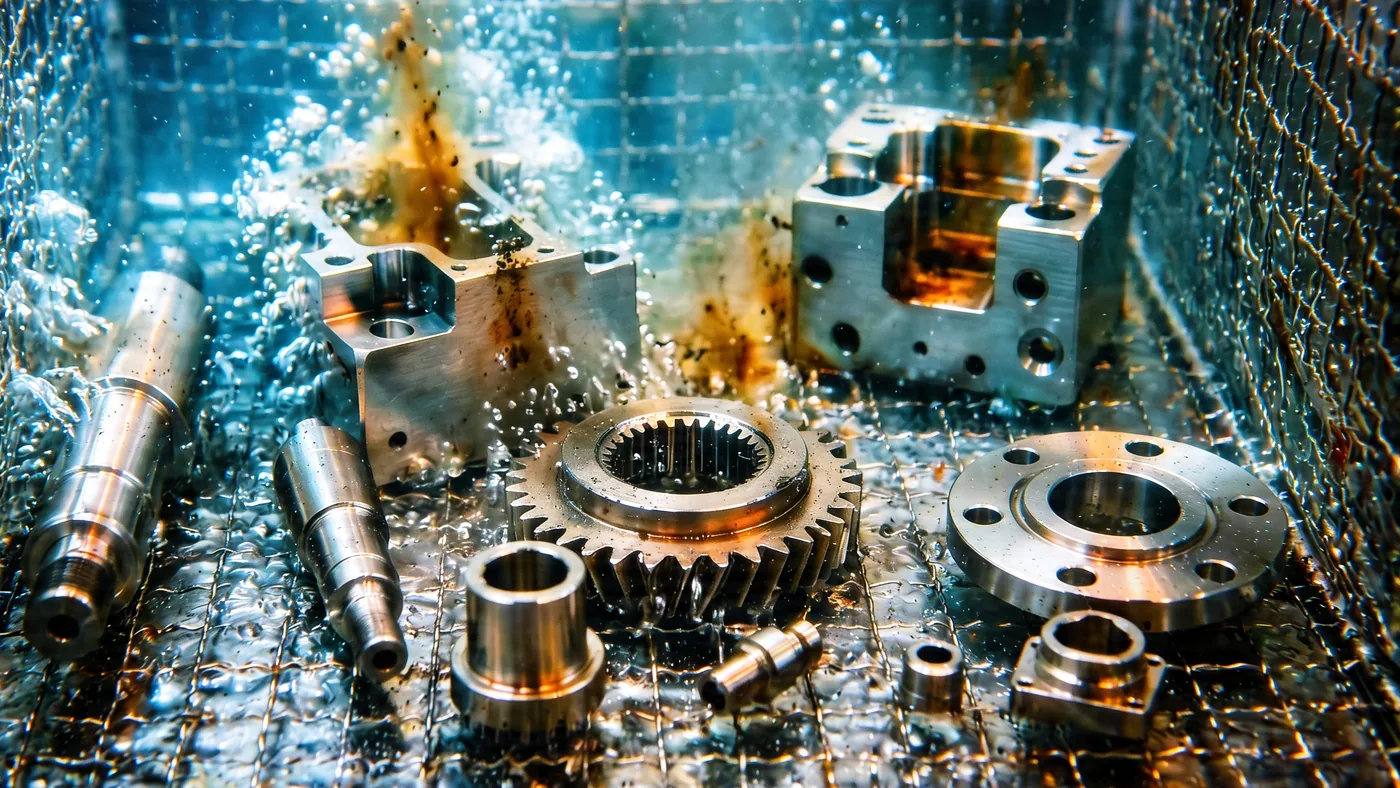
A plant maintenance workshop never cleans just one kind of part. In one week the bench sees a pump casing and impeller, a control valve, conveyor bearings, a reducer gear set and a box of couplings and bolts. All of it comes out of service with old grease, oil and process residue, and must be clean enough to inspect, measure and refit.
Which ultrasonic cleaner suits a plant maintenance workshop? For most workshops, one heated ST industrial tank at 28 kHz covers pumps, valves, bearings and gears. Size it on the largest part that comes in every month, plus 20 mm
Which maintenance parts can go in an ultrasonic tank?
Metal parts that are inspected or reused go in an ultrasonic tank: pump casings and impellers, valve bodies and trims, open bearings, gears, shafts, couplings and bolts, each up to the 100 kg
| Part | Typical soil | In the tank? |
|---|---|---|
| Pump casings, impellers, wear rings, shafts | oil, grease, process residue, light deposits | Yes, dismantled. The motor, mechanical seal and O-rings stay out |
| Valve bodies, plugs, seats, stems | grease, oil, process residue | Yes. Packing, O-rings and soft seats stay out |
| Open bearings from an overhaul | old grease, wear particles | Yes; see bearings and mechanical components |
| Gears, shafts, couplings, reducer covers | gear oil, sludge, wear metal | Yes |
| Bolts, small fittings | oil, dirt | Yes, in a fine-mesh insert |
| Sealed bearings (2RS, ZZ) and new bearings | – | No. Replace sealed ones; leave new ones in their preservative |
| Motors, sensors, positioners, anything with windings or electronics | – | No |
| Elastomer seals, gaskets, packing | – | No, they are replaced at overhaul anyway |
What tank size does a maintenance workshop need?
A maintenance workshop sizes its ultrasonic tank on the largest monthly part plus 20 mm
Size for the regular part, not the biggest one you ever overhauled: list the ten largest parts from last year's work orders with length, width, height and weight. The basket and the gap to the transducers take space that the tank volume does not show; see choosing the right ultrasonic cleaner for the other factors.
Measure flanged valve bodies across the flanges: the flange diameter, not the body, usually sets the height a valve needs in the basket.
| Model | Volume | Basket L × W × H | Basket load | Heating | Heat-up to 60 °C |
|---|---|---|---|---|---|
| ST-65 | 65 L |
480 × |
75 kg |
3 kW | 1.0 h |
| ST-96 | 96 L |
580 × |
100 kg |
4 kW | 1.1 h |
| ST-157 | 157 L |
680 × |
100 kg |
5 kW | 1.5 h |
| ST-206 | 206 L |
730 × |
100 kg |
6 kW | 1.6 h |
Source: Sonixtek product data, Nov 2026. Heat-up from 20 °C
Weight. From about 75 litres
Heat-up. From 20 to 60 °C
Supply. The four tanks in the table run on 400 V or 220 V AC with a 16 A supply; the larger ST-300 and ST-400 need 32 A. Check your socket and fuse at the planned spot before you order.
US versions: the ST-40 to ST-206 are quoted for 208–240 V three-phase, the ST-300 and ST-400 for 480 V or 208–240 V three-phase, all 60 Hz.
Is 28 kHz or 40 kHz better for maintenance parts?
28 kHz is the better single frequency for most maintenance parts. Most maintenance soil is grease and oil on steel and cast iron, and the larger cavitation bubbles at 28 kHz carry more energy and loosen thick, aged grease faster. 40 kHz suits machined aluminium, softer metals and fine bores, where erosion must stay low.
If the list is mainly pumps, gearboxes and bearings, take a single 28 kHz tank. If fine parts come in every week, such as small instrument valves or precision bearings, the UMX Pro compact cleaners (50 to 255 L
Which cleaner works for steel, aluminium and brass in one bath?
One cleaner for a mixed maintenance list must name every metal on the list in its data sheet. On steel and cast iron, an alkaline degreaser with inhibitor at 3 to 5 % and 55 to 65 °C
Hardened, dried grease needs 65 to 70 °C
- Aluminium pump and gearbox housings turn grey in a strong alkaline bath. Use the light-alloy cleaner for the whole bath, or keep the time and temperature down for aluminium parts.
- Brass and bronze valve trims and impellers tarnish in strong alkali. A mildly alkaline cleaner is the safer choice.
- Rust and mineral scale on pump parts do not come off in an alkaline degreaser; they need a deruster or descaler. Hydrochloric acid, other products with chloride and strong mineral acids pit the AISI 304 tank and never go into it. A deruster that its supplier releases for AISI 304 stainless steel (chloride-free, usually inhibited citric or phosphoric acid) can be used in the tank at the supplier's concentration and temperature, as a separate step after degreasing and rinsing.
Test one aluminium part before you run a full basket. Flammable solvents never go into a heated ultrasonic tank.
When does a maintenance workshop need filtration?
A maintenance workshop needs filtration when oily gearbox and hydraulic parts come in every day. An alkaline bath holds only a few grams of oil per litre: a 100-litre bath is saturated after roughly 200 to 500 g
A workshop that runs a few baskets a day manages with an ST tank and a regular bath change. A saturated bath lays a thin oil film back on every part on the way out. In the SF series a pump draws the bath through a filter into a buffer tank, where an oil skimmer takes off the free oil, and the liquid returns across the surface. The SF series takes longer but shallower baskets than the larger ST tanks, and heavier loads (table below); the trade-off is floor space: an ST-206 takes about a third of the floor area of an SF-225. A stand-alone filtration loop can also be added to an ST tank later.
| Model | Volume | Basket L × W × H | Basket load |
|---|---|---|---|
| SF-225 | 225 L |
840 × |
200 kg |
| SF-360 | 360 L |
940 × |
200 kg |
Source: Sonixtek product data, Nov 2026.
Laminar flow. With laminar flow, the filtered liquid returns as an even, gentle flow across the bath surface and carries floating oil and dirt to the overflow, so a basket lifted out passes through a clean surface instead of an oil film. It is standard on the SF series and the AU series, where the PLC sets it. On the AL series it is an option, and on the UMX Pro it comes with the optional filtration module; the ST series does not have it. How laminar flow works explains it in full, with images.
The UMX Pro sits between the two: 50 to 255 litres
A routine that keeps the tank working
- Drain and scrape. Drain the oil and take off the bulk grease with a spatula. Every gram left on the part is a gram the bath has to hold.
- Dismantle and mark. Remove seals, packing and anything electrical. Mark parts and note their position.
- Prepare the bath. Fill, heat and degas.
- Load. One layer with 10 to 20 mm
(0.4 to 0.8 in) between parts. Blind holes tilted 30 to 45° upward or sideways, so air escapes. Heavy parts on the basket floor, light parts on a rack above. - Clean and check. Run the starting time, lift and look, then extend if needed.
- Rinse in warm water with a corrosion inhibitor.
- Dry at once with hot air, best in a hot-air dryer of the DT series: the DT-96 and DT-206 take the basket of the ST-96 and ST-206 without repacking. Then oil or preserve bare steel. Clean bearing steel rusts within hours in humid air; see preventing water spots and flash rust.
- Inspect while the surfaces are clean and dry.
- Look after the bath. Skim, top up carry-over with solution at working strength, and log the baskets between bath changes.
The mechanical engineering overview shows where ultrasonic cleaning fits in other mechanical work.
Frequently asked questions
Does a loaded basket need a crane?
From about 75 litres
What happens to the parts right after cleaning?
Rinse them in warm water with a corrosion inhibitor, dry them at once with hot air, for example in a hot-air dryer of the DT series, then oil or preserve bare steel. Clean bearing steel rusts within hours in humid air, so inspect while the surfaces are clean and dry.
Can sealed or new bearings go in the tank?
No. Sealed bearings (2RS, ZZ) are replaced, not cleaned, because the bath would enter behind the seals. New bearings stay in their preservative. Only open bearings from an overhaul go in, and they are dried and oiled at once.
Can a deruster go into the ultrasonic tank?
Yes, if its supplier releases it for AISI 304 stainless steel: chloride-free, usually inhibited citric or phosphoric acid, used at the supplier's concentration and temperature. Hydrochloric acid, other products with chloride and strong mineral acids pit AISI 304 and never go in.
Even a released deruster often works better in a beaker, an insert tank or a second tank. The main bath holds the alkaline degreaser, and acid and alkali neutralise each other, so derusting is a separate step after degreasing and rinsing. A few litres of deruster also cost less and are easier to dispose of than a full bath, and only the rusty parts go in. See direct and indirect cleaning.
What to send us for a quote
- The five to ten largest parts you clean regularly: dimensions, weight and material, with a photo if you have one.
- The soil: grease, gear oil, process residue, rust, scale.
- How many baskets per day or per week, and whether oily gearbox or hydraulic parts come in daily.
- The supply at the planned spot (voltage and fuse), and whether a crane or hoist covers it.
- What happens after cleaning: inspection, measuring, painting or storage.
Send this through the quote form. Our technical team proposes the model, frequency, basket and cleaner, and says which assumptions it made.