
Parts and contaminants · 7 min read · Updated 2026-11-16
Cleaning plastic parts before painting or bonding
Prepare moulded plastic parts for paint or adhesive: identify release agents, protect the polymer, rinse away residues and verify the finished joint.
Technical guide. Figures are taken from our own spec tables; for your process we confirm the settings with a cleaning trial.
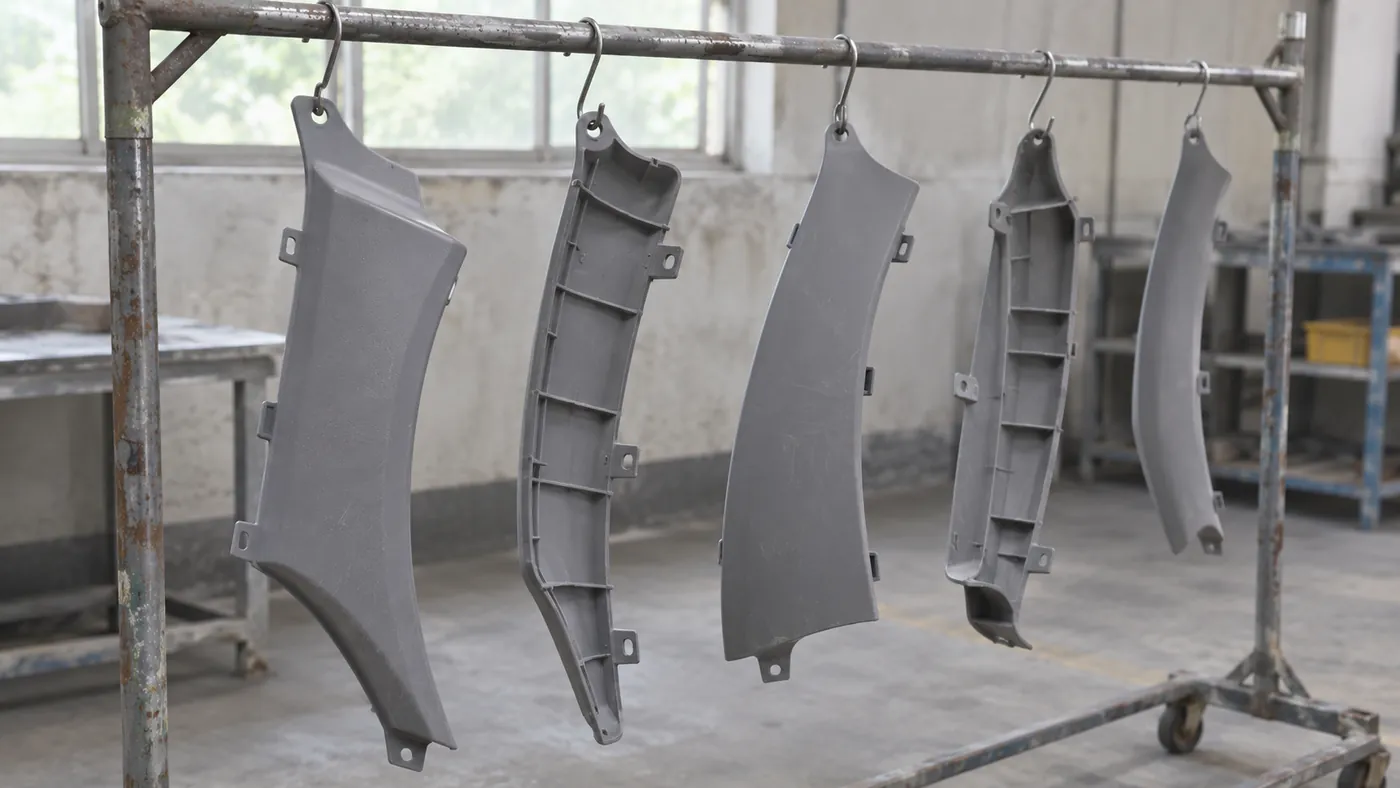
A moulded part can look ready for paint and still carry a thin release-agent film, fingerprints or handling residue. Washing removes that contamination. It does not change the polymer itself: some plastics are hard for paint or adhesive to wet even when clean. Keep the two tasks apart: clean first, then give the surface any treatment the finishing process specifies.
How should moulded plastic parts be cleaned before painting or bonding? Identify the polymer and the release agent, wash in a compatible aqueous cleaner below the grade's softening point, rinse twice, finishing in demineralised water, and dry without distorting the part. Release the process by the adhesion of the finished coating or joint, not by appearance.
What temperature can the moulded part tolerate?
Our temperature guide places plastics below the material's softening point, often at 40 to 50 °C
A resin name alone says nothing about fillers, reinforcement, additives or moulded-in stress, and these change how a grade responds to heat. A thin clip and a thick housing of the same family need not behave alike. Ask the moulder for the grade designation and its limit for wet cleaning and warm air, then measure critical dimensions after the first trial batch.
For grades that soften easily, start in the guide's lowest band, 20 to 35 °C
How should plastic parts be exposed to ultrasound?
Plastic parts clean most evenly in a single, supported layer with 10 to 20 mm
Stand flat parts on edge in a rack so both faces see the sound field. Nested housings shield each other, and parts that touch leave an unwashed line along the contact. A solid tray is not a basket: it shields everything above it. Support flexible mouldings along their length, not only at the ends, and keep clamping force off the faces that will be bonded. The basket-loading guide covers spacing and orientation. Choose an orientation that lets ribs and pockets drain, so the part does not carry wash solution into the rinse.
Find out what the release agent is
The release agent is often the contamination that decides the result. Silicone from release agents, sprays or some hand creams causes craters, the "fish eyes" in paint. A trace from a spray can used near the line is enough to crater a whole batch. Contaminants and the defects they typically leave:
- Silicone: craters and fish eyes in paint.
- Fingerprints: local adhesion loss.
- Dried cleaner or hard-water residue: blisters and poor adhesion.
Ask the release-agent supplier which cleaner removes the actual film without attacking the polymer; a water-soluble handling residue is a much easier task. Do not raise the concentration because a film remains: above the maker's recommended concentration most cleaners gain little and leave more residue for the rinse. Keep silicone-containing sprays and creams out of the cleaning and painting area altogether.
What rinse quality is useful before finishing?
Two rinses are normal before painting or bonding. The first removes the cleaner; the second, in demineralised water below about 20 µS/cm, removes the salts the first leaves behind. Tap water in the last rinse leaves mineral spots that dry under the coating and are a common cause of blistering. Keep both rinses within the grade's temperature limit.
Run the first rinse with overflow so it does not fill up with carried-over detergent, and monitor the conductivity of the final rinse to know when to change it. Where mouldings have blind holes or deep ribs, an ultrasonic rinse flushes the wash film out of them, which a still dip does not. A clean final rinse cannot make up for a fixture that carries a pool of wash solution from station to station; fix the drainage instead.
| Step | Reference | Condition |
|---|---|---|
| Wash temperature | 40 to 50 °C |
Below the grade's softening point |
| Part spacing | 10 to 20 mm |
Single layer, flat parts on edge |
| Frequency | 40 kHz | Delicate or decorated faces |
| Final rinse | Below about 20 µS/cm | Demineralised water |
| Drying air | 60 °C |
Only within the grade's limit |
Source: Sonixtek guides on cleaning temperature, basket loading, frequency, rinsing and dryer tanks; the grade's limit takes priority.
What drying temperature suits plastic parts?
The DT-96 hot-air dryer has a 96 L
| Model | Capacity (L) | Heating range (°C) |
|---|---|---|
| DT-96 | 96 |
30 to 100 |
Source: Sonixtek product data and archived live product copy; capacity and heating range agree.
The 30 to 100 °C
Release the process by the finished coating or joint
The cleaning-before-coating guide describes three checks. In the water-break test, water forms a continuous film for at least 30 seconds on a clean surface. On plastic the result needs care: some untreated polymers have a low surface energy and break the film even when clean, so a break alone does not prove contamination.
Test inks or dyne pens of known surface tension show the surface energy of the part; the paint or adhesive supplier states the minimum value their product needs. An adhesion test on the finished part, such as cross-cut or pull-off, checks the whole chain of cleaning, surface treatment and coating.
If the polymer needs plasma, flame or another specified surface treatment, washing comes before it and does not replace it. Coat soon after drying, within hours rather than days, and handle the parts with clean gloves without touching the faces to be finished. Record the ink value before finishing and the adhesion result after it, so a change in the wash can be traced to the result.
For the station layout, compare UMX Pro compact cleaners, AL systems with lift and DT drying tanks. The plastics page covers related moulding applications.
Frequently asked questions
Does cleaning replace surface activation?
No. Cleaning removes a contaminant film such as a release agent. It does not raise the surface energy of the polymer itself. Keep any plasma, flame or other specified treatment after the wash, and check the result with test inks and an adhesion test.
Can I use a metal-degreasing recipe for plastic?
Not directly. Metal recipes often run hotter and stronger than plastics tolerate. Keep the wash below the grade's softening point, often 40 to 50 °C
Is a water-break test enough to approve the part?
Not on plastic. Some clean polymers break the water film because of their own low surface energy, while a thin contaminant can also cause it. Use the test inks or method the finishing supplier specifies and confirm adhesion on the finished part.
What to send us for a quote
Send the polymer grade and its temperature limit, the release agent, the largest part dimensions, the finish (paint or adhesive) and the number of parts per batch. Our technical team can propose the fixture, rinse sequence and drying from your quote enquiry.