
Process and parameters · 4 min read · Updated 2026-09-25
Choosing the cleaning temperature
Heat speeds up the chemistry and thins the oil, but above about 80 °C cavitation weakens. Where to set the bath for oil, carbon, machining residue, flux and biological soil, and why our tanks heat to 100 or 110 °C when most cleaning happens at 50 to 65.
Technical guide. Figures are taken from our own spec tables; for your process we confirm the settings with a cleaning trial.
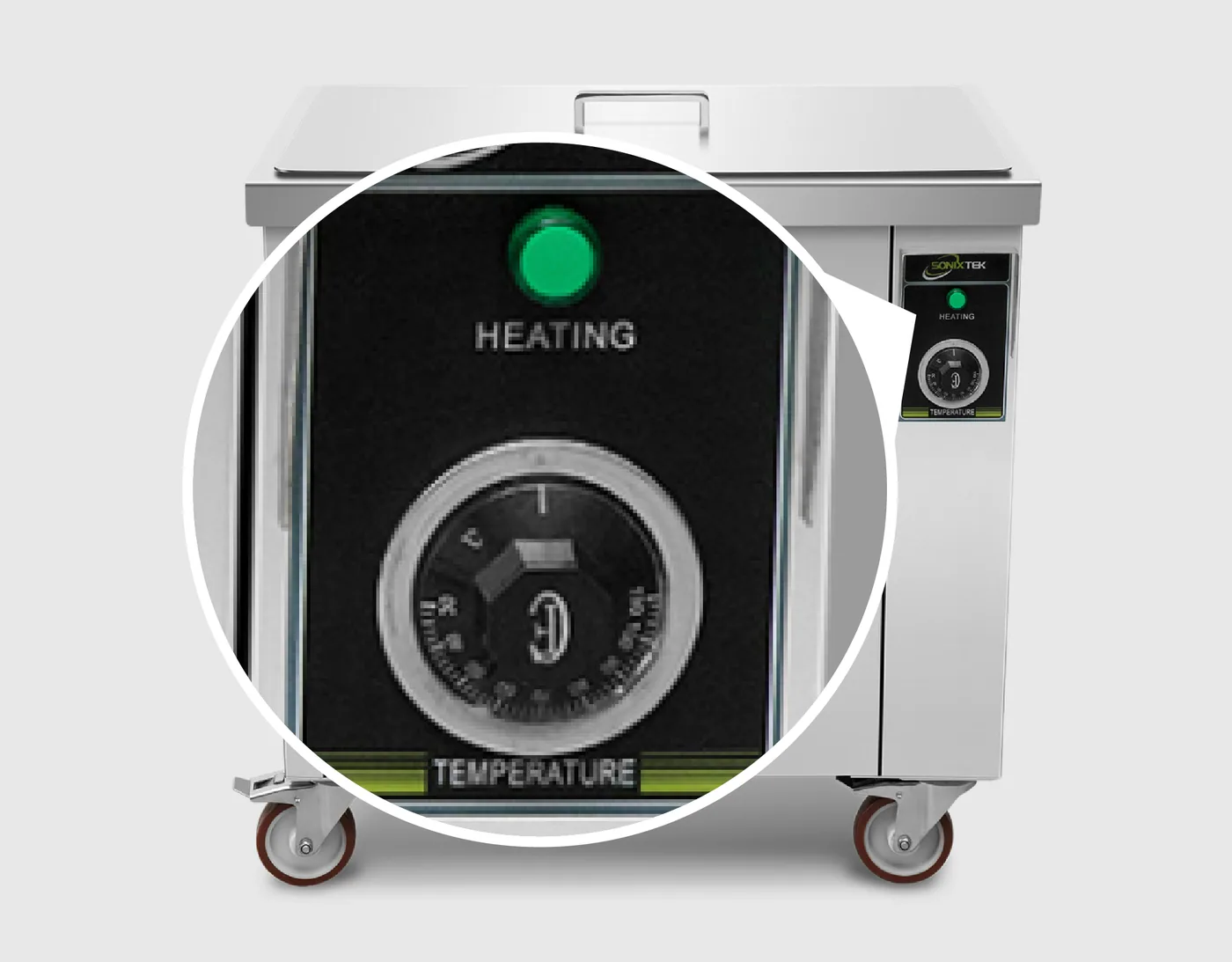
Temperature is the one process setting that pulls in two directions. Chemistry and physics both want the bath hot: detergents work faster, oil and grease turn from a paste into a liquid, water gets thinner and wets the part better. Cavitation wants it cooler: as the bath approaches boiling, the bubbles fill with vapour instead of collapsing hard, and the scrubbing action fades. The best temperature is where those two curves cross, and for most aqueous cleaning that is between 50 and 65 °C.
What happens as the bath warms
| Bath temperature | Chemistry | Cavitation | Typical use |
|---|---|---|---|
| 20 to 35 °C | slow; grease stays solid | strong but gas-rich until degassed | delicate parts, enzymatic cleaners, plastics that soften |
| 40 to 55 °C | good for most alkaline cleaners | near maximum | electronics, precision parts, laboratory glassware |
| 55 to 65 °C | fast; oils and greases liquid | still strong | general degreasing, machining residue, automotive parts |
| 65 to 80 °C | very fast; waxes and heavy grease melt | beginning to fall | heavy carbon, baked oil, mould release agents |
| above 80 °C | fastest | weak; the bath cushions its own bubbles | soaking stages, not ultrasonic stages |
Cavitation in water peaks around 50 to 60 °C. In a detergent solution with lower surface tension it peaks a little higher, and the useful range stretches to about 70 °C.
Settings by contaminant
- Light oil, coolant, fingerprints: 45 to 55 °C, mild alkaline cleaner, 3 to 8 minutes.
- Heavy grease, chassis grease, lubricants: 60 to 70 °C, alkaline degreaser, 8 to 15 minutes. The heat does half the work; the ultrasound lifts what is left.
- Carbon, varnish, baked-on oil on engine and injector parts: 65 to 75 °C, strong alkaline cleaner, 15 to 30 minutes. Above that the bath loses cavitation faster than it gains chemistry.
- Machining swarf and coolant: 50 to 60 °C; the aim is to flush particles, and the filtration matters more than the last five degrees.
- Flux on circuit boards: 45 to 55 °C in a flux remover, 40 kHz, 3 to 6 minutes. Hotter baths risk the components; the PCB articles go into it.
- Biological soil on instruments: 35 to 45 °C with an enzymatic cleaner. Enzymes are proteins and denature above about 55 °C; blood coagulates above 45 °C and becomes harder to remove, not easier.
- Aluminium and zinc die castings: keep to 50 to 60 °C and a cleaner formulated for light alloys; hot strong alkali etches them.
- Plastics and rubber: stay under the material's softening point, often 40 to 50 °C.
Why the tanks heat higher than that
Our ST tanks heat to 110 °C, the AL, AU and SF ranges to 100 or 110 °C. Nobody runs ultrasonic cleaning there. The headroom is for two things: a soak stage before the ultrasound on parts with baked-on soil, where 85 to 95 °C in the same tank softens carbon that would otherwise take three cycles, and holding the set point under load. A basket of cold, wet castings drops a 200-litre bath by several degrees; a heater sized to reach 110 °C recovers 60 °C in minutes, a heater sized just to reach 60 °C takes a quarter of an hour.
Heating power and time to temperature
| Model | Volume | Heating | From 15 to 60 °C, roughly |
|---|---|---|---|
| STS-300 | 30 L | 800 W | 120 minutes |
| ST-40 | 40 L | 2000 W | 65 minutes |
| ST-96 | 96 L | 4000 W | 75 minutes |
| ST-206 | 206 L | 6000 W | 110 minutes |
| AL-300 | 300 L | 9000 W | 105 minutes |
| AL-1000 | 1000 L | 18 000 W | 175 minutes |
These are calculated from the water's heat capacity with a lid on and ignore losses, so real times are somewhat longer, and considerably longer without a lid. The practical answer is a timer that starts the heater an hour before the shift, which the digital generators and the AL and AU controllers all offer. The ultrasound itself adds heat, about half of the ultrasonic power ends up in the bath, so a tank at working temperature under continuous use often needs the heater only to cover evaporation.
Measuring, not guessing
The set point is the heater's; the bath temperature at the part can lag it by 5 to 10 °C in a large tank without circulation. A probe thermometer in the basket for the first runs of a new process tells you what the part sees. Evaporation from a hot open bath is also the main heat loss and the main water loss: a lid, or the diamond-shaped lid on the larger series, cuts both.