
Parts and contaminants · 7 min read · Updated 2026-11-16
Cleaning gearbox housings and gears with ultrasonics
Clean gearbox housings and gears by pre-washing the sludge, checking basket height against the housing and loading gears so the bath reaches every tooth root.
Technical guide. Figures are taken from our own spec tables; for your process we confirm the settings with a cleaning trial.
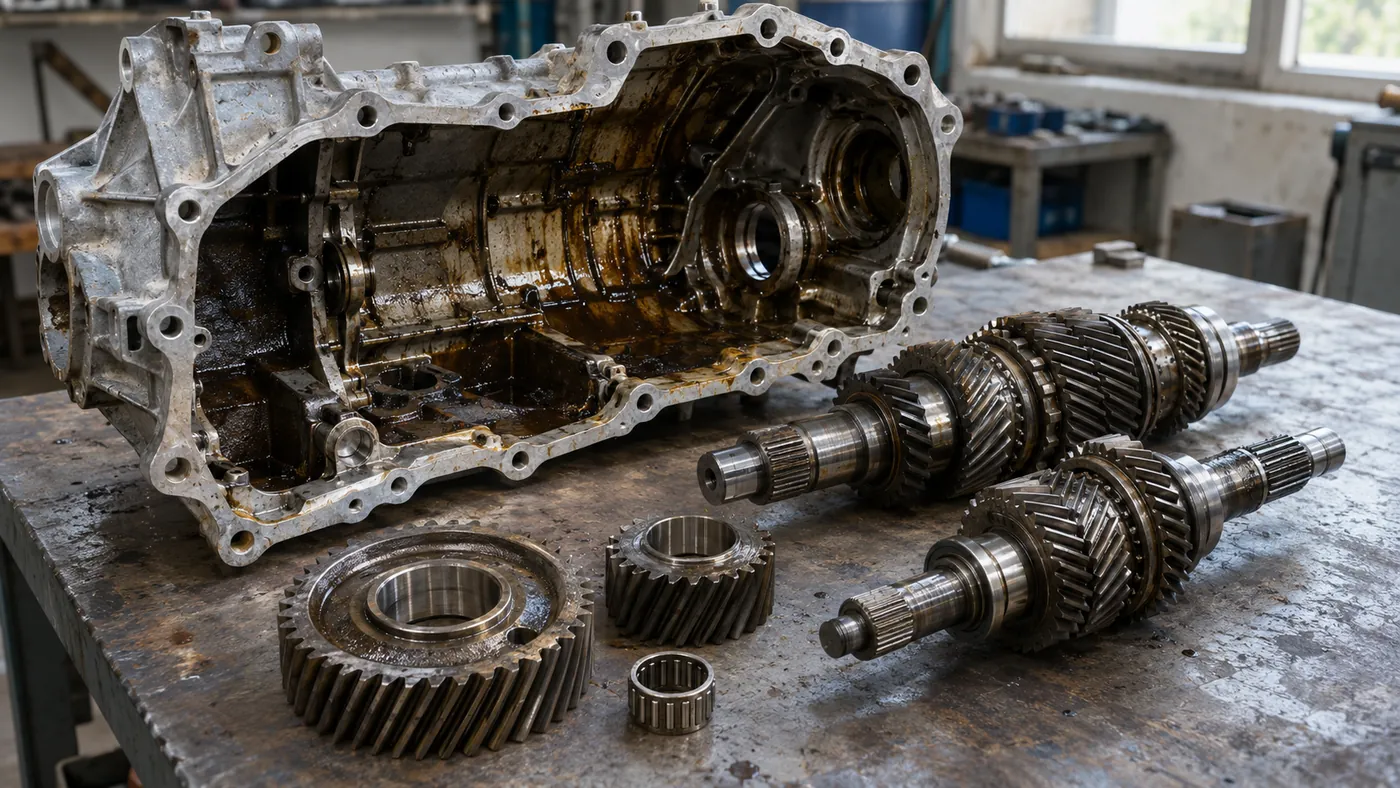
A gearbox brings two cleaning jobs. The housing arrives with oil sludge and road dirt on the outside. The wear particles sit inside, in oil pockets, bearing seats and tooth roots. The first job is bulk removal, the second is fine cleaning before inspection. Doing both in one bath saturates it with oil within days.
How should gearbox housings and gears be cleaned ultrasonically? Drain the oil and remove bulk sludge first, by hand or in a spray washer. Then clean robust castings at 28 kHz, and aluminium cases and machined faces at 40 kHz. Check basket height against the housing, load parts with 10 to 20 mm
Should a gearbox housing be pre-washed before ultrasound?
Yes, when it arrives caked in oil sludge. A 100-litre alkaline bath is saturated after roughly 200 to 500 g
Drain the oil and scrape off loose sludge before the parts go into any machine. Large debris does not belong in a pump or a basket. The SPR spray washers turn the load on a platform and wash it in a closed, heated water circuit with an oil skimmer. Spray is fast on open surfaces, but it cannot reach blind holes the way cavitation does.
Spray alone can be enough. A newly machined housing with a film of coolant and a few chips on open faces cleans faster by hot spray than by immersion; the spray-washer or ultrasonic-bath guide explains the choice. Oil galleries, bearing pockets and blind holes still need the ultrasonic stage.
Keep the fine bath for fine work. If you also clean automatic-transmission valve bodies, a bath used only for those precision parts, and not for housings, lasts far longer. See the valve-body guide.
Which frequency suits the housing and the gear set?
28 kHz suits heavy soil on robust parts such as cast gearbox housings: the bubbles are larger and each implosion carries more energy. 40 kHz suits machined faces, threads, small bores and aluminium, where erosion must stay low. For an aluminium housing with heavy sludge, remove the bulk first and test 40 kHz on the part.
Housing and gears need not share a setting. Most industrial tanks can be built for either frequency, and a dual-frequency generator switches between 28 and 40 kHz from the panel. That suits a workshop that cleans cast housings in the morning and machined gears or aluminium covers in the afternoon. For one stable part family, a single-frequency tank is the better buy.
Chemistry matters as much as frequency. For aluminium cases, use a degreaser rated for light alloys and keep to the lower temperatures; strong hot alkali turns aluminium grey. Run steel and aluminium as separate batches when their chemistry differs. Set temperature, concentration and time with your detergent supplier and test them on your own parts. The heavy-grease guide covers the hot soak and the skimmer.
Which basket dimensions limit a gearbox housing?
Basket height is often the limit for a gearbox housing, not litres or weight. The ST ultrasonic cleaning tanks in the table below have 260 mm
| Model | Type | Volume (L) | Basket L × W × H (mm) | Basket load (kg) | Largest footprint at 20 mm per side (mm) |
|---|---|---|---|---|---|
| ST-157 | Ultrasonic cleaning tank | 157 |
680 × |
100 |
640 × |
| ST-206 | Ultrasonic cleaning tank | 206 |
730 × |
100 |
690 × |
| SF-225 | Ultrasonic cleaner with filtration | 225 |
840 × |
200 |
800 × |
| SF-360 | Ultrasonic cleaner with filtration | 360 |
940 × |
200 |
900 × |
Source: Sonixtek products.json and live product pages, read 16 Nov 2026 (volume, basket, load). Footprint = basket minus 20 mm
Measure the dismantled housing with studs, dowels and lifting points. The part must also sit under the liquid with 30 to 50 mm
The SF-225 has the longest basket in the table, but it is only 150 mm
Taller housings need a deeper basket or a model from the AL lift series. From about 75 litres
How should gears and housing pockets be loaded?
Load gearbox parts in one layer with 10 to 20 mm
Heavy housings go on the basket floor, light gears on a rack above them, never the other way round. Keep the load below about a third of the working volume and two thirds of the floor area. Beyond that, the sound field collapses in the middle of the load and longer cycles do not help. Do not rest gears on ground bearing seats.
Lower the basket slowly, or lower and lift it once before the cycle, so air escapes from the pockets. After lifting, tip the parts so liquid and loosened particles drain out. If parts in the middle come out dirtier than those at the edge, the load is too dense. The loading guide explains shadowing in detail.
Ultrasound removes oil and loose particles. It does not remove burrs still attached to a tooth. Deburr where needed, then clean again, because deburring creates new particles.
Rinse, dry and inspect
Filtration keeps the wash bath working between batches. A pump draws the bath through a filter, and a skimmer takes floating oil off the surface, so particles and oil do not settle back on the next gear set. The SF series has this built in, with its own buffer tank. The filtration guide explains bath life.
Rinse in tap water, or in demineralised water in the last stage, to remove the detergent film before drying. Dry bare ferrous gears with hot air before they flash-rust, and always in a humid workshop. The rinsing and drying guide covers the options.
Check the degreasing with a water-break test: clean water sheets evenly off a degreased surface and breaks into droplets on an oily one. Then inspect teeth, bearing seats and gasket faces. A clean gear can still be worn or pitted; cleaning does not decide reuse.
Compare layouts in the ST tank range and the SF filtration range. Related vehicle work is on the automotive page.
Frequently asked questions
Does the bigger bath always take the taller housing?
No. The SF-225 holds 225 L
Is a spray washer alone enough for a gearbox housing?
Often, for open surfaces with a film of oil or coolant and a few chips: hot spray at 3.3 bar
Can aluminium housings and steel gears share one bath?
Only if the detergent suits both. Strong hot alkali turns aluminium grey, and 40 kHz suits aluminium better than 28 kHz. Use a degreaser rated for light alloys, or run aluminium and steel as separate batches with their own settings.
Does ultrasound remove burrs from gears?
No. Ultrasound loosens oil and loose particles; burrs still attached to a tooth need a deburring step. Inspect tooth roots and shoulders after cleaning, deburr where needed, and clean again, because deburring creates new particles.
What to send us for a quote
Send the dimensions and weight of the largest housing, its loading position, gear sizes, materials, photos of the sludge and the number of gearboxes per day. Say whether you clean on arrival, before dismantling, or as the final wash before assembly, and how much floor space you have for pre-wash, rinse and dry.
Our technical team checks basket height, pre-wash and filtration from your quote request.