
Choosing a machine · 2 min read · Updated 2026-09-25
How to size an ultrasonic tank
Start from the basket, not the litre figure: the part, the clearance, the batch and the heat-up time decide the tank.
Technical guide. Figures are taken from our own spec tables; for your process we confirm the settings with a cleaning trial.
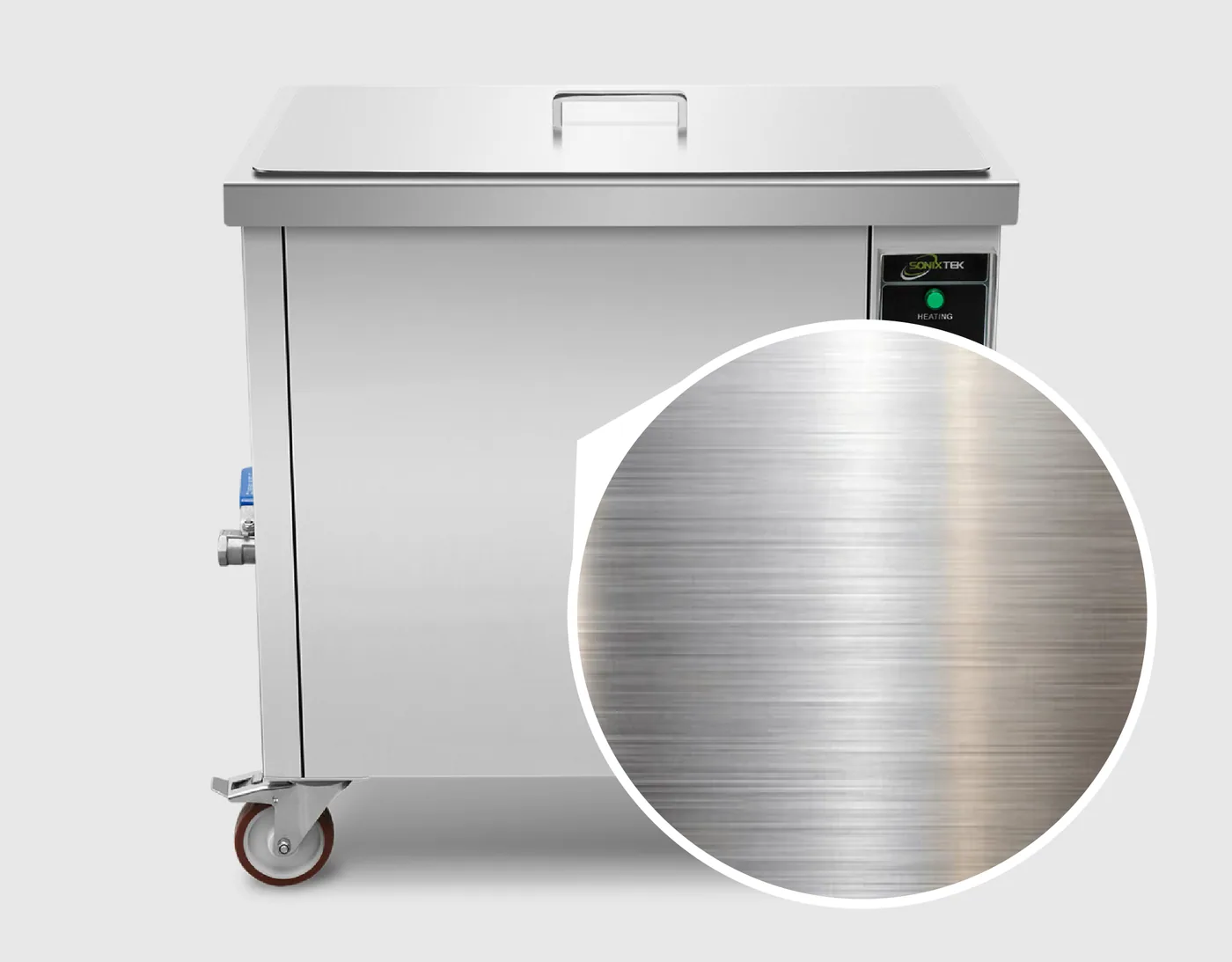
Measure the part, then add clearance
Take the longest, widest and tallest dimensions of the biggest part you will clean and add 20 mm on every side. That is the space it needs inside the basket, lying in the orientation you will actually load it. Compare that with the usable tank size in our spec tables, never with the tank size: the basket and the gap to the transducers take 20 to 40 mm off each dimension. An ST-96 has a 600 × 400 × 400 mm tank and a 580 × 380 × 200 mm basket, so its practical envelope for a single part is about 540 × 340 × 180 mm.
Lay out the batch
Parts that touch or overlap shield each other from the sound field, so the batch should sit in a single layer, or in two layers with a spacer or a second basket. Divide the basket floor by the part footprint plus clearance to get parts per layer. If that does not reach your hourly throughput at your cycle time, move up a size or plan two baskets in rotation: one cleaning while the other loads.
Check the load
Basket load ratings run from 75 kg on the ST-40 to 100 kg on the ST-96 and ST-206, 750 kg on the AL-1000 and 1000 kg on the AL-2000. Above about 75 litres a loaded basket is too heavy to lift safely by hand, which is where the AL lift series starts to make sense regardless of the litre figure.
Mind the liquid
The part must sit fully under the liquid with 30 to 50 mm above it, and the parts should not displace more than a quarter of the bath, or the level and the sound field both suffer. Load parts with blind holes tilted, the openings angled upward about 30 to 45° or sideways, so trapped air can rise out and the liquid reaches the bottom of the hole; a blind hole facing straight down holds a pocket of air, and a pocket of air is a pocket that does not get cleaned. After lifting the basket, tip the parts so liquid and loosened chips drain.
Size the heating
Most oils loosen between 50 and 70 °C. As a rule of thumb, 1.16 Wh heats one litre by one kelvin, so a 96-litre ST-96 with its 4 kW heater climbs from 20 to 60 °C in roughly 1.1 hours before losses. If the bath must be ready at shift start, either specify more heating, insulation, or a timer that starts the heater early.
Then ask
Send us the part drawing or a photo, the soil, the parts per hour and what happens to the part next. The tank size finder on our front page gives a first answer from the usable dimensions; an engineer confirms the size, the frequency and the basket design.