
Parts and contaminants · 3 min read · Updated 2026-09-26
Cleaning automatic-transmission valve bodies
Varnish from old fluid and friction-material fines stick the spool valves, and the gearbox shifts late, hard or not at all. How rebuilders strip a valve body, keep every spool with its bore, and clean the channels and valves at 40 kHz without harming a single clearance.
Technical guide. Figures are taken from our own spec tables; for your process we confirm the settings with a cleaning trial.
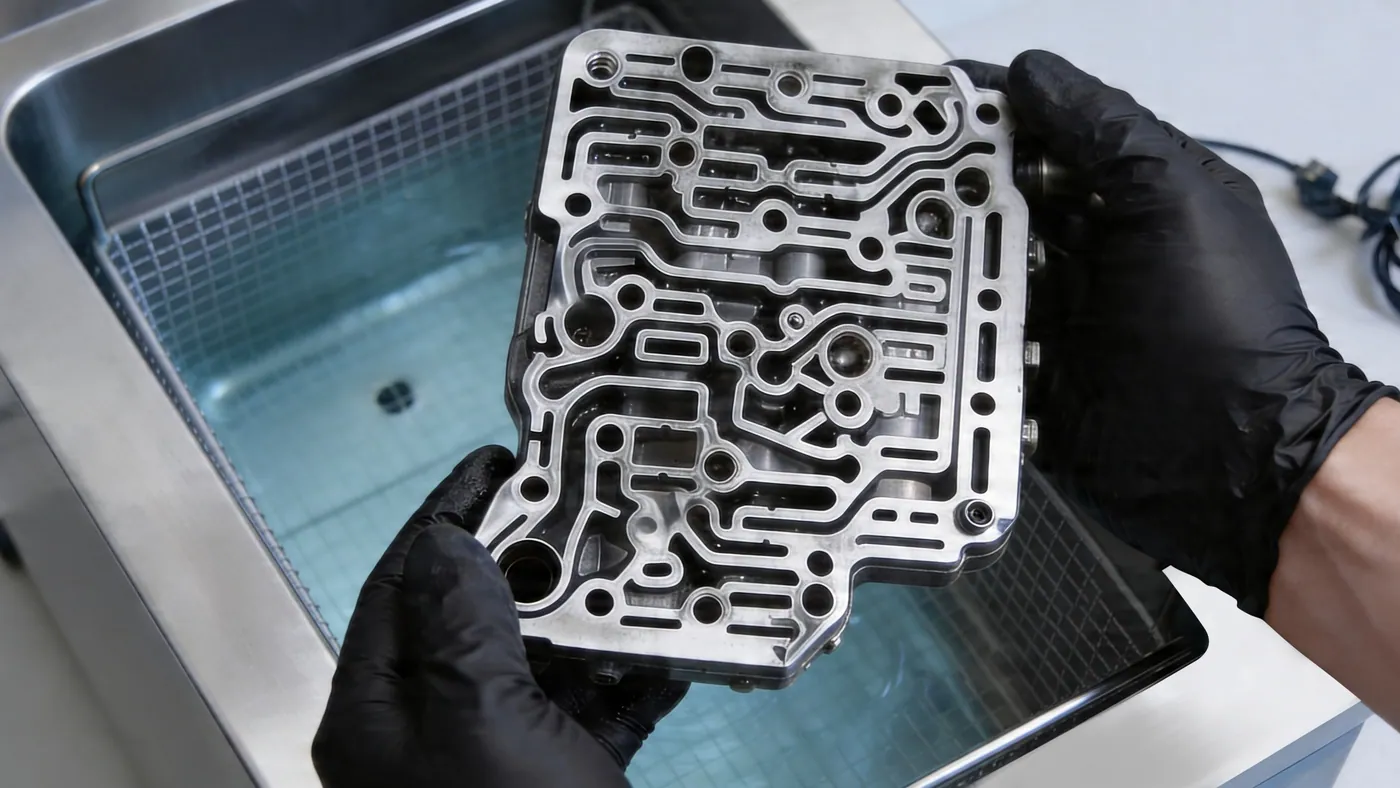
The valve body is the hydraulic brain of an automatic gearbox: an aluminium casting, or a stack of two or three plates, with a maze of channels on its faces and a row of bores holding spool valves, springs, check balls and the solenoids that the gearbox controller drives. The spools slide in their bores with clearances of a few thousandths of a millimetre. A film of varnish or one particle of clutch material is enough to make a spool hang, and a spool that hangs gives the harsh, late or slipping shifts that bring the car in.
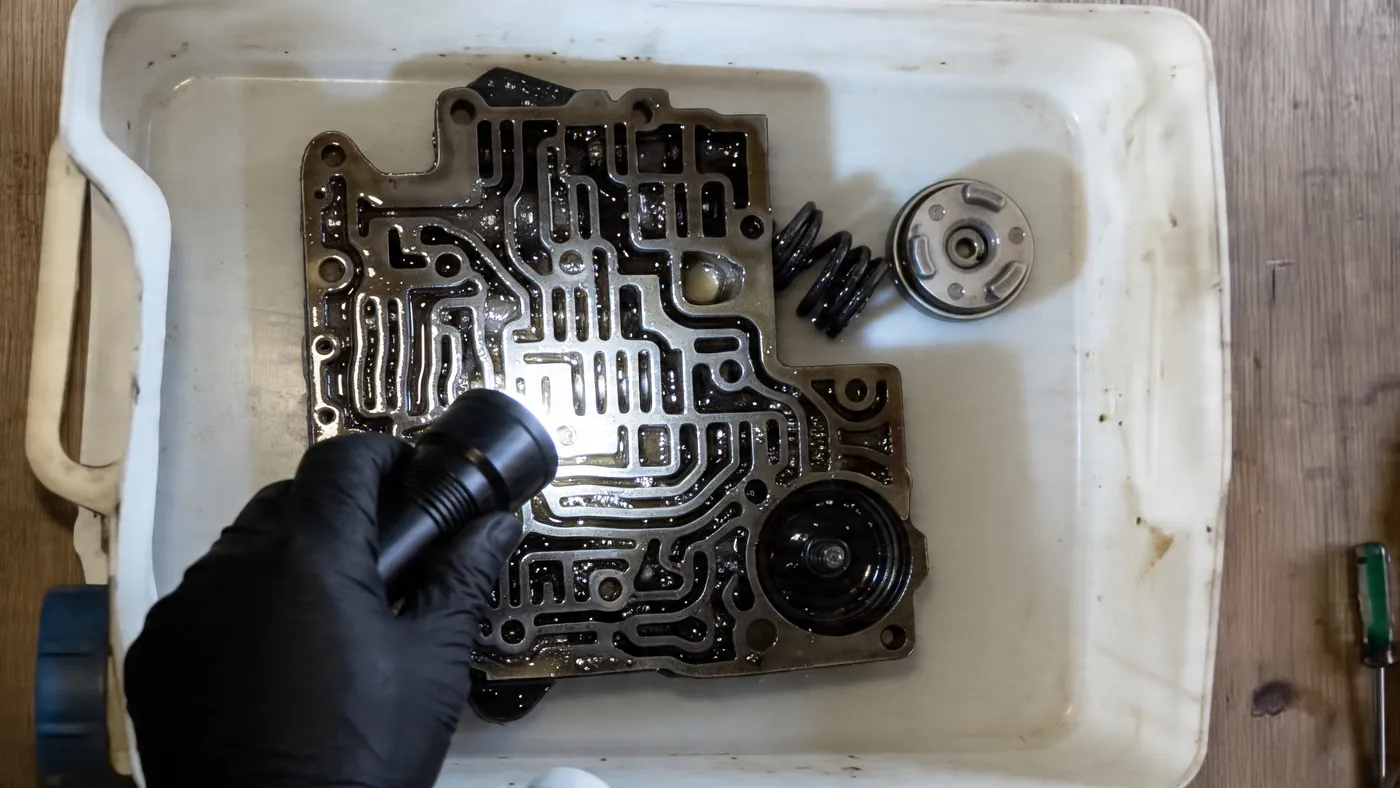
What is in it
- Varnish from fluid that has run hot: brown, hard, on the spools and in the bores.
- Friction-material fines from worn clutch packs and bands, black, in every low corner of the channels.
- Metal particles from pump and bushing wear, held by the fluid.
- Old fluid, which carries all of the above.
Strip it with a map
A valve body is only rebuilt as fast as it can be reassembled correctly.
- Photograph and number every spool, spring and retainer as it comes out, and put them in a divided tray in order. Spools are not interchangeable between bores even when they look the same.
- Count the check balls and note their positions on a photo of the separator plate.
- Remove every electrical part: solenoids, pressure switches, temperature sensors, and on mechatronic units the whole control module. None of them goes in the bath.
- Remove the separator plate and gaskets; gaskets are replaced.
The bath
Liquid. A mild alkaline cleaner rated for aluminium, with corrosion inhibitor, 3 to 5 %. The body and many spools are aluminium, often anodised; a strong cleaner dulls anodising and alters the bore surface.
Temperature. 50 to 60 °C.
Frequency. 40 kHz. The bores and spools are finished surfaces, and the smaller bubbles of 40 kHz clean them without eroding them.
Time. 10 to 15 minutes for the body and plates. Spools, springs and small parts in a fine-mesh insert, still in their order, for 5 to 10 minutes.
Degas a fresh bath first; sweep and degas explains why it matters most on fine work like this.
After the bath
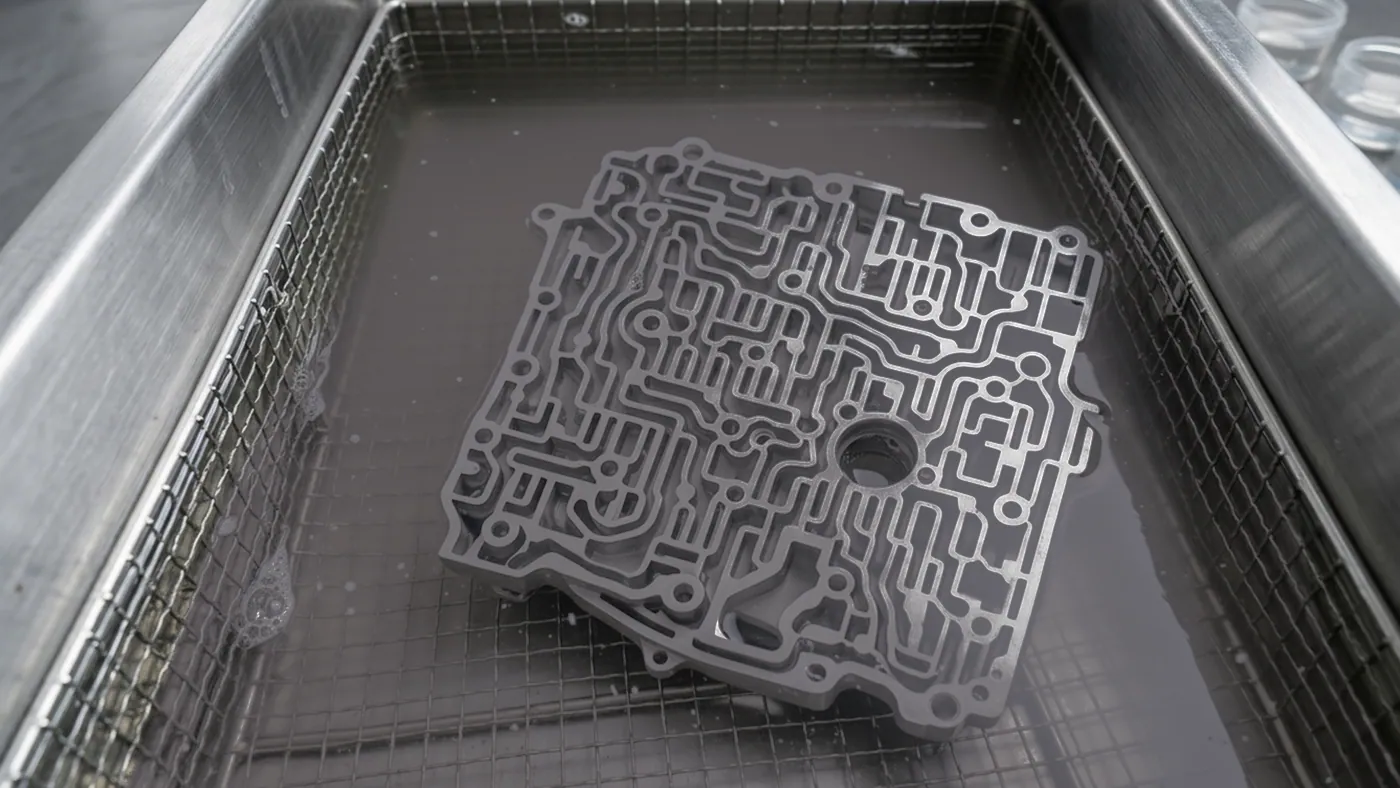
- Rinse in clean warm water, then blow every channel and bore dry with filtered compressed air. Fines loosened by the bath must leave the channels, not settle in them.
- Inspect the bores with a light for wear marks; a worn bore takes an oversize valve kit, which cleaning cannot replace.
- Check every spool slides freely under its own weight in its bore, dry, before lubrication.
- Lubricate spools and bores with clean transmission fluid immediately and assemble with new gaskets, torquing the plate bolts in sequence.
Keep the bath clean
Friction fines are fine enough to stay in suspension and land back in the next valve body. A small circulation loop with a 5 to 10 µm filter, or an SF unit with its buffer tank and skimmer, keeps them out. A bath that is used only for valve bodies and other precision hydraulics, and not for gearbox housings, lasts far longer.
Which machine
A car valve body is roughly 350 × 250 × 60 mm; stacked mechatronic units and truck valve bodies are larger and heavier.
| Work | Machine |
|---|---|
| Gearbox specialist, one or two bodies at a time | UMX Pro 50L or 62L at 40 kHz with a stored programme and the filtration module |
| Rebuilder, bodies and housings, daily | SF-225 with filtration and skimmer for valve bodies; a separate ST or AL tank for gearbox cases and pumps |
| Remanufacturing line | AL series with lift and a programme per unit type; rinse and dryer as separate stations beside it |
For the gearbox case, pump and clutch drums, which carry more oil and less precision, see heavy grease on engine parts. For the filtration side, filtration and bath life.