
Choosing a machine · 3 min read · Updated 2026-09-25
Spray washer or ultrasonic bath
A rotating spray washer throws hot detergent at the part from nozzles as the basket turns; an ultrasonic bath immerses it. One is fast on big, open parts with gross soil; the other reaches inside. The SPR series, what it is good at, and the lines that use both.
Technical guide. Figures are taken from our own spec tables; for your process we confirm the settings with a cleaning trial.
Not every part needs cavitation. A gearbox housing with a film of coolant and a few chips on open surfaces is cleaned faster by hot spray than by immersion, and a spray washer uses a fraction of the liquid. The question is what is on the part and where.
How a spray washer works
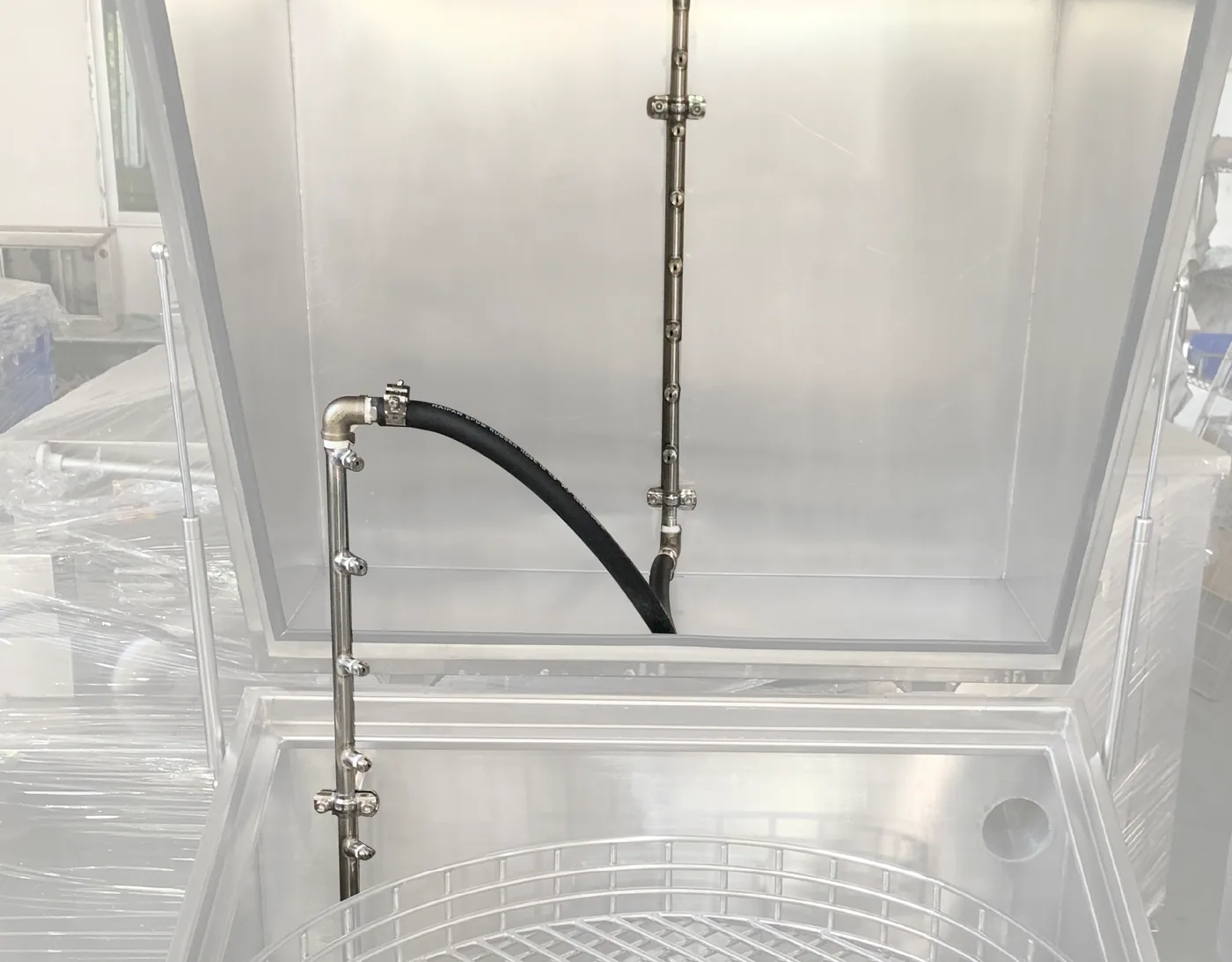
The SPR series is a cabinet with a round rotating basket on a trolley. The basket turns at a few revolutions a minute while fixed nozzle arms spray heated alkaline solution at it from the sides, above and below, at pressures of a few bar and flows of hundreds of litres a minute. The solution drains back to a heated sump, passes a filter and an oil skimmer, and is pumped round again. The cycle is wash, then a drip or a rinse from the same arms, then a blow-off on the larger models.
| Model | Basket (diameter × height) | Load | Heating | Outside (L × W × H) |
|---|---|---|---|---|
| SPR-250 | 750 × 500 mm | 250 kg | 9 kW | 1250 × 1300 × 1280 mm |
| SPR-500 | 1000 × 500 mm | 300 kg | 12 kW | 1250 × 1250 × 1380 mm |
| SPR-780 | 1250 × 500 mm | 300 kg | 15 kW | 1500 × 1500 × 1400 mm |
Loading is by the trolley: the basket rolls out of the cabinet, is loaded on the shop floor or by crane, and rolls back in.
What spray does well
- Gross soil on open surfaces: coolant, chips, dust, light grease on castings, housings, frames and plates. The mechanical impact of the jet moves more mass per minute than cavitation.
- Large parts: anything up to 1.25 m across and 300 kg, without the volume of liquid an immersion tank of that size would need.
- Throughput: cycles of 3 to 8 minutes with the door closed and the operator elsewhere.
- Liquid economy: the sump holds a few hundred litres for a basket that an immersion tank would need a thousand to cover.
What spray does not do
- Blind holes, bores, cross-drillings, threads: a jet cannot enter a hole smaller than its own diameter against the air inside, and it passes over the mouth. Chips stay.
- Shadowed faces: the basket turns, but a part on the basket floor is sprayed from below through a grid, and parts stacked on each other shield each other.
- Fine detail and delicate surfaces: jets at pressure damage anodised and polished finishes and move small parts around the basket.
- Tenacious soil: carbon, varnish, polymerised oil need chemistry and time in contact; a spray cycle is too short and the mechanical action is in the wrong place.
Where the two meet
The common line is spray first, then ultrasonic: the SPR takes the gross soil off large parts in minutes and keeps it out of the ultrasonic bath, which then does the internal passages in a short cycle with a bath that lasts weeks. Rinse and dry follow. In an MT multi-tank line the first station can be a spray tunnel for the same reason.
For small and medium parts with internal features, the ultrasonic tank alone is the answer and the spray washer is not needed. For large open parts with gross soil and no internal passages, the spray washer alone is the answer and the ultrasonic tank would be an expensive way to do it.
Deciding
- List the features of the part: open faces, blind holes, bores, threads, cavities.
- If the list is all open faces, spray. If it contains holes that matter, ultrasonic. If both and the part is large, spray then ultrasonic.
- Check the largest part against the basket sizes above and the tank sizes of the ST and AL series.
The quote article asks the spray-or-immersion question directly, and a photo of the part usually answers it.