
Parts and contaminants · 6 min read · Updated 2026-11-16
Cleaning pistons and rings during an engine rebuild
Clean piston crowns, ring grooves and oil returns during a rebuild: alloy-compatible chemistry, basket loading and inspection before reassembly.
Technical guide. Figures are taken from our own spec tables; for your process we confirm the settings with a cleaning trial.
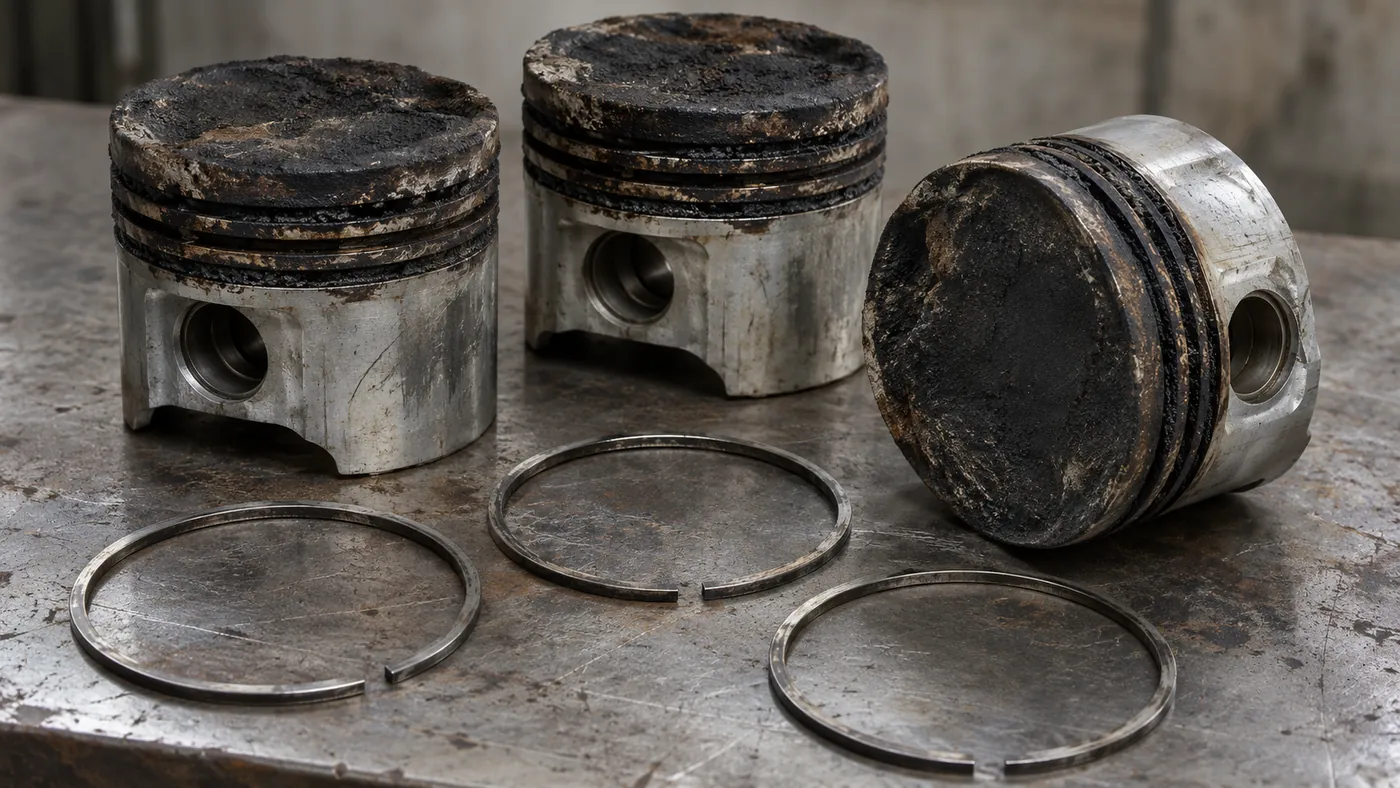
A piston crown can look clean while a ring groove still holds a hard black ridge and an oil return hole remains blocked. During an engine rebuild, those hidden deposits matter more than an even colour on the crown. The cleaning job is to expose the surfaces for inspection without changing the dimensions that the inspection is supposed to measure.
How do you clean pistons and rings during an engine rebuild? Dismantle them, use a carbon cleaner made for aluminium and expose the grooves. Ultrasound loosens crown carbon and softens groove coke; packed grooves may still need a groove cleaner and a second cycle. Cleaning does not decide reuse.
Which frequency suits aluminium pistons?
Start aluminium pistons at 40 kHz. The smaller bubbles reach into fine features and keep erosion low on soft metal and machined faces. Heavy coke on robust parts is a case for 28 kHz, and our carbon guide uses it for pistons, but frequency never replaces a cleaner formulated for light alloys.
On a piston, the carbon and baked-on oil guide finds two soils: hard coke on the crown and varnish in the ring grooves. Varnish is mainly a chemical job. Coke also has to break up mechanically, and the fragments have to leave the surface before they settle back.
A coated skirt, a treated groove and bare aluminium react differently to the same bath. Note the coatings and the piston maker's restrictions before the wash. Remove the parts that the rebuild procedure replaces, and keep the rest identified by cylinder.
What temperature and time should a piston trial use?
The carbon guide starts aluminium pistons at 65 °C
Keep pistons out of the hot pre-soak that the guide uses for heads and turbo housings unless the piston maker allows it. A steel-only cleaner turns aluminium grey and etches machined faces within minutes, while the carbon stays. Aluminium in a strong alkali at 70 °C
| Parameter | Value | Scope |
|---|---|---|
| Frequency | 40 kHz | Aluminium, machined faces |
| Temperature | 65 °C |
Light-alloy carbon cleaner |
| Time | 20 to 40 min | Check at intervals |
Source: Sonixtek options, frequency; carbon-deposits guide, starting values for aluminium pistons.
At the first check, lift one piston out, rinse it and look into the grooves under good light. If the surface changes before the deposit lets go, stop and change the process. Measure the bath with a thermometer: the controller setting does not describe every position in a loaded basket.
What ultrasound does in the ring grooves
Coke packed into a ring groove sits in a narrow slot with little exchange of liquid. The bath softens and loosens it, but a hard layer can remain after the cycle, especially in the top groove. A ring-groove cleaner, or the tool named in the rebuild documentation, then lifts the rest without cutting into the groove flanks.
A second short cycle and a thorough rinse wash the fragments out and show the real groove surface. The carbon guide notes that heavy coke sometimes needs two cycles. Check that every oil return hole in the oil-ring groove is open; a hole can look open from outside and still be blocked further in.
How should pistons and rings sit in the basket?
Load pistons tilted or on their sides, with 10 to 20 mm
A hollow underside facing straight down traps air. Facing straight up, it holds dirty liquid when the basket rises. The fixture should let the piston fill during immersion and drain afterwards without marking the skirt. The basket-loading guide explains how orientation and contact points affect the result.
The STS-300 benchtop ultrasonic cleaner holds 30 L
| Model | Volume (L) | Tank (mm) | Basket (mm) |
|---|---|---|---|
| STS-300 | 30 |
500 × |
– |
| ST-40 | 40 |
400 × |
380 × |
Source: Sonixtek product data and archived product copy; no basket size is listed for the STS-300.
For repeated batches, watch how much loose carbon stays in suspension and what the rinse station can take. A larger tank alone will not stop debris settling back on the parts. Removing loose deposits before immersion and adding filtration can matter more than nominal volume.
Valves, heads and the inspection after cleaning
Valves are steel or nickel alloy and tolerate a strong carbon remover better than bare aluminium. The engine-valve guide keeps each valve in a numbered insert so it returns to its own guide. Aluminium cylinder heads need the same care as pistons: the carbon guide runs them at 65 °C
After washing, rinse the grooves and dry the cavities before dimensional inspection. A dark patch can be remaining deposit or a changed surface; scraping a working face to get an even colour can damage it. Check groove condition, ring clearances and dimensions against the rebuild documentation. Cleaning makes defects visible; it does not decide reuse.
Compare ST industrial tanks, STS benchtop cleaners and SF cleaners with filtration when planning the station. The automotive page puts this operation into the wider rebuild sequence.
Frequently asked questions
Does this clean an engine without dismantling it?
No. This process concerns dismantled components immersed in a bath. It does not describe a treatment fed into an assembled engine. Access to ring grooves and oil return holes requires the dismantling specified by the rebuild procedure.
Do I still need a ring-groove cleaner?
Often, for hard coke in the top groove. The bath softens and loosens it; a groove cleaner then removes the rest without cutting the flanks. Rinse again afterwards so the fragments leave the groove before you measure.
Can clean piston rings be reused?
Cleaning alone cannot decide that. Inspect the rings, their clearances and the grooves against the rebuild documentation. Keep the parts identified by cylinder and set aside the components that the procedure says to replace.
Is a benchtop tank enough for several pistons?
Check the pistons on their fixture, the gaps between parts and the actual immersion depth. The STS-300 tank dimensions are not a batch capacity: the basket and the clearances reduce the space available for the load.
What to send us for a quote
Send piston dimensions, alloys and coatings, parts per batch, deposit type and the operation after cleaning. Include a photo of the grooves and the proposed fixture. With the quote form, our technical team can assess usable space, filtration and the rinse stages.