
Operation and maintenance · 8 min read · Updated 2026-11-16
Dryer maintenance: fan, heater and intake filter
A hot-air dryer that slows down usually has a loaded filter, a blocked air path or a full drain, not a failed heater. What to check, and how often.
Technical guide. Figures are taken from our own spec tables; for your process we confirm the settings with a cleaning trial.
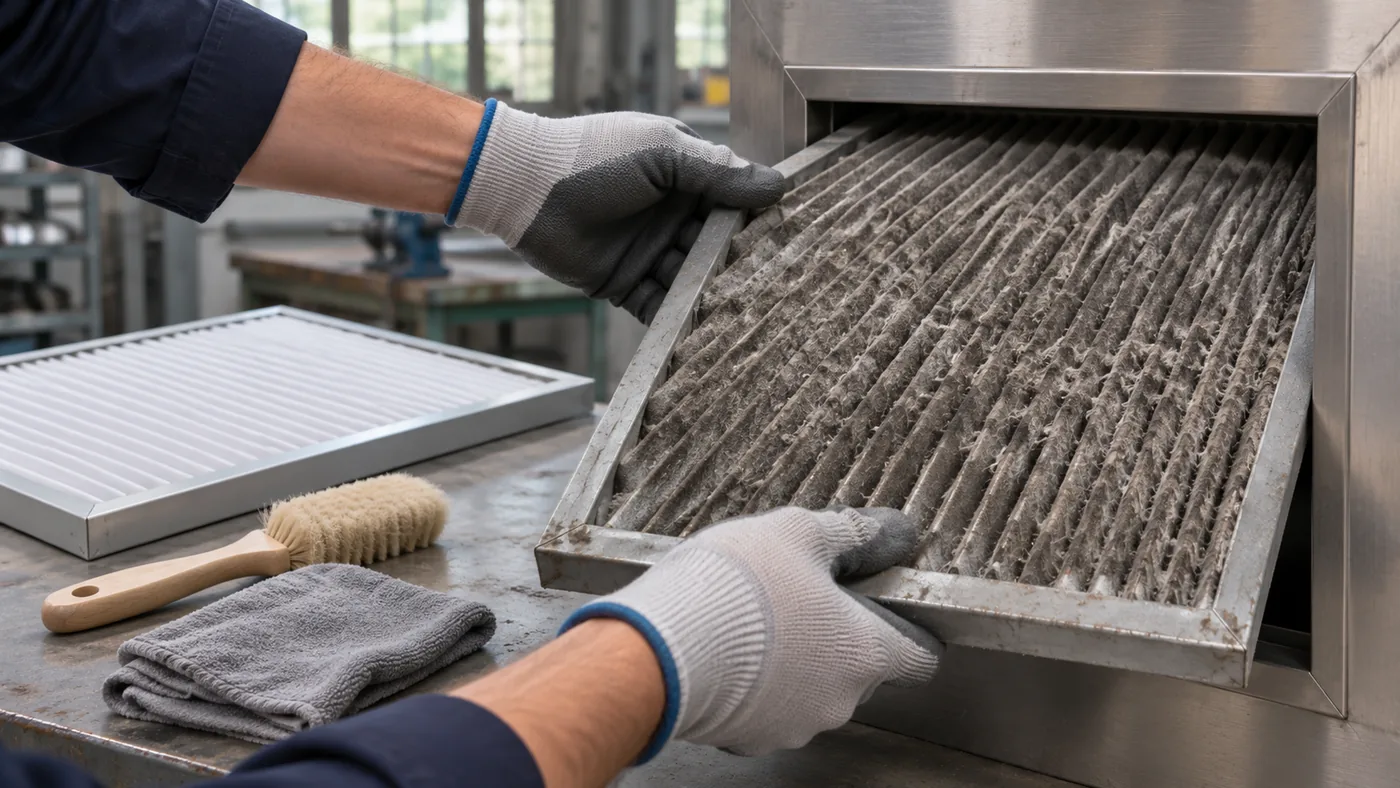
When a DT dryer needs longer for the same basket, the heater is rarely the cause. More often the turbine pulls against a loaded intake filter, condensate stands where it should drain, or the basket is packed differently. Turning the thermostat up hides all three and moves the process away from the one you approved.
How do you maintain a hot-air parts dryer? Maintaining a hot-air dryer means keeping the air path clear and checking against a recorded reference load: a weekly visual round of intake, chamber, lid and turbine sound, intake-filter cleaning at least monthly according to its type, labelled drains, unchanged controller settings, and work inside the cabinet by qualified staff only.
How does the air path of a DT hot-air dryer work?
In a DT hot-air dryer, a heating turbine draws air over the elements and drives it up through the basket and out through the lid. A digital thermostat sets 30 to 100 °C
The lid's diamond profile lets condensate run to the edge instead of dripping back onto the parts. All three models run on 400 V and have an AISI 304 stainless-steel chamber from 2 mm
For US sites the DT dryers are quoted for 480 V or 208–240 V three-phase, 60 Hz, with 60 Hz motors.
| Model | Volume (L) | Basket (mm) | Heating (kW) | Air temperature (°C) | Supply (V) |
|---|---|---|---|---|---|
| DT-96 | 96 |
580 × |
3 | 30–100 |
400 |
| DT-206 | 206 |
730 × |
6 | 30–100 |
400 |
| DT-300 | 300 |
on request | on request | up to 100 |
400 |
Source: Sonixtek product data, Nov 2026.
Everything in that chain depends on airflow. The heater only passes its power to the parts if air moves past it. A loaded filter, a tighter basket or a dripping lid edge all give the same symptom, longer drying, which is why the routine starts with the air path.
How do you tell whether the dryer or the process has changed?
A recorded reference load tells you whether the DT dryer or the process has changed. Write down one typical load: basket (730 ×
Keep that sheet at the machine. When drying slows, compare like with like: a heavier, wetter basket or a new part with blind holes takes longer on an unchanged machine. If the reference load still passes, the cause sits upstream, in the rinse or the loading; our rinse and drying guide covers those causes.
Keep the model, serial number, installed options and current manual with the sheet: not every DT has the same filter box or drains.
Weekly: look before you take anything apart
Our general maintenance guide sets a weekly round for the wash tank. Give the dryer a slot in the same round, and check more often if the room is dusty or the dryer runs on several shifts. Where the manual gives a different interval, the manual applies.
- Intake: openings free, no lint, film or dust drawn against the grille.
- Basket and chamber: no loose parts, labels or residue on the chamber floor, nothing blocking the air entry under the basket.
- Lid: moves freely, the diamond profile is clean, condensate runs to the edge and not onto parts being unloaded.
- Sound: turbine sound and vibration as usual. A new rattle or whine is a reason to stop and call maintenance, not to add minutes to the timer.
Clean accessible surfaces only with the machine stopped and cooled down, and never point a hose or spray towards the electrical cabinet or into the intake.
How often should the intake filter of a hot-air dryer be cleaned?
The intake filter of a DT hot-air dryer should be cleaned at least once a month, and more often in a dusty hall or near grinding or blasting. How it is cleaned depends on the element fitted: a coarse inlet screen is cleaned and refitted, a fine filter element only as its own instructions allow.
Our DT overview sets monthly cleaning for the turbine's inlet filter; treat that as a minimum. A filter can look clean on its face and still be loaded inside, and a damaged medium or a lifted seal lets air bypass the element. On reassembly, check that the element sits square and the seal closes all round. Never run the dryer without the filter to get the airflow back; unfiltered air carries dust straight onto clean parts.
Record the element, its condition, the action and any replacement. Where the documents give no replacement interval for your element, ask our technical team for one rather than setting one by guesswork.
Does a HEPA-grade intake module need a pre-filter?
Yes. A HEPA-grade intake module on the 206 L
The module is for parts that must not pick up dust after cleaning: one buyer dries washed filter cartridges with it at about 50 °C
One buyer fitted the HEPA-grade module without the pre-filter that had been advised. If you plan this option, plan both stages, and check both in the monthly round.
Which drain valve does what on a DT-206 with intake filtration?
A DT-206 with intake filtration has two drains. The 1-inch ball valve empties the tank; the 3/4-inch ball valve drains moisture from the filter box. Opening the tank drain does not empty the filter box, and the smaller valve is not a second tank drain, so label both at the machine and in the work instruction.
On other configurations, confirm what each valve does on your own unit first. Check that each valve opens fully and closes tight, and note any defect in the log.
Turbine and heater: the inside belongs to qualified maintenance
Signs you can see from outside are slower drying of the reference load with a clean filter, a change in turbine sound or vibration, and unusual temperature behaviour. Any work inside the cabinet, on the turbine or near the heater is for qualified maintenance following the manual: stop the cycle, isolate the supply and let the heater cool. Never bypass guards or temperature protection to finish a batch, and do not change wiring or fan settings as a quick fix. After a repair, the reference load must pass before production restarts.
Should you reset a dryer controller to factory defaults?
No. A factory reset of the DT-206 dryer controller restores the controller maker's defaults, not the configuration the machine was set up with, and it is never a cleaning or fault-finding step. The controller ships in ON/OFF mode; a change to PID needs one auto-tune at working temperature, about 2 h including a check run.
Run that auto-tune with a typical load, then leave the settings alone. Keep the set temperature, the timer setting and the controller configuration on file so anything that changes can be put back. If the temperature starts to swing, check load, airflow and sensor first.
A record that holds up in an audit
| Area | What to look at | What to record |
|---|---|---|
| Intake filter and pre-filter | Load, damage, seating, seal | Element, action, replacement, date |
| Turbine and air path | Sound, vibration, blocked openings | Finding, repair under isolation |
| Heater | Temperature behaviour on the reference load | Qualified check, passing check run |
| Drains | Standing water, valve identity, tight closing | Drained, defect, label checked |
| Lid and basket | Drips onto parts, blocked air entry | Correction, passing load |
| Controller | Unexpected changes to settings | Configuration, who changed what |
A food-supplement plant that runs a DT-96 after its own ultrasonic cleaner asked for the manual, the cleaning and maintenance plan, the wiring diagram and the spare-parts list for its GMP/IFS audits. The routine above fills the maintenance part of that pack; our article on drying and documentation in audited plants covers the rest.
Frequently asked questions
Should I turn the temperature up when drying gets slower?
Not as a fix. A higher setting hides a loaded filter, standing condensate or a tighter basket, and moves the process away from the approved one. Check the air path and the reference load first, then decide whether the set temperature needs to change.
May the dryer run without its intake filter for a while?
No. Running a DT dryer without its intake filter brings the airflow back but carries dust straight onto the clean parts. Clean or replace the element according to its type, and check that it sits square and that the seal closes all round.
Who may work on the turbine and the heater?
Only qualified maintenance staff, following the manual: stop the cycle, isolate the supply and let the heater cool first. Guards and temperature protection are never bypassed to finish a batch, and after a repair the reference load must pass before production restarts.
What belongs in a dryer maintenance record?
For each check: the date, who did it, the element or area, the finding, the action and whether the reference load passed afterwards. Cover the intake filter and pre-filter, turbine and air path, heater, drains, lid and basket, and the controller configuration.
What to send us for a quote
To discuss a pre-filter stage, the HEPA-grade module or a replacement dryer from the DT series, send the model, the installed options and what you observe through the quote form.