
Operation and maintenance · 3 min read · Updated 2026-09-25
Daily and weekly maintenance of an ultrasonic cleaner
An ultrasonic tank has no wear parts in the liquid, so maintenance is about the bath, the floor, the filter and the heater. A routine that takes ten minutes a day and half an hour a week, and what to look at once a month.
Technical guide. Figures are taken from our own spec tables; for your process we confirm the settings with a cleaning trial.
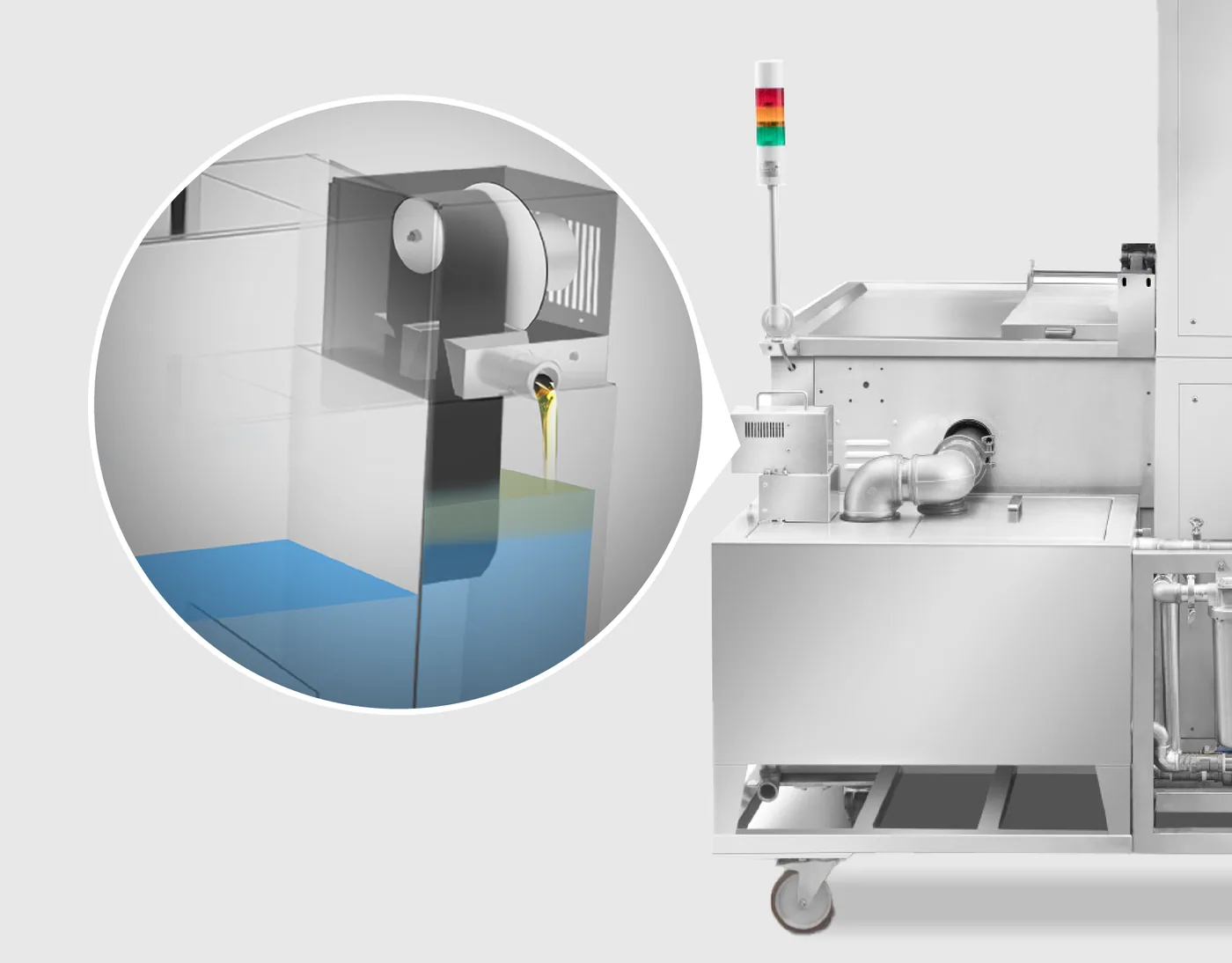
The machines that reach fifteen years of service are not the ones with the most careful operators; they are the ones with a written routine that survives operator changes. This is ours. Adjust the intervals to your load: a tank on three shifts of oily castings runs the weekly items daily.
Every day, at start-up
- Check the level. Liquid to the mark, never below the minimum. Top up evaporation with water; top up carry-over with solution at working concentration.
- Heat before you clean. Start the heater a lead time ahead of the shift, on the timer where the machine has one. Cleaning in a cold bath wastes the first batch.
- Degas. Five to ten minutes of ultrasound, or the degas programme, after any top-up or a night's standing.
- Look at the surface. Floating oil means the skimmer needs emptying or the bath is saturated; foam means too much cleaner or a contaminated bath.
- Look at the parts. The first basket out tells you more than any instrument.
Every day, at shutdown
- Lift the basket out and leave it to drain over the tank.
- Skim floating oil or let the skimmer run.
- Put the lid on. Evaporation is the main heat loss, the main water loss and the main source of smell in the room.
- Switch the ultrasound off. Leave the heater on the timer only if the next shift is within a few hours.
Every week
- Filter. Change the bag or check the differential pressure on a cartridge. Empty the skimmer's oil container.
- Concentration. Titrate the bath with the cleaner supplier's kit and correct it. A bath at half strength is the commonest cause of "it used to clean better".
- Floor sludge. Open the floor drain valve briefly into a bucket to draw off the sludge that no filter reaches, then top up.
- Basket and rails. Wipe the basket rails and feet; a basket that no longer sits square rattles against the tank.
- Outside. Wipe the cabinet and the control panel, check that the generator cabinet's ventilation is clear and its fan runs.
Every month
- Foil test. Sixty seconds, three positions, filed with the date; the foil test article has the reading.
- Bath change, or as the titration and the batch count dictate. Drain fully, wipe the floor and walls with a soft cloth, look at the floor above the transducers for the matt patches of cavitation erosion, refill.
- Heater. Check the time to temperature against the first month's figure. A slow heater is scaled up or has an element down.
- Seals and hoses on filtration loops and the drain valve. A weep at a hose clamp becomes a puddle under the generator.
- Lift platform on AL and AU systems, and the transport carriage on MT lines: guide rails wiped and lightly lubricated as the manual specifies; on the pneumatic AL lift, air lines checked for leaks and the compressor's water trap drained.
Every year
A service visit or a check by your own maintenance team: generator output measured, transducer bonds inspected from below, heater elements and thermostat checked, safety cut-outs tested, the PLC backed up. Keep the foils from the year in the file for the visit.
What not to do
- Do not run the ultrasound in an empty or under-filled tank. It puts the energy into the floor.
- Do not use chlorinated cleaners, bleach or acids in a standard AISI 304 tank. See tank material.
- Do not scrape the floor. Erosion patches are not dirt.
- Do not use flammable solvents in an open heated tank. If the process needs a solvent, it goes in a beaker in the indirect method in a ventilated area, cold.
- Do not let parts rest on the floor. Basket, rails, feet.
Consumables to stock
Filter bags or cartridges, cleaner concentrate, a titration kit, aluminium foil, spare fuses for the generator, and a lid if the machine came without one.